Category Archives: Ducks
Unwilling Players
When Ruby (our springer spaniel) was still alive, she and Emma (our English field cocker spaniel) loved to go to the beach with us. There was always something to see.
“Hey, Ruby! Look at these ducks. We could play with them.”
“Come back! We just want to play tag with you!”
“Aw! C’mon, ducks! See how we can run and play with you? That would be so much fun.
They don’t seem to want to play, Ruby. I tried to get them to come closer, but they just swam away. Not very friendly!”
“Oh, I’ll go talk to them. Maybe they thought you were just a bit too rambunctious.”
“Nope! They don’t want to play with us. They just kept on swimming farther away. Hah!”
“Water’s damn cold too.”
“We were just trying to be friendly and have some fun. Go figure!”
Shoveler
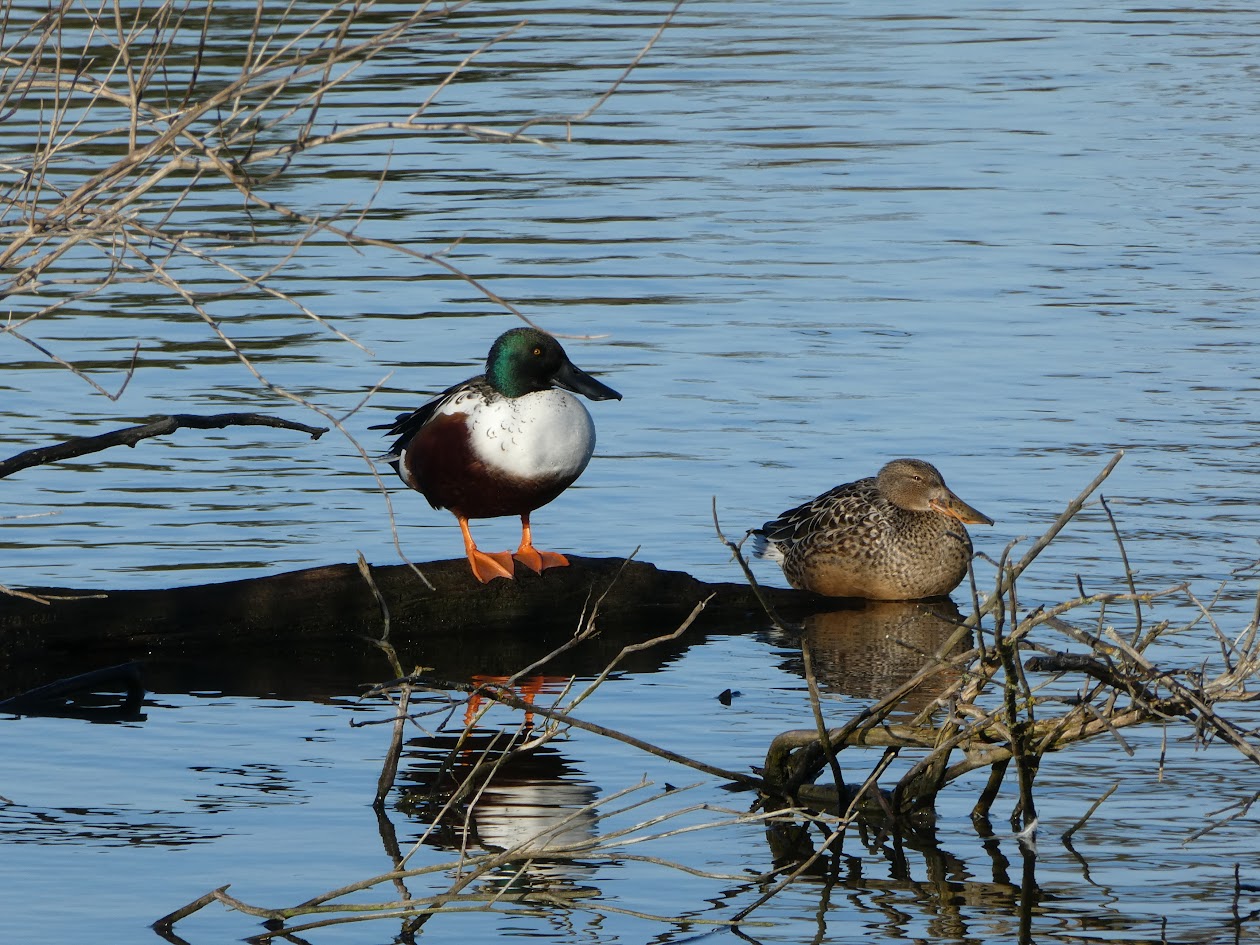
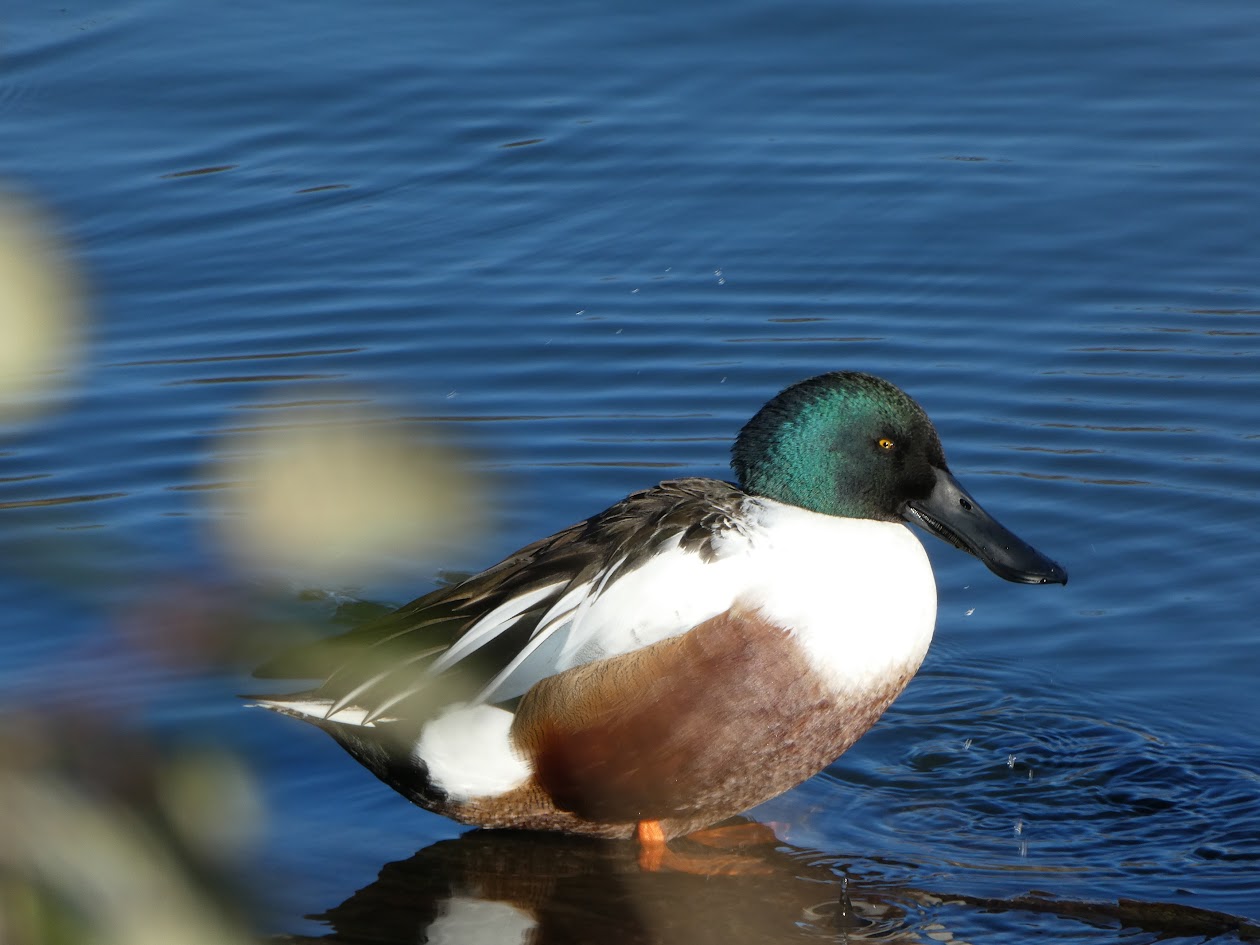
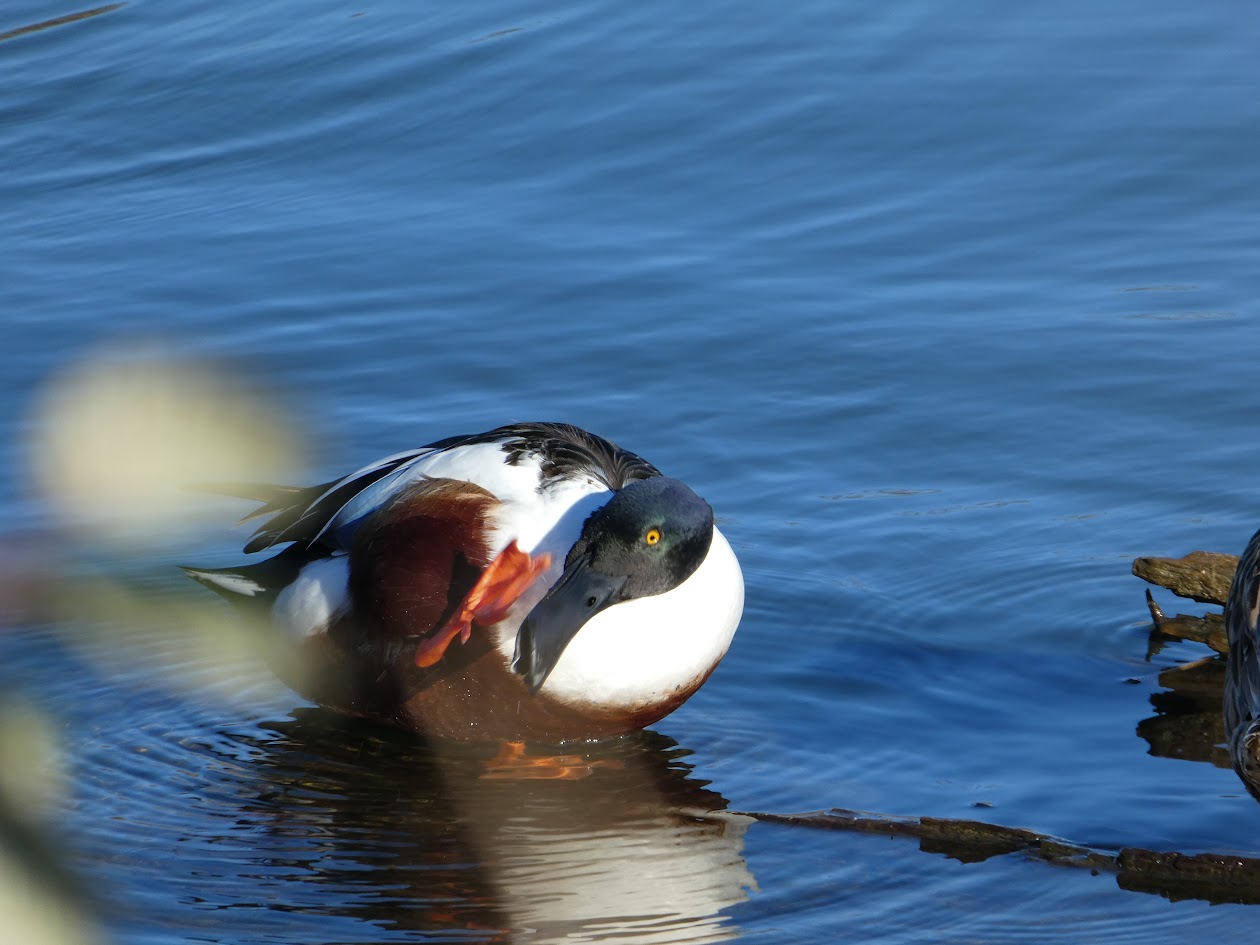
Northern shovelers (Spatula clypeata), named for their shovel-shaped bills, like to find food in the shallow waters and soft, muddy bottoms of marshes. Swishing their wide shovel-like bills back and forth, these ducks slurp up seeds, crustaceans, and aquatic invertebrates, and then sieve their food through the comb-like edges of their bill. If you can enlarge the second photo, you can see some of the 110 fine projections called lamellae that help to sift out the food as if straining it through a colander.
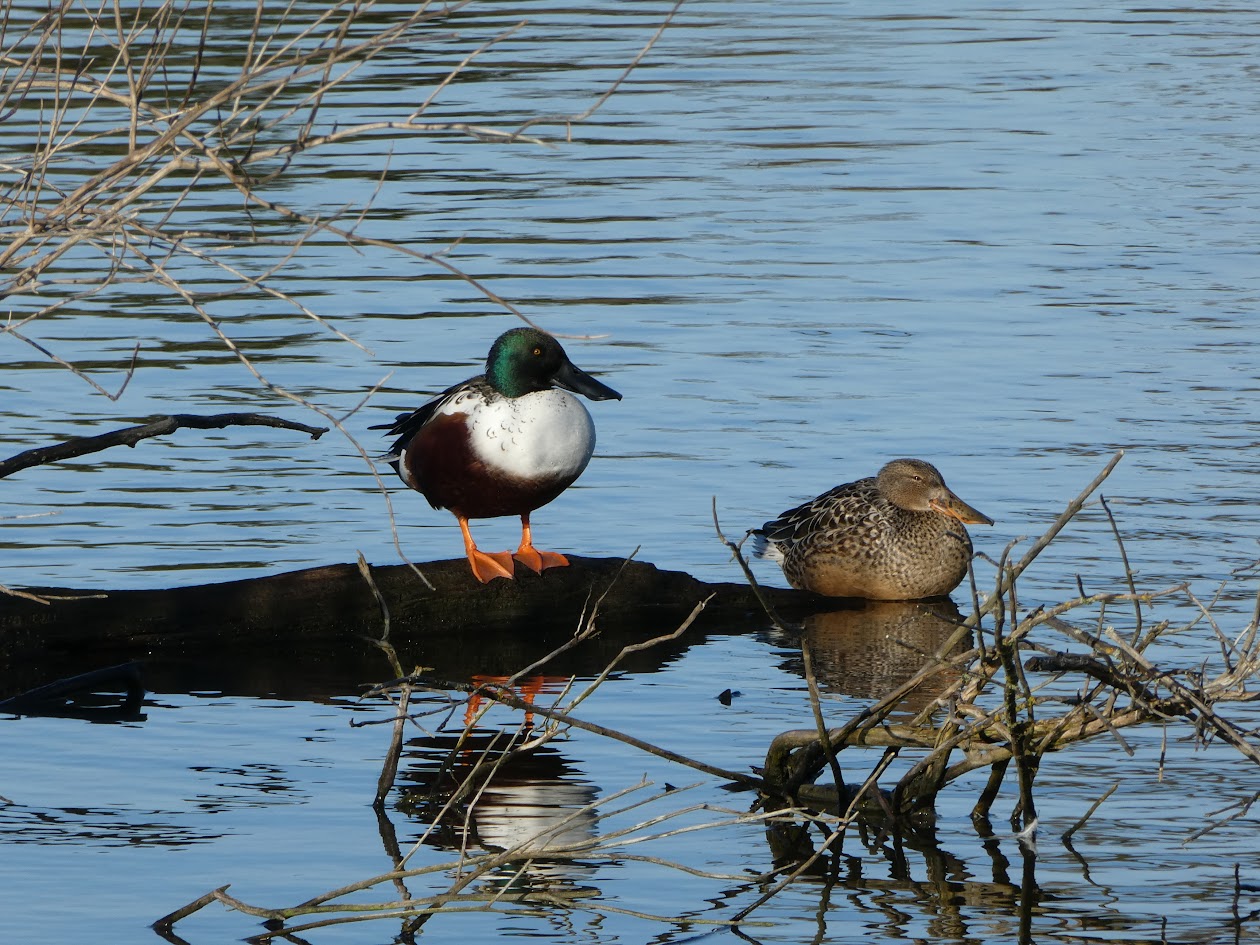
In this first photo, you can see flashy Mr. Shoveler with his drab Missus. She is smart not to be so flashy as she is the one who has to keep their eggs warm at nesting time. It’s best to stay camouflaged while guarding a nest.
I read an interesting anecdote on the site by the Cornell Lab about Mrs. Shoveler’s outlandish behaviour. When she is forced off her nest by a predator, she does her best to make the eggs in her nest unpalatable for the predator by pooping on them before she flees. I was skeptical about this and want to add that possibly, the researcher who came to this conclusion failed to recognize that possibly the mother bird was so scared by the predator that nature simply took its course as she fled the nest. Something to think about … or perhaps rather not.
Can’t you just see Mr. Shoveler chuckling about that in the photo below?
“Excuse me while I scratch my itchy chin.”
So that’s the “scoop” from the shovelers.
Again, photo credits to my friend Sonia.
Pintail Duck
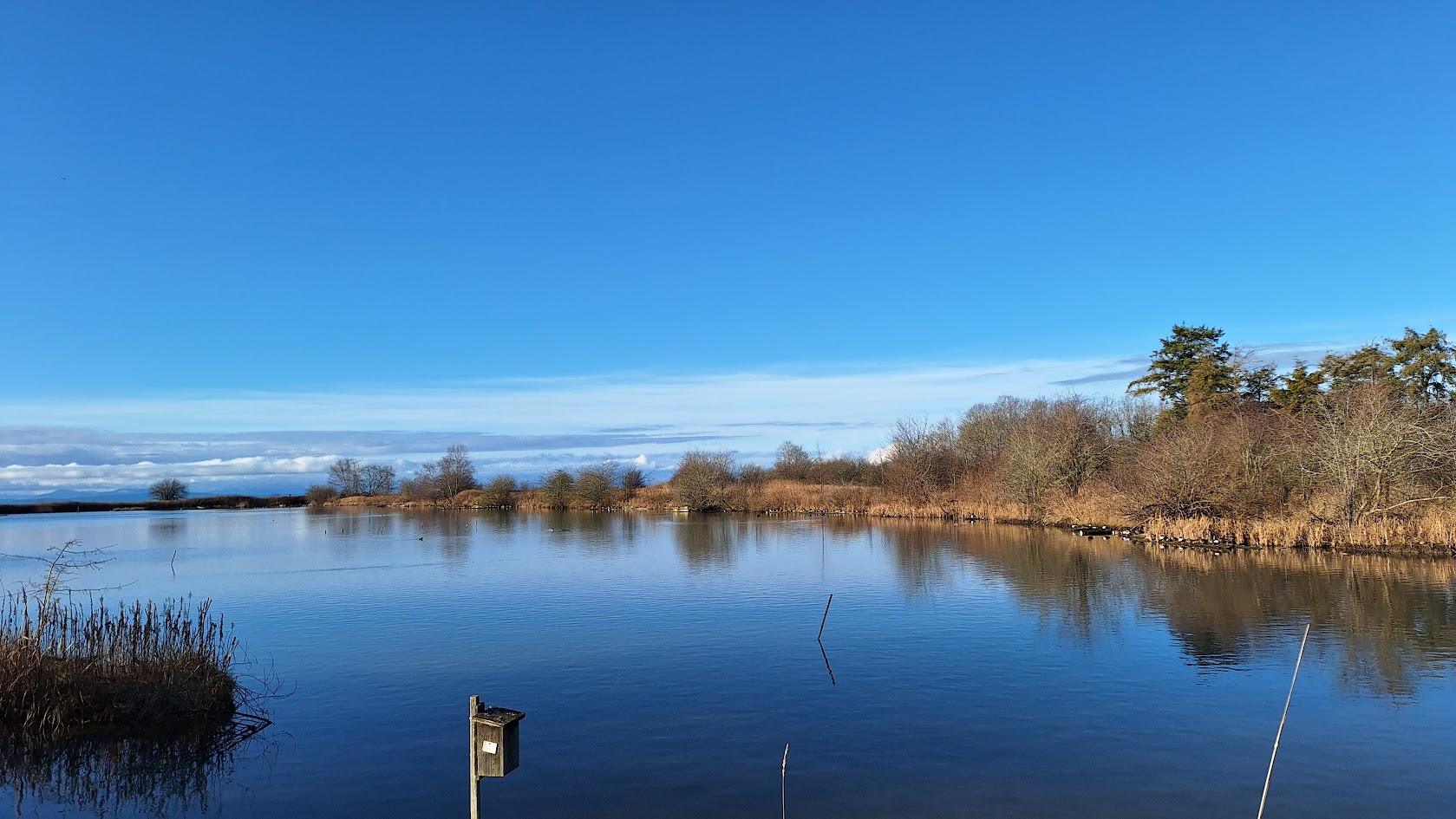
At the George C. Reifel Bird Sanctuary in southwestern BC, you can see may different species of waterfowl and other birds. These photos were taken by a friend, Sonia, who kindly allowed me to use them after her visit to this sanctuary. Many kinds of ducks visit this waterfowl refuge. The pintail (Anas acuta) is one of these.
I grew up thinking that all ducks were yellow when they were little and brown or white when they grew up. It was an eye-opener to me when I learned, a long time ago, that there were so many kinds of ducks, each with special features that made each type unique and helped to identify them.
The pintail is obviously named for its long pointy tail, as you can see in the last photo, but another special feature of this duck is its long neck. Notice the long streak of white that goes up his neck to the side of his head. This one has his neck pulled in somewhat, perhaps to keep warm, but if it were stretched up to take a good look around, you would see that he has a much longer neck than most other ducks do.
And have you even seen such a beautiful design of feathers as what this duck has on his back?
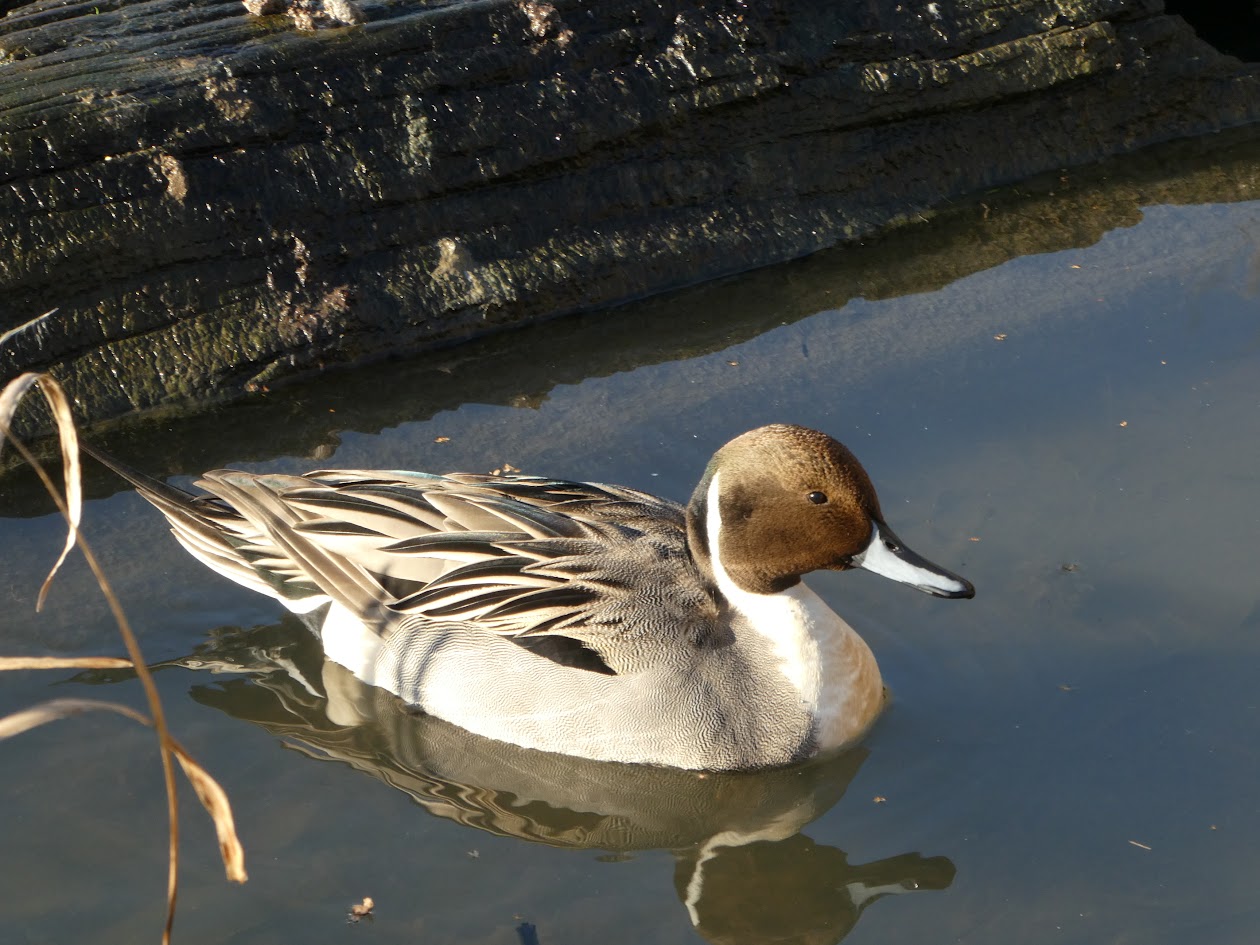
The pintail tips up in shallow water to reach for plant matter in and above the soil under the water. Its long tail helps to balance it as it forages for seeds and rhizomes. It also finds food on land, in fields where it eats roots, grains, and other seeds. In the nesting season it feeds mostly on aquatic insects, invertebrates, molluscs, and crustaceans.
These photos are of the drake pintail. The hen (female) pintail has a similar shape, without the long pointy tail feathers, and with more muted colours (keeping her safer when nesting).
D is for Ducks
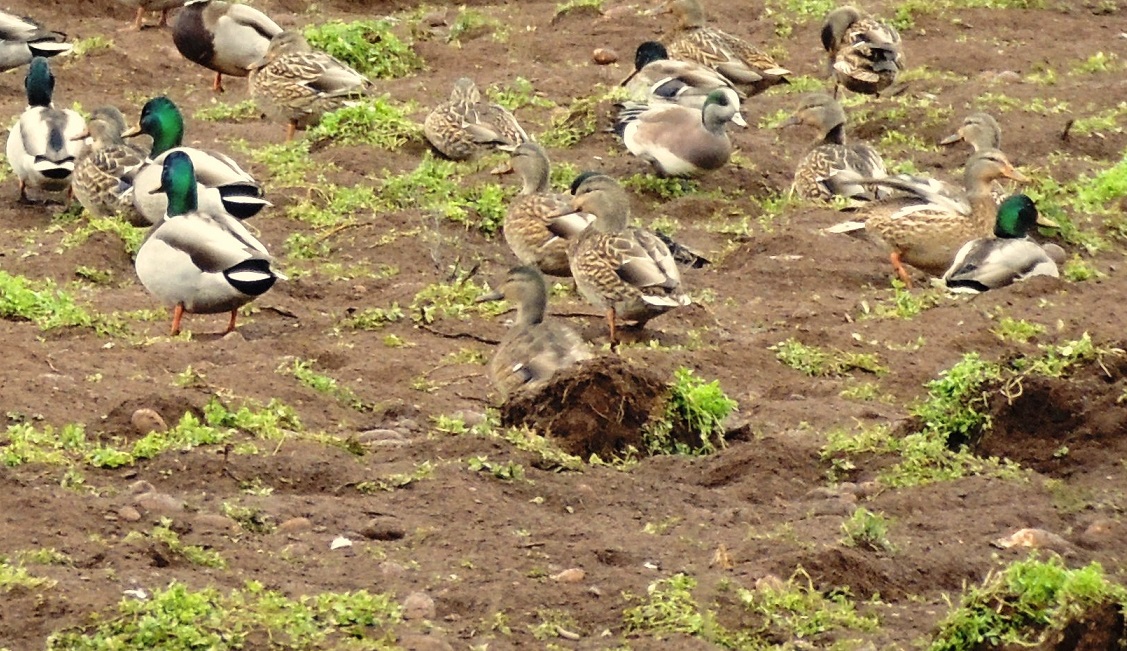
At first glance it looks like the farmer grew a crop of mallards.
On second glance we can see that there are widgeons among them.
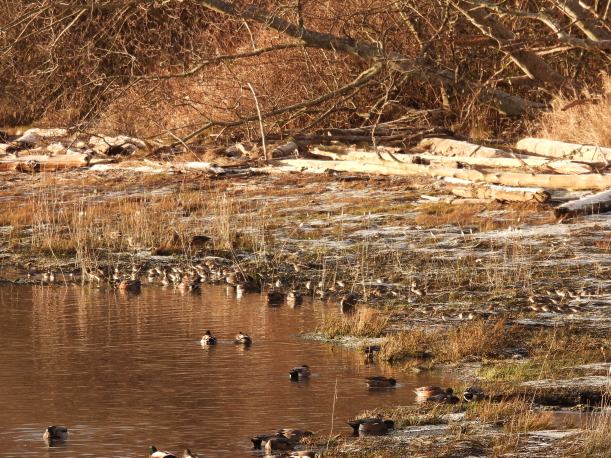
At third glance, in a close look near the bottom of the photo we can see that the farmer actually grew potatoes. Some were missed and have been unearthed by the ducks to nibble on. It’s not their first choice of food but who knows what other seeds or insects may be hiding alongside the potatoes?
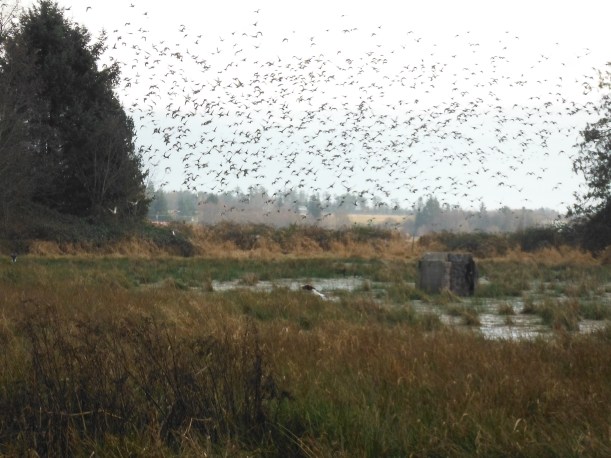
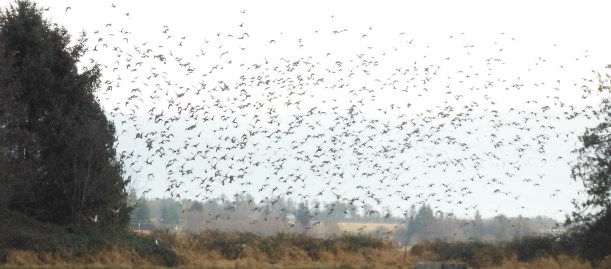
D is for duck, but when they sense danger, they don’t “duck.” They fly!
No Crowds for Me
Just when we got settled, away from the gun,
Along comes this dog, for an innocent run.
“He can’t catch us all,” says an old duck so wise,
“But what if it’s me and it means my demise?”
“Most likely it won’t be, so fear not,” I say,
“Fly up in the air if you’re chicken, and pray.
I plan to stay calm and not show him my fear.”
“In that case I’ll be brave beside you, my dear.”
But flying en masse is not what I prefer,
Wherever I turn, someone tries to deter
My flight path to safety, to freedom, and air.
I’m blocked by the crowds madly flapping up there.
Ah, this is more like it, with just a few friends,
We pick and we scrounge for a few odds and ends,
We don’t crash together in each other’s space,
A wonderful, so much more leisurely pace.
***** If you have spare time on your hands, why not visit my other blog, annelisplace.wordpress.com/
A Cool Change
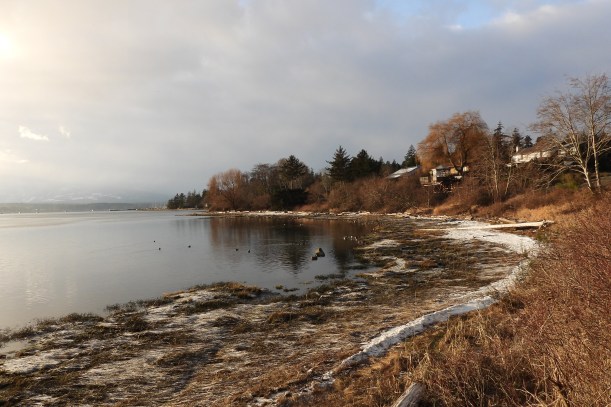
A thin layer of snow covers the usual feeding grounds of ducks, geese, and swans. While the nearby preferred agricultural fields are frozen over with snow and ice, the birds find food and shelter on the edges of the salt water.
The estuary of the Courtenay River holds a lot of bird life. Depending on the wind direction, waterfowl can find sheltered indentations in the shoreline where they can forage for food in the shallows. Rather than feeding on seeds and bits of plant roots when cold weather freezes their usual fields, they make the switch to marine vegetation and bits of animal matter (shrimp, crustaceans) that they find in the tidal areas of the shore. Once in a while, a faint ray of sunshine warms their backs on this southern exposure in spite of the cold day.
In these very short video clips you can see a swarm of what I think are dunlins flying in to land near the beach. Although it is a very small flock, it reminds me of those murmurations of birds, when they fly so close together in an incomprehensible formation without crashing into each other. If you make the videos full screen you might be able to see the fine snowflakes blowing around as well
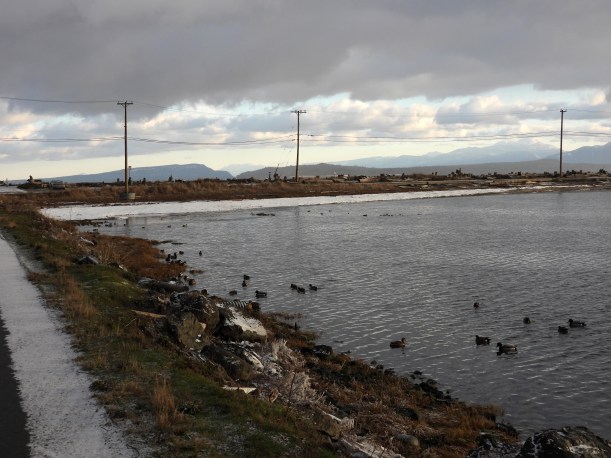
These mallards are close to shore for several reasons. They have slightly more cover in case of predators (better than being “a sitting duck” in the open water), and there is probably more food available in the shallows where they can probe the sand with their bills and find small beach creatures to eat. At high tide there is also marine vegetation that is available only at this level, lifted up by the rising water.
They are in survival mode for now, waiting for a good low pressure southeast system that will bring wind, rain, and warmer temperatures, thawing out the farm fields that offer their preferred diet. I hope they are all lucky ducks.
Hawkeye
The row of trees provides a perch,
For birds of prey whose sharp eyes search,
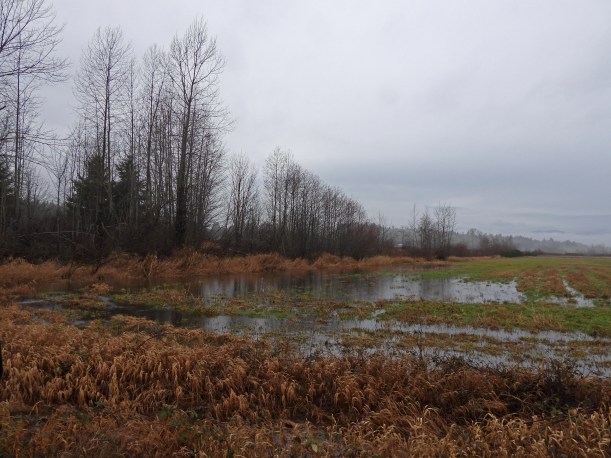
The flooded fields that are so fine,
For waterfowl who wish to dine.
The foggy drippy days drag on,
I ate a mouse, but now it’s gone,
It’s not enough to fill the gap,
Too cold and wet to take a nap.
These leafless trees don’t camouflage,
No chilly bones do they assuage,
Perhaps a meal of ducks is best,
But snatching one will be a test.
The watchful drakes stand on alert
While others forage in the dirt,
“Don’t bother wasting energy,”
They tell the hawk, “We’ll just fly free.”
A Waterfowl Meeting
Mallards, widgeons, fill the sky
Each one calling out their cry,
“Wait for me,” and “Watch my space,”
Desperate to keep up the pace.
In the lee by stands of trees,
Sheltered swans it seems to please,
In a line of purest white,
Feeling safe, to their delight.
For the ducks, a numbers game,
Many of them look the same,
Feeling safe amid the crowd,
They don’t mind if they are loud.
In this field of scraps they find
Food enough to feed their kind,
So much harvest overlooked,
Ducks don’t mind if it’s not cooked.
Look quite closely, you will see
Old potatoes – one, two, three,
If these spuds are not fermented,
Hungry ducks won’t get demented.
It’s a Cruel World Out There
The geese are moving in from places farther north where they have enjoyed warmer weather until now. They sense that the season is cooling off and have come to visit the fields of southern BC to fatten up on leftover grain, bits of corn, and anything else that looks good. Once they have met up with their friends in ever greater numbers, and they have rested and feasted and done little test flights during this staging time, many of them will fly farther south where the winter is not as harsh. A few smaller flocks will settle in to spend the winter here on Vancouver Island, in the hope that the coldest weather will be bearable and not last too long.
The eagle watches and waits. He will take advantage of any stragglers or injured birds to supplement his diet. Once the spawned out fish carcasses are cleaned up by scavengers like seagulls, crows, and eagles, it will be time for a new food source. For the eagles it will often be crippled waterfowl of many kinds.
This bald eagle has a good view of a cornfield that often attracts ducks and geese. If any of them are not able to keep up with the flock, they will make an easy target for a predatory bird.
Little songbirds like these chipping sparrows will be targeted by hawks who sit silently in the nearby trees, waiting for an opportunity to swoop down and scoop up a little snack.
This broad-winged hawk would be happy with a songbird or even a careless squirrel. Patience and alertness are what it’s all about.
The merlin doesn’t mind picking up a songbird either. He’ll happily take down a flicker that might be almost the same size as him.
The red-shafted northern flicker had better be alert. It’s a dangerous world out there.
The general rule for non-predatory birds, especially in the autumn, is “heads up or be eaten.” It’s the raptors who are the meat eaters, while the gentler plant- and insect-eaters need to fear them.
And I haven’t even mentioned the owls yet. Rabbits and mice beware!