Located on the northwestern coast of France, near the mouth of the Couesnon River where it empties into the English Channel, Mont St Michel is a tidal island on which an ancient abbey was built about the year 709 A.D. The last part of the Couesnon River, near the mouth, marks the border between the provinces of Normandy and Brittany. Normandy came out the winner in having the island on its side of the river.
It has been a place of refuge for villagers escaping Viking raids, and a place of worship named after the archangel St. Michael. It is now a tourist attraction, visited by about 2.5 million people each year.
.

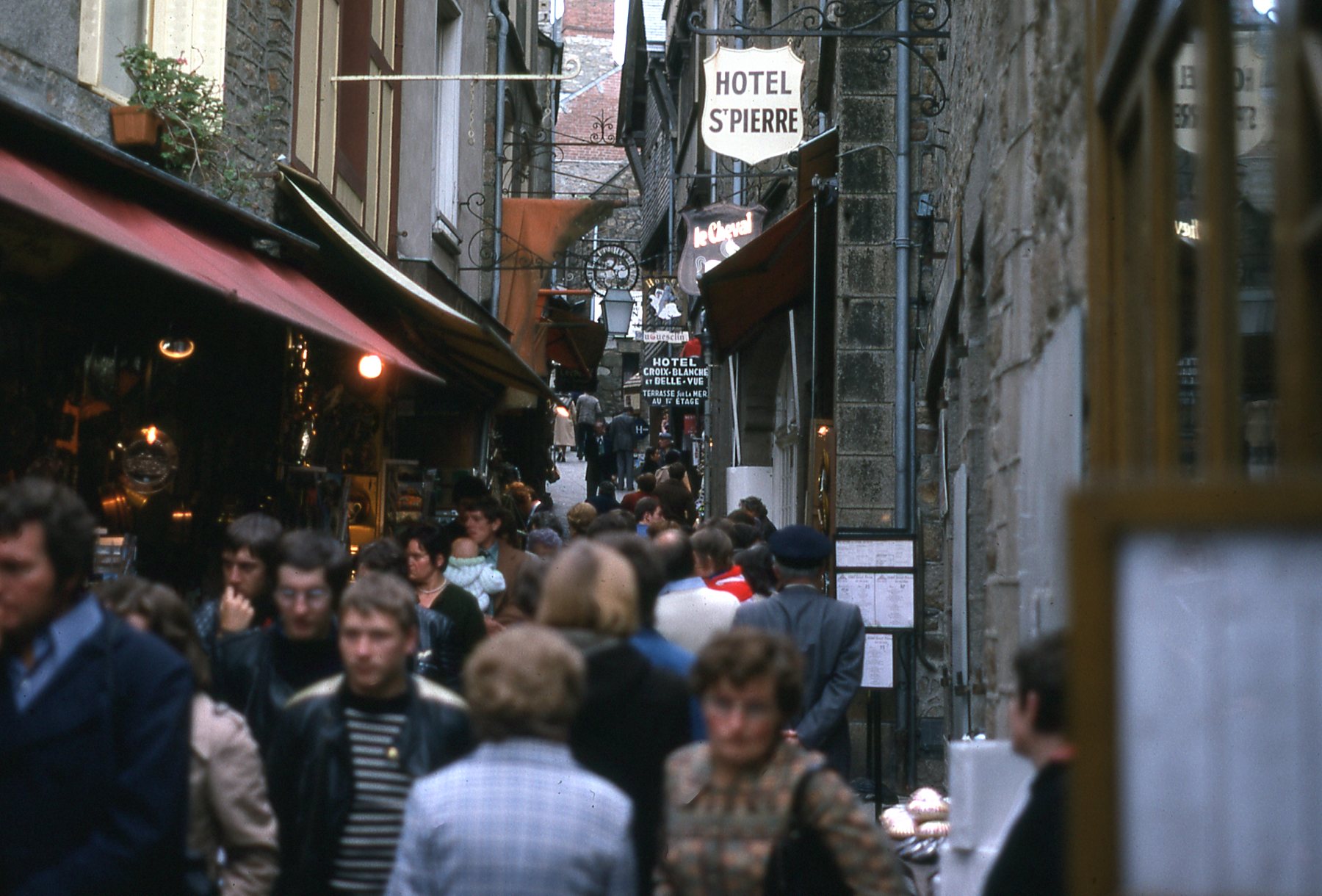
The narrow streets of the buildings on this granite island are packed with tourists, especially in the summer, but there are about 30 residents living on the island permanently. While there are many tourist shops on the island, there are not shops that supply the locals with food and supplies. For that, they must travel about 10 kms (so you don’t want to suddenly run out of half and half for your coffee).
In the old days when it was still used as a monastery type of setting, the monks didn’t leave the abbey. The abbey was built on the top of the cone-shaped granite island, in a combination of Romanesque and Gothic styles. Because of its relatively difficult accessibility, the materials for building the abbey were brought in on barges when the tide was right. The statue of St. Michael on the top has worked as a lightning rod and has spared the island much damage.
In the photo below, you can see a notched track where supplies were pulled up or lowered down with the help of a winch at the top. This was for the benefit of those monks who never left the monastery. About a dozen monks and nuns still live in part of the abbey now.
After the French Revolution, and until 1863, some tiny rooms were used as a prison. These dark stone rooms must have been terrible places to be kept, like in a dungeon, but above ground.
The history of the abbey of Mont St Michel is long and diverse; too much write about here.
It is a fascinating World Heritage Site, worth visiting if you are ever in the north of France.

 wordsfromanneli