wordsfromanneli

Thoughts, ideas, photos, and stories.


30 Comments

Blue Grouse

Blue grouse on Vancouver Island generally live in coniferous forests on the hilly slopes. In the summer they spend more time in the lower elevations near the edges of treed areas, presumably eating more berries and insects, while in the winter they  go higher up the slopes to more dense stand of coniferous trees where they eat buds and shoots of the trees.

We live far from the slopes of the hills, quite close to the water, so I was shocked to see this blue grouse flying up into our fir trees to get away from Emma (our English cocker spaniel) whom I had just put out into the backyard.

I still don’t know how it got here, and what it was doing in our neck of the woods.
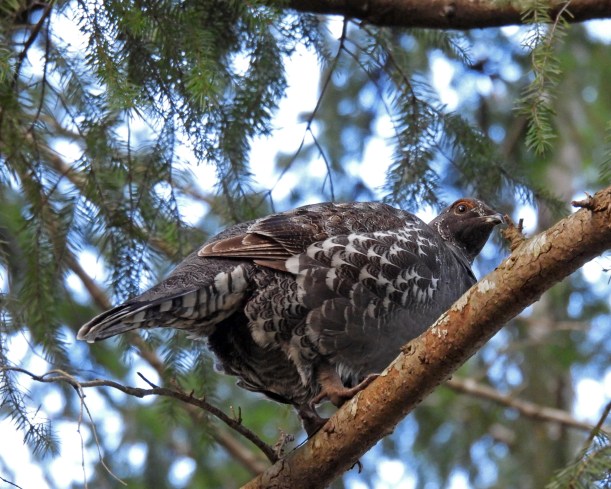
The bright yellow skin over the eye is a telltale marking of the male blue grouse. The female has only a pale patch of bare skin over the eye. But even without noticing this slight difference, if you saw a male and female grouse side by side, you’d wonder if they were the same species. The males are shades of black, brown, blue and gray, speckled with white, while the females are smaller and a dark reddish brown.

Keeping their legs warm on those higher elevations are the tiny feathers that go down to their toes.

I raised chickens many years ago and was used to picking them up. So when I saw a blue grouse strutting back and forth along the side of a logging road one spring, I walked over to it. Most likely its mate had a nest nearby. It was quite aggressive and ran at my legs. I crouched down and slowly reached out my left hand. It pecked the skin between my thumb and forefinger. While it held onto my left hand, I scooped it up in my right hand and immediately tucked its head under my arm so it was in the dark. It stayed very still while the Captain and I had a good look at it. We gave it a gentle pat and put it back down on the side of the road.

I don’t go around disturbing nesting birds (and I can only assume its mate had a nest nearby – I never saw it), but this bird was so actively patrolling the area I couldn’t resist getting out and saying hello. It was an amazing feeling to actually hold a wild bird for a few moments.


41 Comments

Brant Migration

The black brant are back from the coast of Mexico and California. These small sea geese are on their northerly migration to their nesting grounds, mostly in the  coastal areas of the Canadian Arctic.

The long daylight hours of the far north allow plenty of time for the young to feed on plants and insects that are so prolific there.

But right now in the early spring of the year, as these adult black brant take a rest from their travels here on Vancouver Island, they are selectively foraging on marine vegetation. They especially like eel grass and bits of sea lettuce or other greens. Many of them have their beaks in the sand, rooting out plants, and small bits of grit. At this time of year, just after the herring have spawned, the brant might also get the odd mouthful of herring eggs stuck to the seaweed.  Caviar and green salad. Gourmet dining.

The brant have a long flight ahead of them and they need to recharge their strength and stamina for the next part of their northward journey.  This is why they spend so much of their time feeding. They are limited in the availability of the food by the tides. On high tides the grasses and seaweeds are underwater and not as easily accessible, so the brant prefer lower tides when the plants are uncovered. They eat during the day, so they have to make the most of the low tide and eat while the table is set. Low tides at night don’t do them much good.

By the way, do you see one bird who doesn’t seem to belong? It is being tolerated nicely though.

The snow geese are doing pretty much the same thing, heading north to nest, and eating as much as they can before the next leg of their flight. The difference is that they are not as particular about what they eat, and will happily enjoy some grass roots meals.

Our brant numbers seem to be down from past years. I don’t know why that is, but those that are left are a precious sight to see.

Coastal communities have put up many signs for visitors at the beach not to disturb the brant. While these birds are here, it is not helpful to them to let dogs run on the beach. It disturbs the birds,  who then use up energy in flying out of reach of the dogs, before they can then resettle to continue feeding.

While I watched from a distance, I saw a young father take his daughter down to the beach and walk right up to the brant, pointing at them, obviously showing his little girl what wonderful birds these are.

But here is the result of his naive, misguided good intentions.

While I was there, I saw two young fellows go down to the beach to play frisbee, right beside the brant, disturbing them yet again. They could just as easily have played frisbee on the grassy park area across from the beach.

A nearby kiteboarder had sense enough to go along the beach a little farther so he didn’t upset the geese.

The Captain and I drove on a few miles up the road to check out another beach that often had brant on it. Beautiful as the beach was, not a bird was to be seen. Perhaps the landscape here allows the tide to come right in  much faster and doesn’t leave as much “brant food” exposed.

We enjoyed the empty scene for a while before continuing on the road home, happy to have seen the brant earlier in the day.