Located on the northwestern coast of France, near the mouth of the Couesnon River where it empties into the English Channel, Mont St Michel is a tidal island on which an ancient abbey was built about the year 709 A.D. The last part of the Couesnon River, near the mouth, marks the border between the provinces of Normandy and Brittany. Normandy came out the winner in having the island on its side of the river.
It has been a place of refuge for villagers escaping Viking raids, and a place of worship named after the archangel St. Michael. It is now a tourist attraction, visited by about 2.5 million people each year.
.
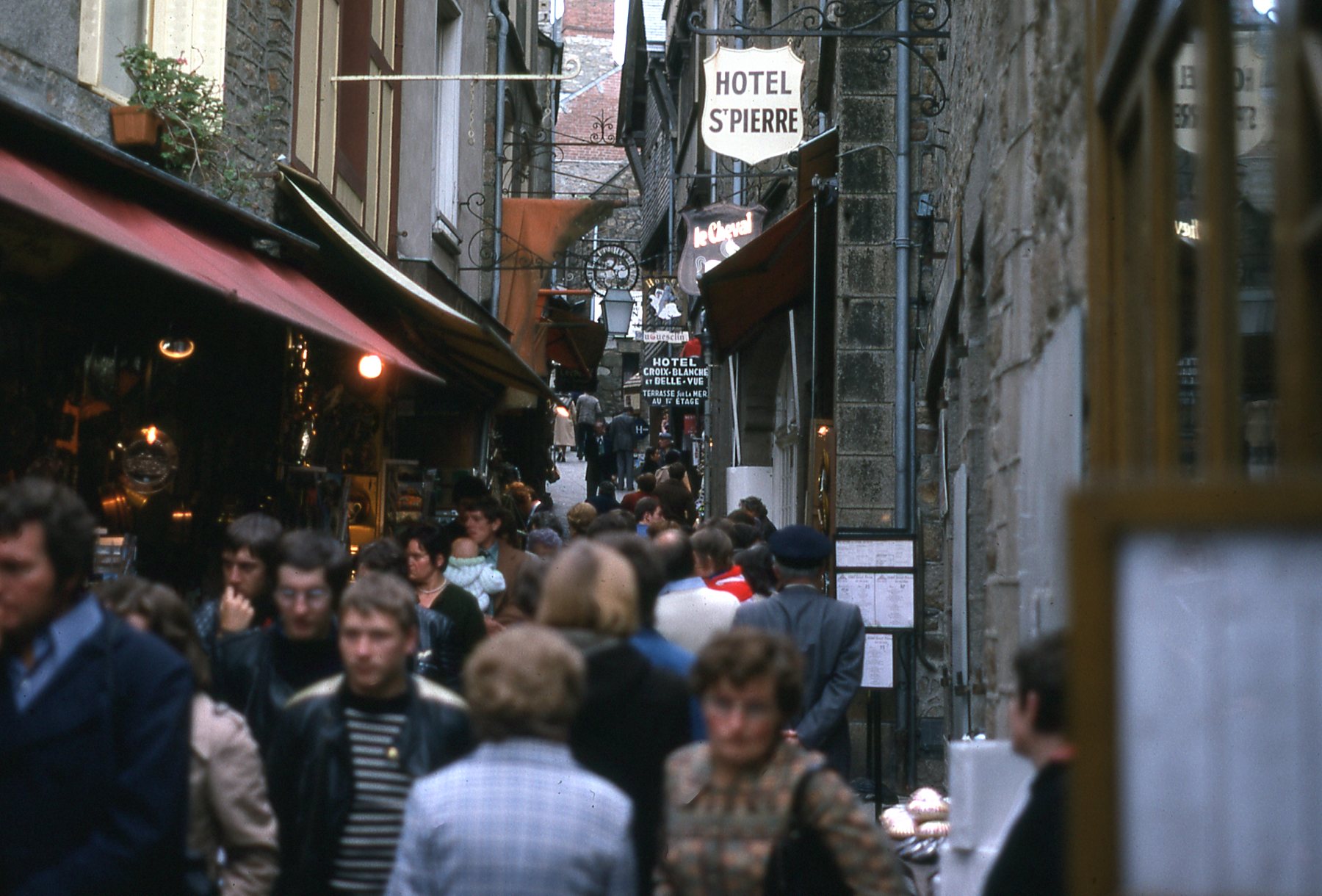
The narrow streets of the buildings on this granite island are packed with tourists, especially in the summer, but there are about 30 residents living on the island permanently. While there are many tourist shops on the island, there are not shops that supply the locals with food and supplies. For that, they must travel about 10 kms (so you don’t want to suddenly run out of half and half for your coffee).
In the old days when it was still used as a monastery type of setting, the monks didn’t leave the abbey. The abbey was built on the top of the cone-shaped granite island, in a combination of Romanesque and Gothic styles. Because of its relatively difficult accessibility, the materials for building the abbey were brought in on barges when the tide was right. The statue of St. Michael on the top has worked as a lightning rod and has spared the island much damage.
In the photo below, you can see a notched track where supplies were pulled up or lowered down with the help of a winch at the top. This was for the benefit of those monks who never left the monastery. About a dozen monks and nuns still live in part of the abbey now.
After the French Revolution, and until 1863, some tiny rooms were used as a prison. These dark stone rooms must have been terrible places to be kept, like in a dungeon, but above ground.
The history of the abbey of Mont St Michel is long and diverse; too much write about here.
It is a fascinating World Heritage Site, worth visiting if you are ever in the north of France.
Let me tell you a little bit about Jacqui Murray and her latest book.
Jacqui Murray is an amazing woman. She is constantly researching the history and facts about how man lived on this earth from hundreds of thousands of years ago to several thousands of years ago. She has read dozens and dozens of books and articles about the evolution of the earth and how man survived in the harsh environment of nature as it was back then.
She has drawn on this research to write many novels, but if you think research has made her books dry or boring, think again. They are page turners!
Jacqui Murray has done all the work. The only thing we need to do is read and enjoy the wonderful novels she writes about the people of those times. She gives the characters personalities that we can identify with. Some are wise, some foolish, some good and caring, others vain or selfish, hardworking or lazy, skilled or unskilled. Not much different from people today. Humans had emotions and basic needs throughout history. The emotions haven’t changed. But how they reacted to those emotions and needs was sometimes very different from what we would do today.
Most of us love nature. But imagine having nothing but nature around you, and having to survive without most of the conveniences of food, shelter, and security that we take for granted nowadays. How hard would life be if the world was still in upheaval from extreme weather conditions, earthquakes, and volcanic eruptions, as landmasses were still forming and changing?
You can’t go to the store to buy a coat if you’re cold; there are no stores. You have little protection against wild animals, and no modern medicine for illnesses. You need to learn which animals are dangerous to your health and which plants will kill you if you eat them. There is no book to consult about these mysteries. You are basically on your own. Most of us would not survive.
The survival instinct is one of the main reasons that early man learned to work together with others of their kind, and formed groups or tribes. They knew that there is strength in numbers.
In Jacqui Murray’s books, you will love getting to know the people and you will feel their joy and their pain. Best of all, you will find yourself in a world you’ve probably never imagined. It’s as if you went back in time … WAY back in time.
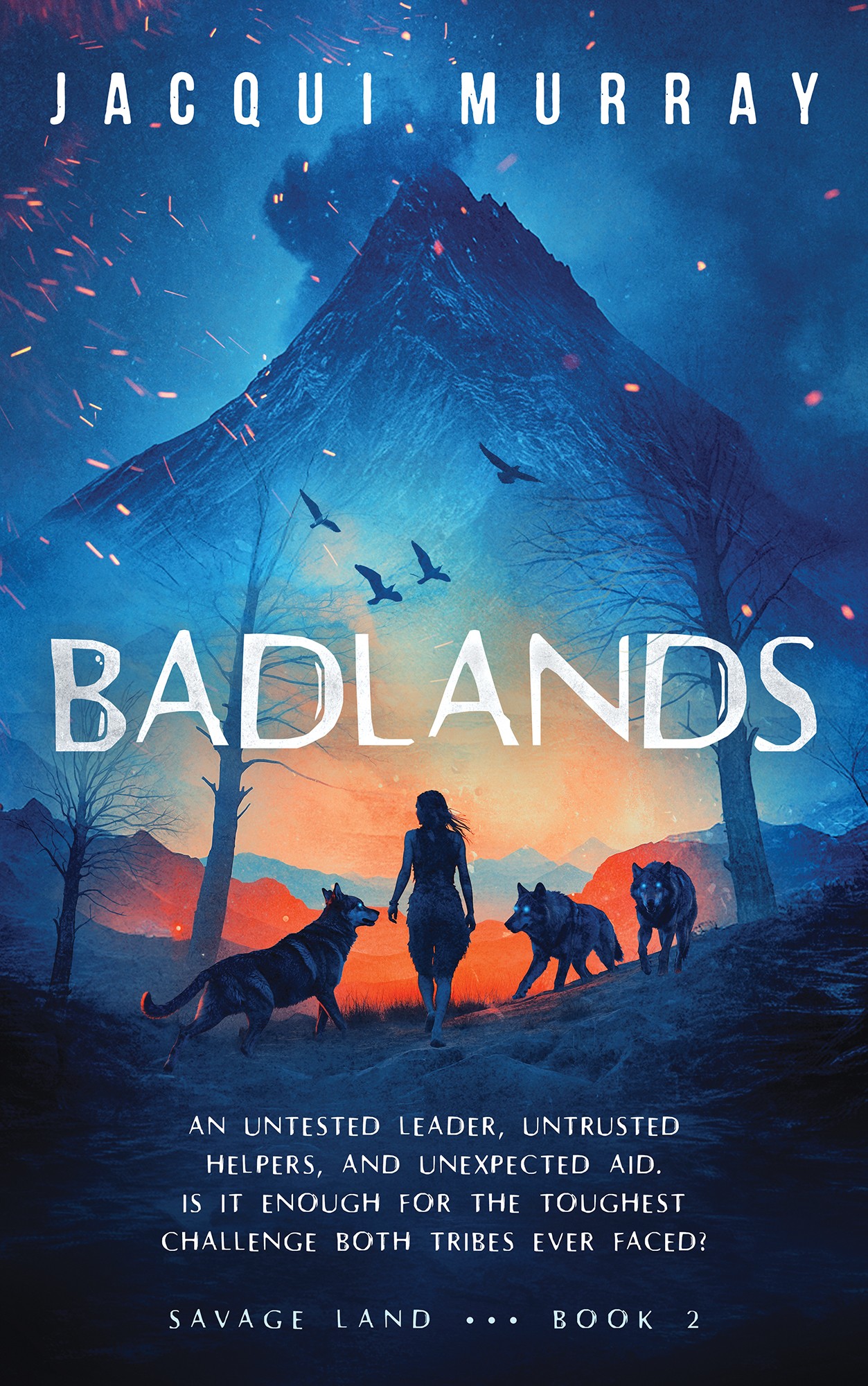
Don’t miss Jacqui’s latest exciting page turner, “Badlands,” the second book of the trilogy, “Savage Land.” If you haven’t read Book One in the series, please check out “Endangered Species.” You can find both books if you click on the link belowthe cover image of “Badlands.”
*****
Author bio:
Jacqui Murray is the author of the popular prehistoric fiction saga, Man vs. Nature which explores seminal events in man’s evolution one trilogy at a time. She is also author of the Rowe-Delamagente thrillers and Building a Midshipman, the story of her daughter’s journey from high school to United States Naval Academy. Her non-fiction includes 100+ books on tech into education, reviews as an Amazon Vine Voice and a freelance journalist on tech ed topics.
Here is a sample – just a small part of Chapter One.
Chapter 1
75,000 years ago
Modern day Altai Mountains, Siberia
Yu’ung’s legs churned, arms pumped, throat straining to draw in air. Her red hair hung in damp sweaty ropes on her neck and shoulders. After narrowly escaping the cave-in and then Hyaena’s attack, time had run out. B’o was supposed to leave with or without her when Sun reached a particular spot overhead. That point had passed and now, the maelstrom was upon them. She must get to her tribe.
Running never tired her, no matter how long or far. Today was different. Driven by desperation and worry for those who relied on her, she ran too hard and slammed up against her limit.
She stumbled to a stop and bent forward, chest heaving, sucking in one mouthful of air after another. The blue-eyed Canis–the massive Ump with his dark coat, the smaller White Streak with the light colored stripe cutting her black fur from one side of her forehead to the other, and the older Ragged Ear–circled back to her, huffing and prancing. Somehow, they knew time was short. Shanadar, who seemed to be their pack leader, wasn’t even winded. He waited, patient but anxious.
She muttered, “The smoke–it’s much worse.”
Yu’ung had departed her homebase before Sun woke. She had gone there to tell the Tall One Fierce that the People would join him. The air tasted of ash then, but lightly. By the time she reached where Fierce and his Tall One band should have been, the small flakes had grown chokingly large. The Tall Ones–wisely–were gone, but her mother, Kriina, now Fierce’s pairmate, left a message in the tunnel telling Yu’ung their destination and of a possible new homebase for the People.
It was there Yu’ung would lead the People.
“I’m ready, Shanadar,” and she took off again.
She expected the Angry Mountain’s destruction to clear closer to her homebase, but instead, cinders and smoke thickened and the air dimmed to a dingy gray. Uprooted trees blocked the usual passages forcing her to divert onto new, untried trails. Pockets of flames burned without pause on all sides. The grassland and forests that fed the People were almost wiped out.
An oyster bed near the shoreline is encouraging to see. If you like oysters, be sure you’ve checked your local website for updates on any shellfish contamination that may be happening in your area.
We saw tons of oysters, but our fishing licences only allowed 12 each. That is certainly enough for a meal.
Poor Emma. She ran over these oyster shells and was soon limping along with sore feet from the rough barnacles on the shells.
After that, she preferred to run over pure sand or maybe a clam bed, both of which were easier on her feet.
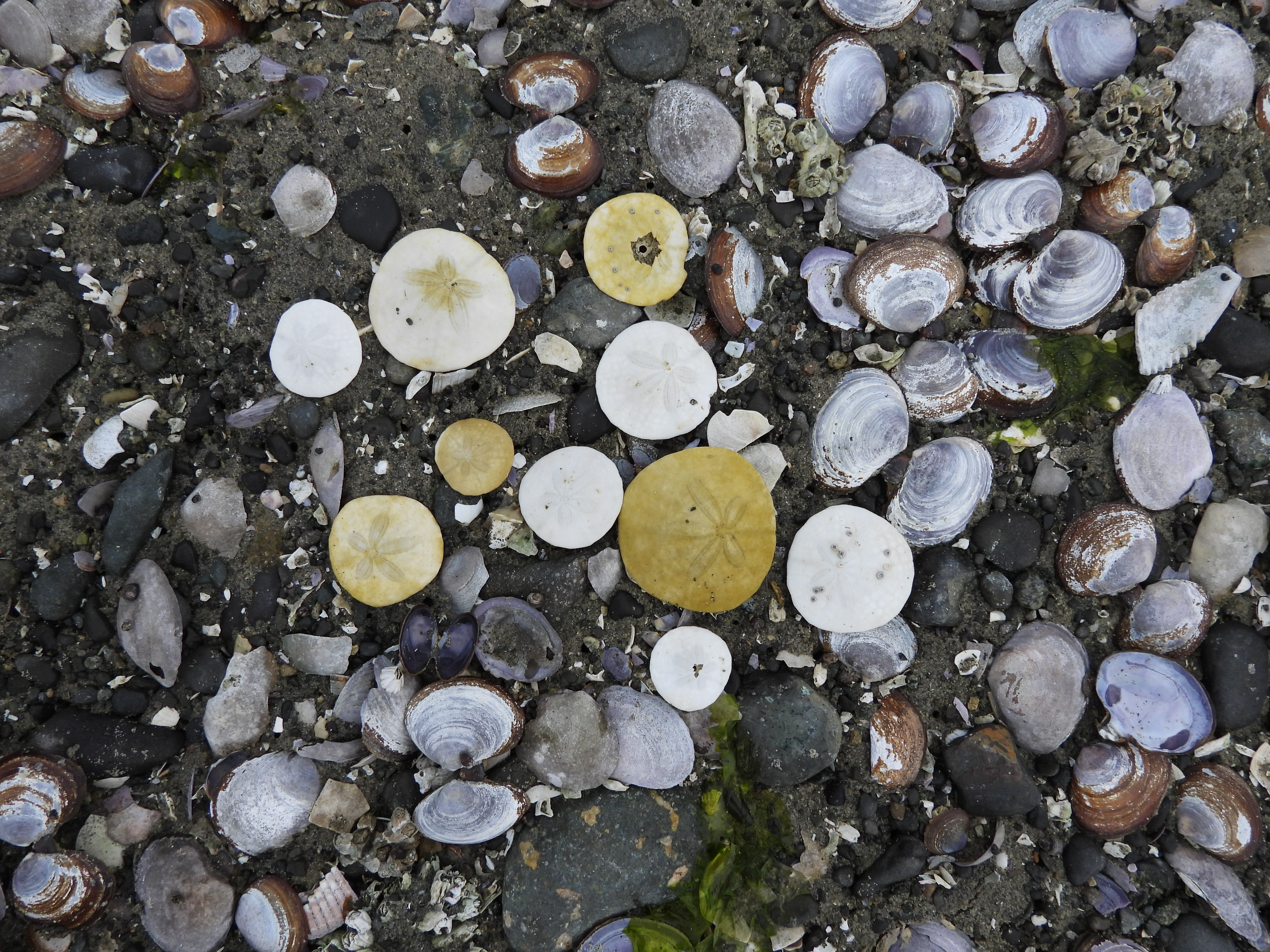
I found a bit of beach money to pay for the clams and oysters. See the sand dollars below? The whiter ones were dead and sun bleached; the yellower ones were probably not feeling well; and the darker purplish brown ones (not pictured) were quite alive. I didn’t get a picture of them because I didn’t find them until later when I figured out that they were a few inches below the surface of the sand.
Emma was interested in a lot of things on the beach. This oyster was by itself, away from the rest and was covered with big barnacles. It seemed out of place here among all the clam shells.
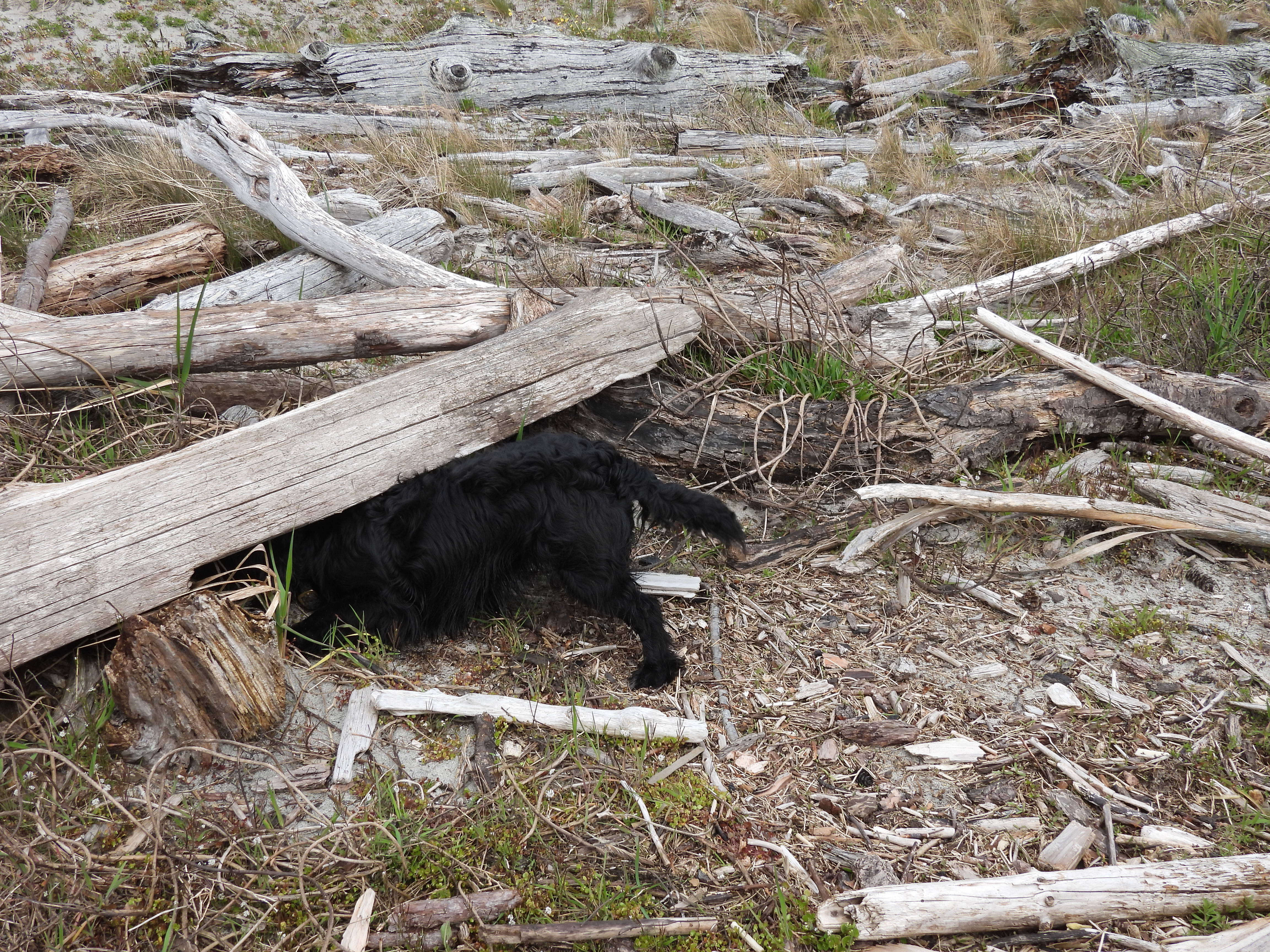
The beach had so much driftwood washed up that it was an endless job for Emma to explore for mice and other little creatures that left their telltale scents on or under the logs.
She finally decided to tackle that big job, one log at a time.
It kept her busy all day.
So much fresh air and a tiny bit of sunshine ensured that we all slept well that night.
Today we spent a few hours on a nearby island beach that sees little use because it is only accessible by boat.
I was surprised to see the sandy fields blooming with tiny wildflowers.
I don’t know the names of all these flowers but the blue ones (below) look like tiny violas. I’m sure they have a proper name but I don’t know what it is. The little white flowers on the reddish stems might be saxifraga.
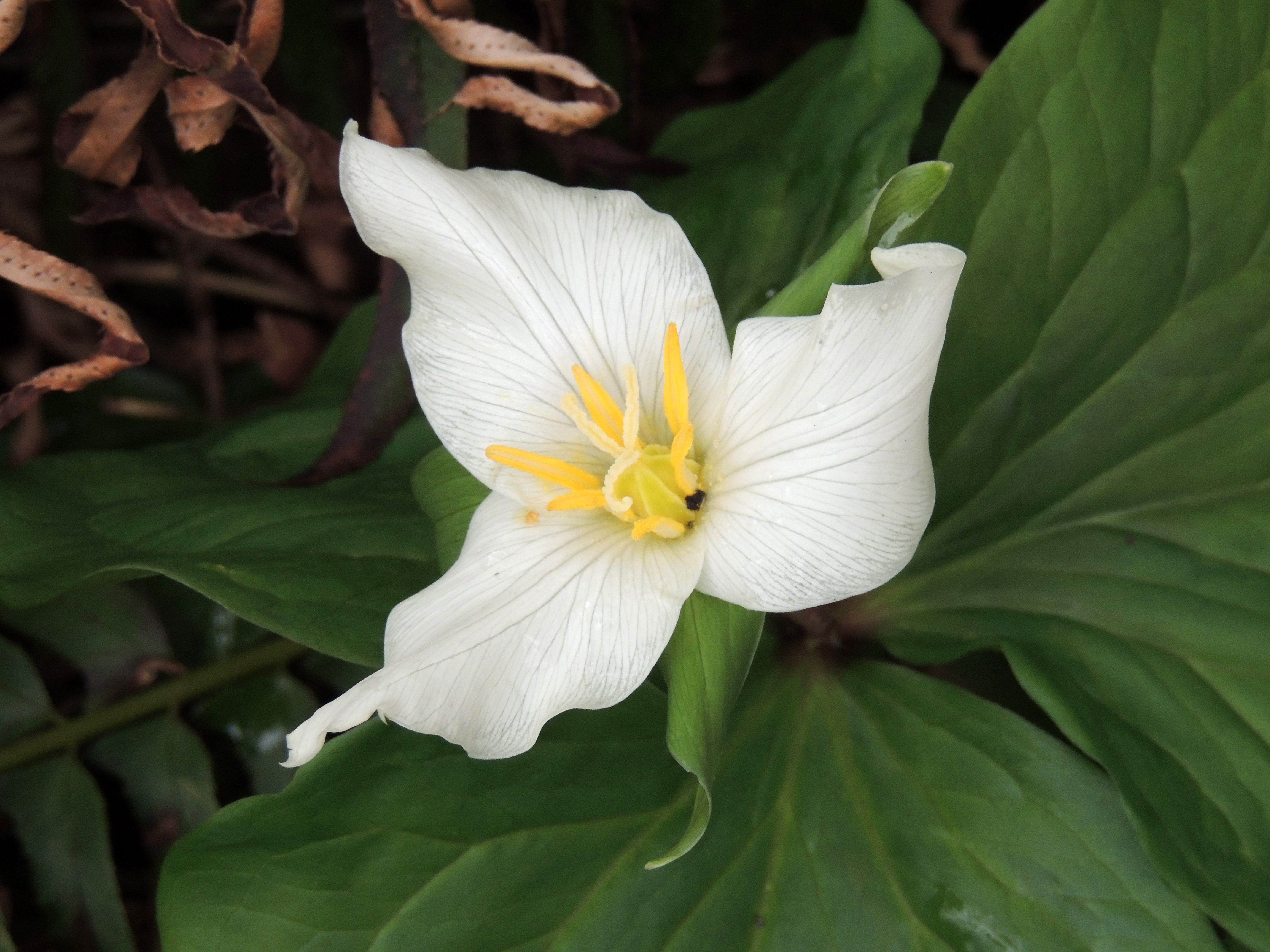
But this one I know. It is Oregon grape (berberis aquifolium, or holly-leaved barberry). Those yellow flowers turn into blue berries that look like a cluster of tiny grapes. I’ve read that the berries also have many health benefits, but they should be washed before eating. I’ve never enjoyed eating them raw. They are very tarty, but they make an excellent Oregon grape jelly.
Notice the dry moss all around the flowers. Even the moss has tiny blooms. The island has a rather dry climate so it makes its own unique, messy, but very pretty, flower garden.
More flowers will bloom here in the next weeks. I recognized leaves of lupins, and many other new shoots from various plants coming up from last year’s stock that has gone to seed.
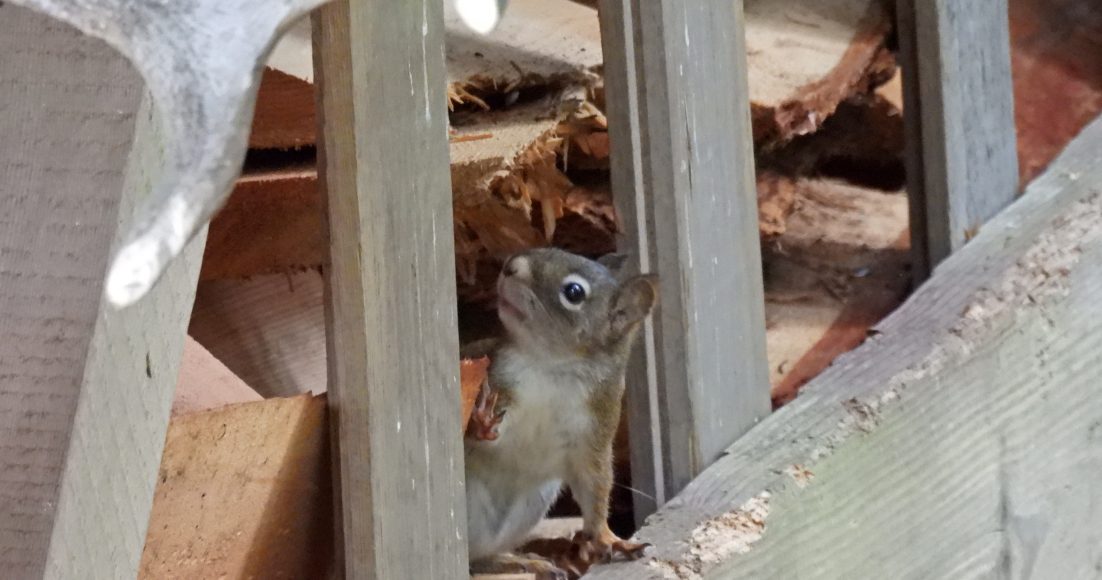
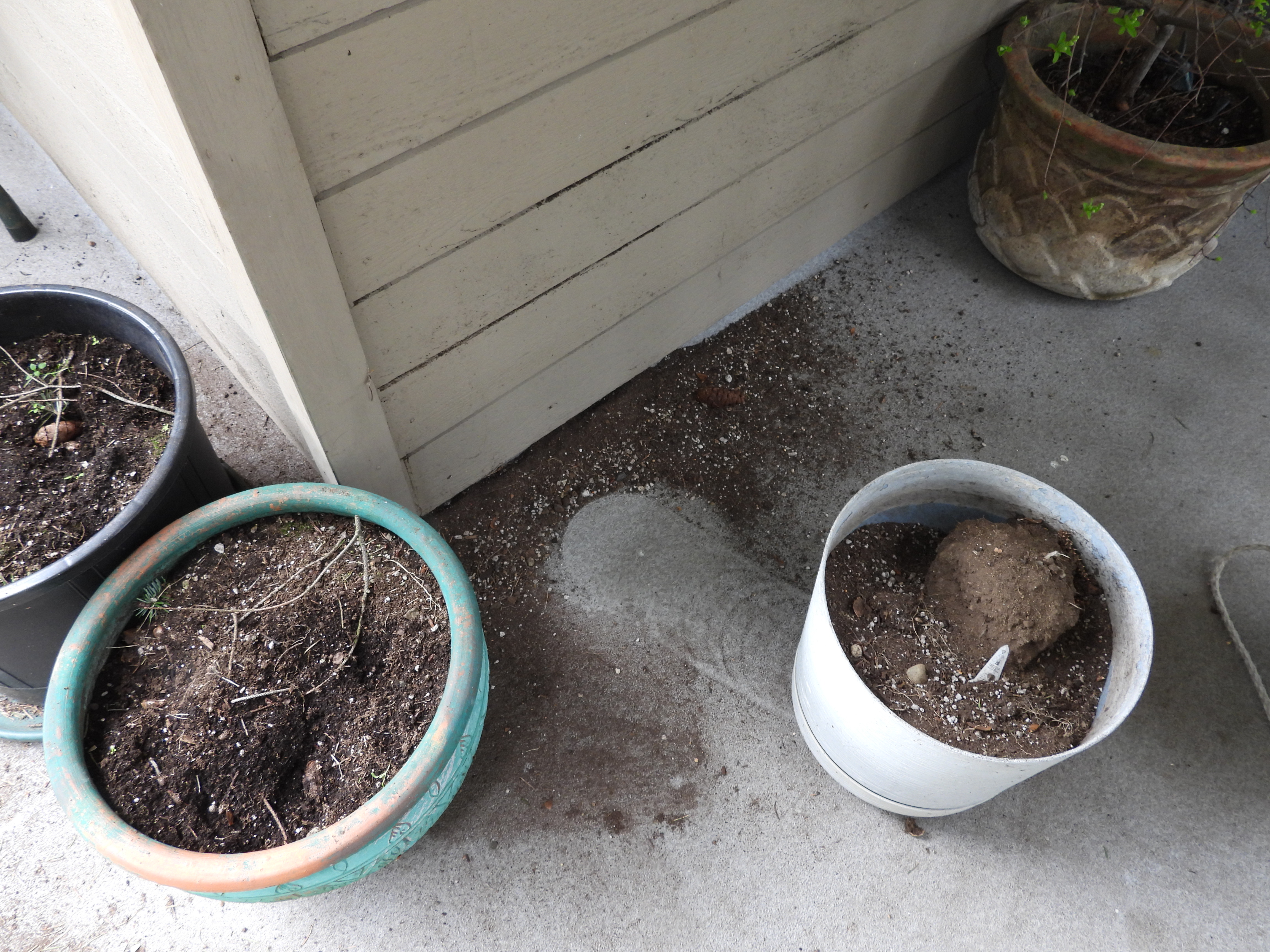
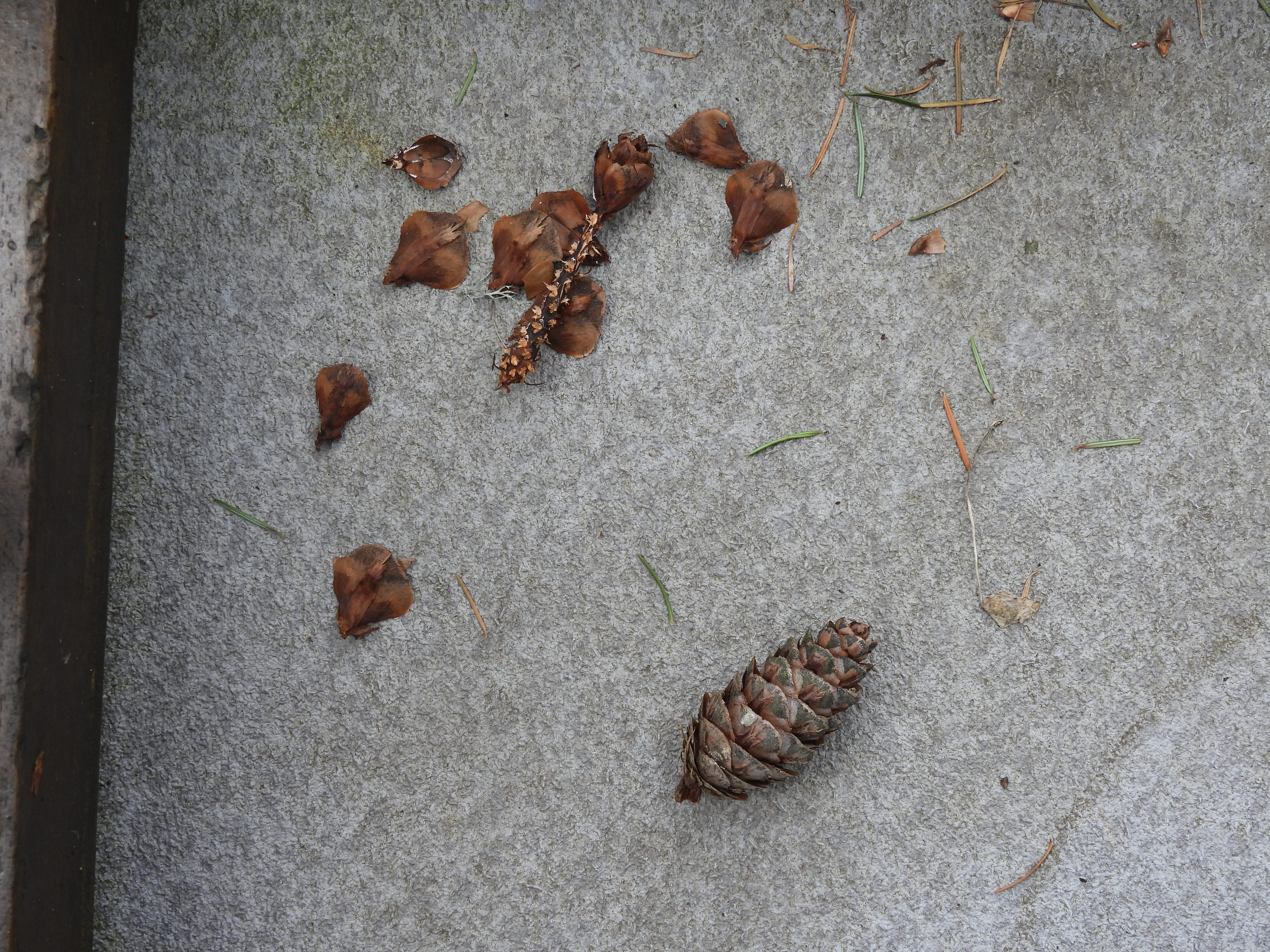
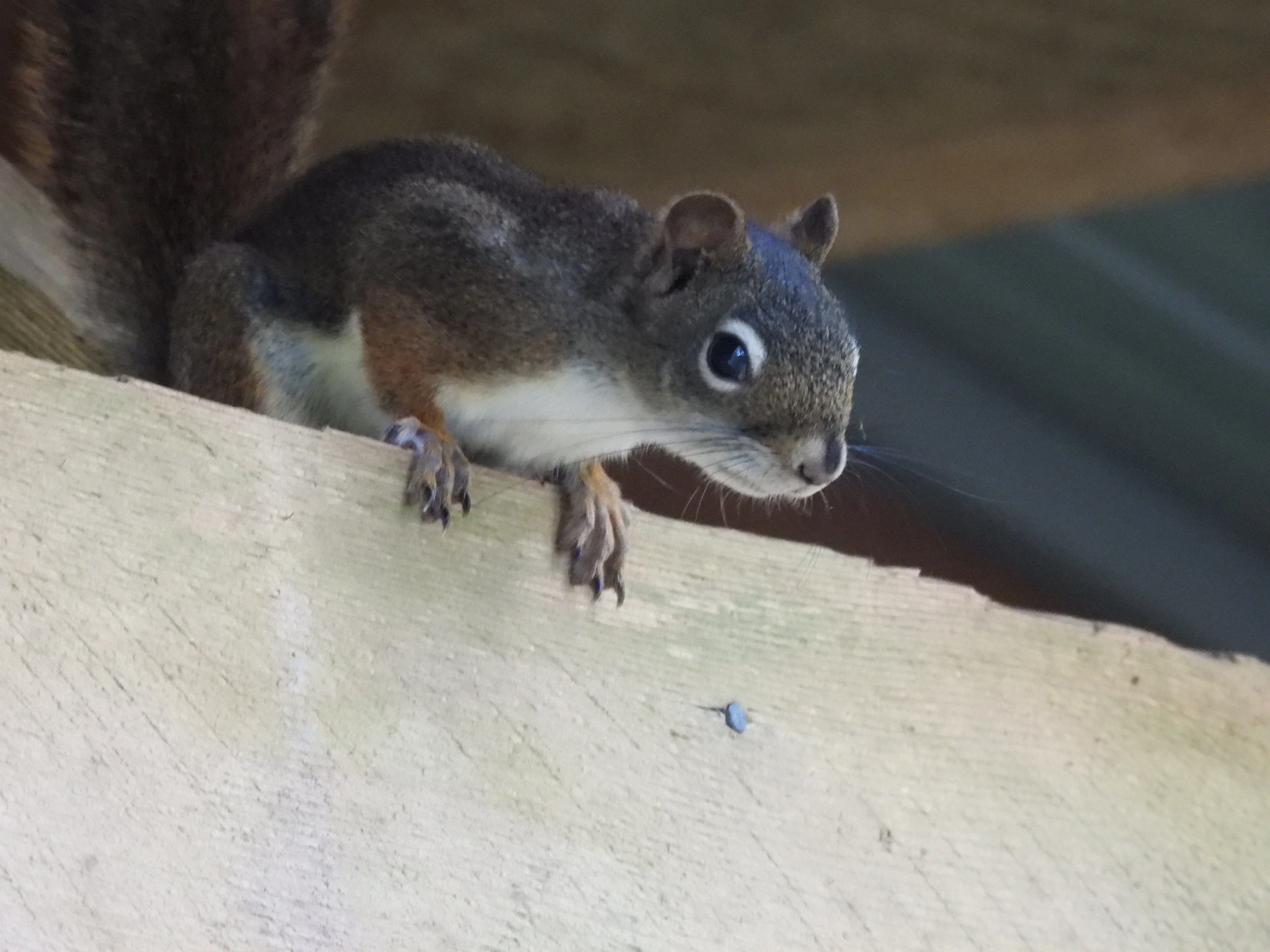
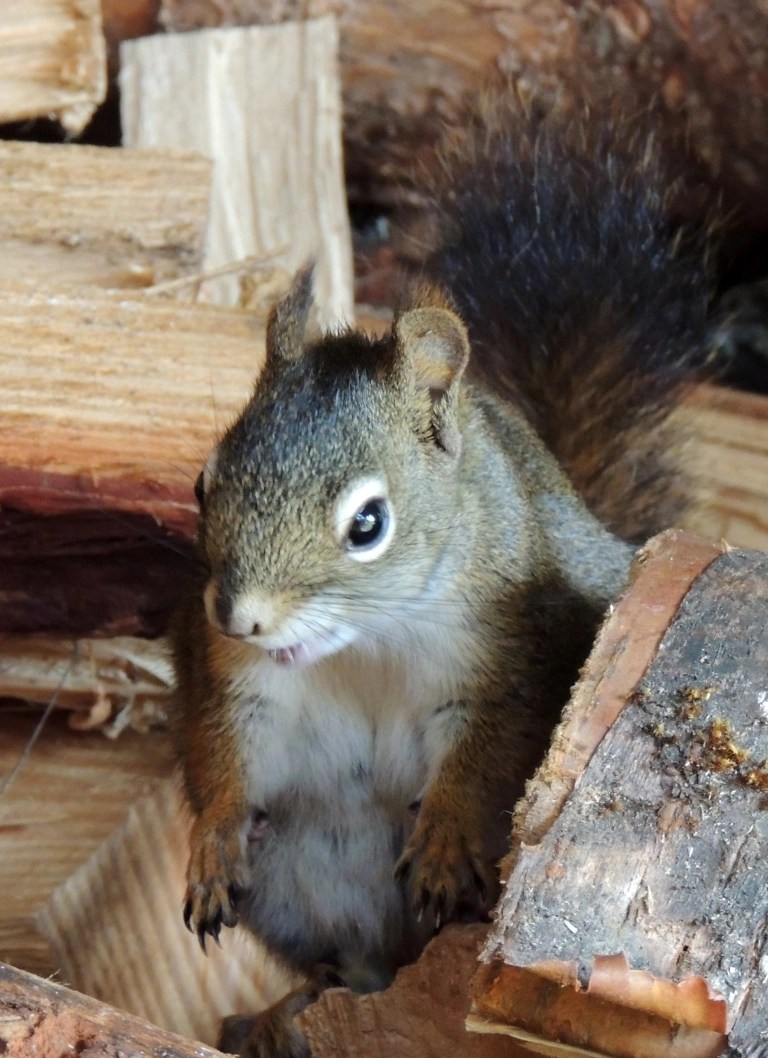
It’s time for spring cleaning and I took a broom to sweep the deck. But whoa! What was this? Did I have a raccoon or a rat visiting at night? What a mess!
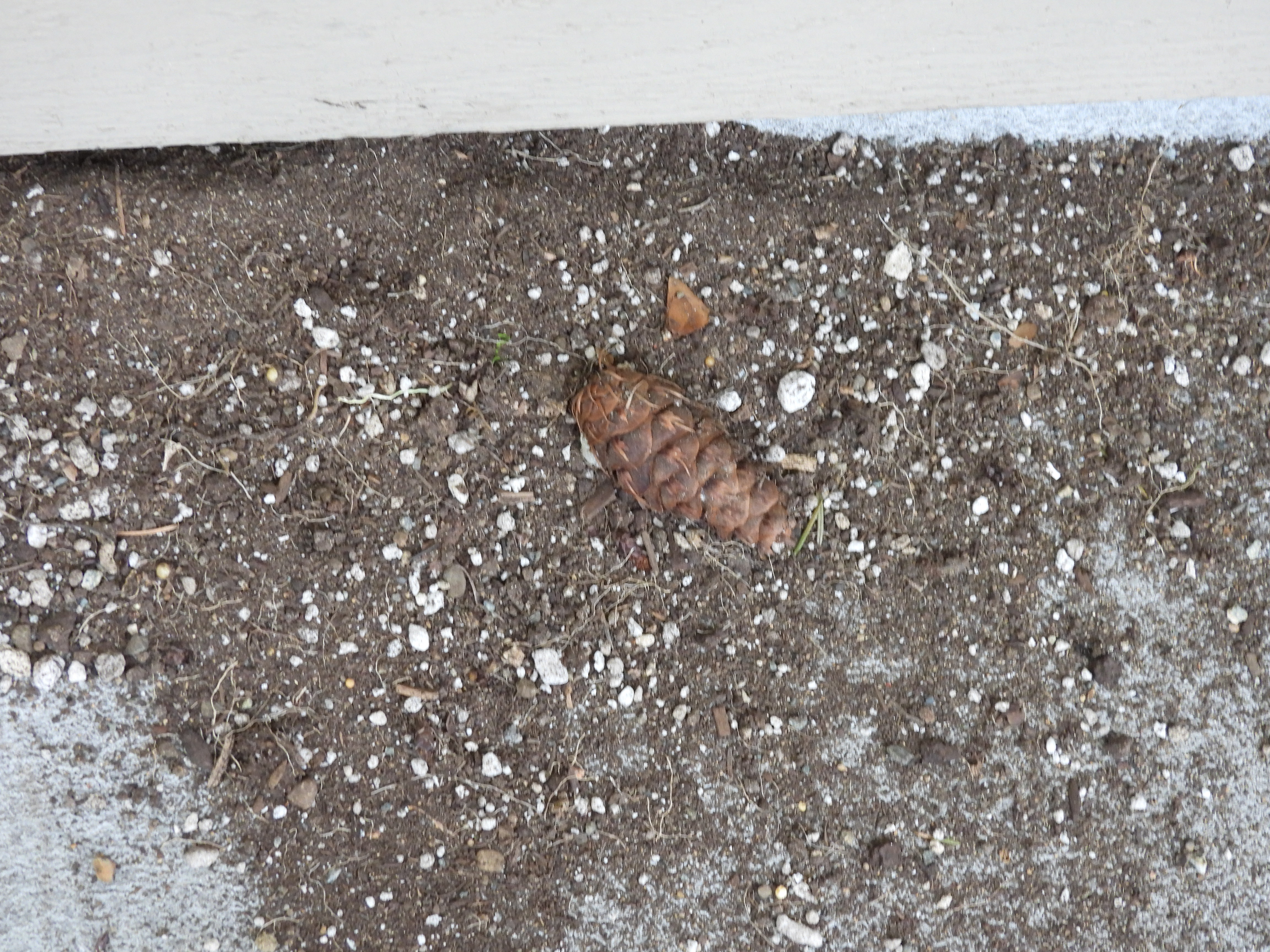
I found a clue. A fir cone left behind. But maybe it had just been blown there by the wind. We have had some very windy days….
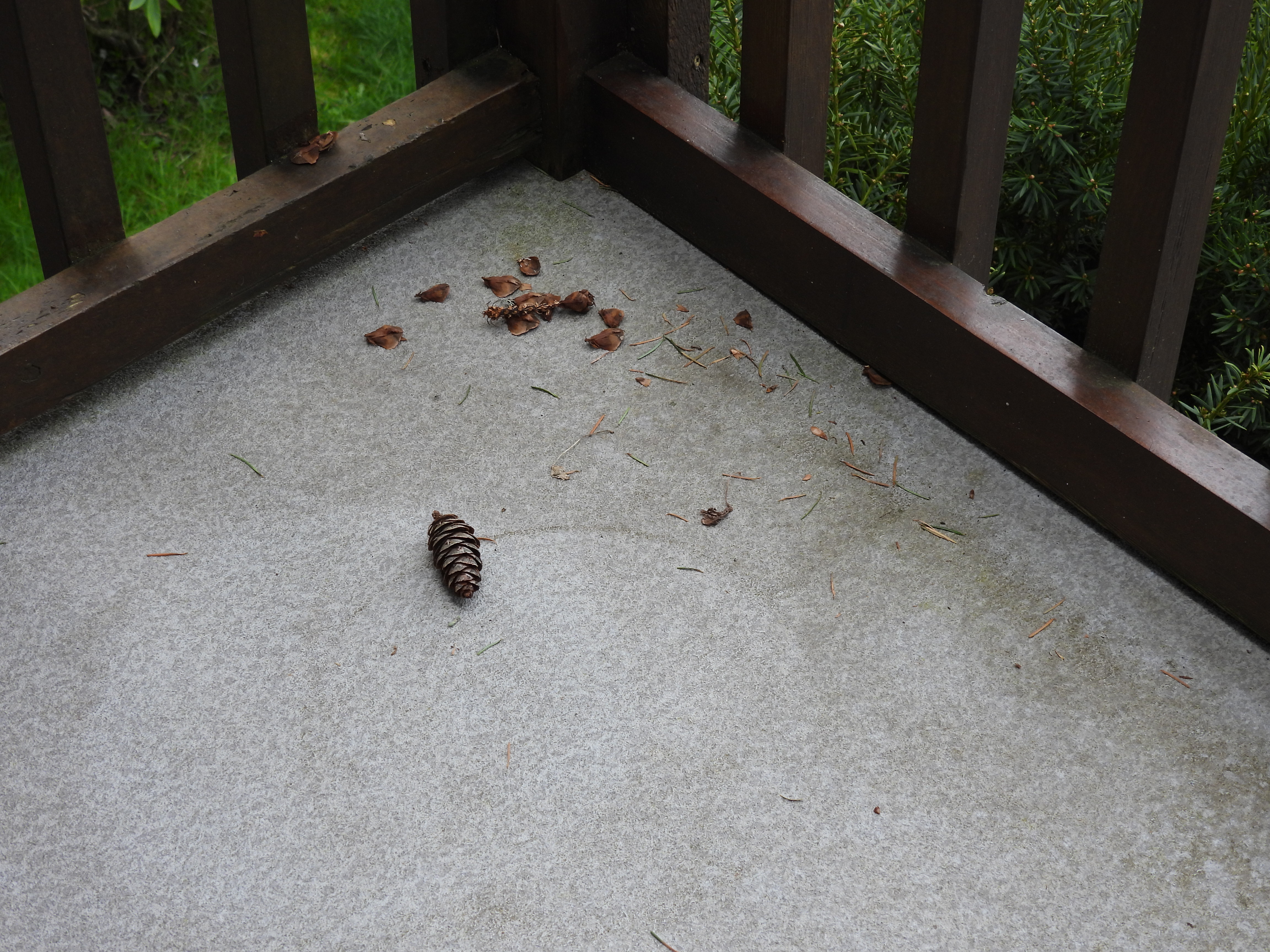
But in the corner at the front of the deck, I found more clues. Again, it could have been blown there by the wind….
But a closer look told me that the vandal had taken time out to have a snack and even had plans to eat a second cone before something scared him away.
The northern red-shafted flicker is fairly common on Vancouver Island and I’m glad he is. He eats a lot of ants and beetles and even wasps. That suits me just fine.
Here is Mr. Flicker (notice his red cheek slash) trying to get the attention of Ms. Flicker to ask her for a date.
Turn on your sound to hear him drumming on my chimney and then calling to her. His grammar isn’t great but I don’t think it bothers him (or her).
With a rat-a-tat-tat,
I say, where are you at?
Ms. Flicker (no red cheek slash) misses his call but comes by to announce that she’s a bit late, but she’s here.















 wordsfromanneli