wordsfromanneli

Thoughts, ideas, photos, and stories.


92 Comments

Balance of Nature

Jacqui Murray has done it again. With “Balance of Nature,” the third book in her latest trilogy, “Savage Land,” she will thrill her readers. They will come away satisfied with the ending, yet hoping she is already working on her next trilogy because we can never get enough of these exciting, well-researched novels.


In the trilogy called Savage Land, Jacqui Murray takes us through the  travels and challenges facing two groups of Early Man, the Neanderthals and the homo sapiens who were called The Tall Ones. All of them were simply trying to survive.

It was a time when major changes were still taking place on the earth. Earthquakes, volcanic eruptions that darkened the sky for years, tsunamis crossing the ocean in crushing waves, and widespread wildfires all threatened to annihilate the tribes. Their shelters became unsafe, and sources of food and water were destroyed, so the tribes fled in search of land that could support them. 

*****


In Balance of Nature, Book Three of the trilogy, Yu’ung’s Neanderthal tribe hopes to settle at Gibraltar, and nearby  hospitable lands.  However, the interactions between her group, Fierce’s Tall Ones, and a third nefarious group are a source of tension as they try to sort out who can be trusted.

Yu’ung’s mother, Aynoh, the healer of the Neanderthal group (The People), has gone over to the homo sapiens group (The Tall Ones), to pairmate with their leader, Fierce, just like love and marriage in our modern world.

Yu’ung is also a skilled healer, but she stays with The People (the Neanderthals) when the time comes for the tribes to move on, driven by violent volcanic activity that is rapidly altering their usual territories. Many groups, human and other life forms, had to flee the catastrophic turmoil of the earth’s upheaval.

Fierce’s group, along with Aynoh, having taken an inland detour on a salt-finding mission, meet up with Yu’ung’s group on the Mediterranean coast. Yu’ung had been on a side-trip to try to bring a revered elder of their group to a nearby tribe since it was unlikely that he could make the long journey to the Mediterranean (The Shoreless Sea) with his tribe.

Fierce’s group, originally from Africa, had left their boat hidden along the coast, but a rival group wrecked it while trying to steal it. Now the challenge was to build a new boat without the saboteurs’ interference.

Deception and lies from this devious rival group make it almost impossible to tell which of them were innocent of the former sabotage and which of them were sworn enemies.

Sorting the good from the bad results in many tense situations.

Finding refuge in caves is often a good thing, but in unfamiliar territory, new challenges appear in these caves. Lack of light, narrowing tunnels, and sudden crevasses present life-threatening situations. No problem if you can call on members of other groups for help, but if you don’t know whom to trust, this can be a matter of life or death. Do you take the hand that reaches out to you? Can you trust them? Are they friend or foe?

The tension mounts as the new boat gets built, supposedly away from prying eyes, but as the completion date nears, the danger increases.

This book immerses us in many aspects of the lives of Early Man, and we learn so much of our history without even realizing it. What a wonderful way to get an education, while reading a book that makes the experience like watching an exciting movie.

Jacqui Murray winds up her latest trilogy of The Savage Land with chapters full of tension that will have you biting your nails in anticipation of the next dilemma and its resolution.

Don’t miss this exciting conclusion to The Savage Land trilogy.

*****

For the best click you’ll ever make,

you can find Balance of Nature and all of Ms. Murray’s books by clicking the link:

HERE.


Author bio

Jacqui Murray is the author of the popular prehistoric fiction saga, Man vs. Nature which explores seminal events in man’s evolution one trilogy at a time. She is also author of the Rowe-Delamagente thrillers and Building a Midshipman , the story of her daughter’s journey from high school to United States Naval Academy. Her non-fiction includes 100+ books on integrating tech into education, and a freelance journalist on tech ed topics.




107 Comments

Come with me to the Badlands

Let me tell you a little bit about Jacqui Murray and her latest book.

Jacqui Murray is an amazing woman. She is constantly researching the history and facts about how man lived on this earth from hundreds of thousands of years ago to several thousands of years ago. She has read dozens and dozens of books and articles about the evolution of the earth and how man survived in the harsh environment of nature as it was back then.

She has drawn on this research to write many novels, but if you think research has made her books dry or boring, think again. They are page turners!

Jacqui Murray has done all the work. The only thing we need to do is read and enjoy the wonderful novels she writes about the people of those times. She gives the characters personalities that we can identify with. Some are wise, some foolish, some good and caring, others vain or selfish, hardworking or lazy, skilled or unskilled.  Not much different from people today. Humans had emotions and basic needs throughout history. The emotions haven’t changed. But how they reacted to those emotions and needs was sometimes very different from what we would do today.

Most of us love nature. But imagine having nothing but nature around you, and having to survive without most of the conveniences  of food, shelter, and security that we take for granted nowadays. How hard would life be if the world was still in upheaval from extreme weather conditions, earthquakes,  and volcanic eruptions, as landmasses were still forming and changing?

You can’t go to the store to buy a coat if you’re cold; there are no stores. You have little protection against wild animals, and no modern medicine for illnesses. You need to learn which animals are dangerous to your health and which plants will kill you if you eat them. There is no book to consult about these mysteries. You are basically on your own. Most of us would not survive.

The survival instinct is one of the main reasons that early man learned to work together with others of their kind, and formed groups or tribes. They knew that there is strength in numbers.

In Jacqui Murray’s books, you will love getting to know the people and you will feel their joy and their pain. Best of all, you will find yourself in a world you’ve probably never imagined. It’s as if you went back in time … WAY back in time.

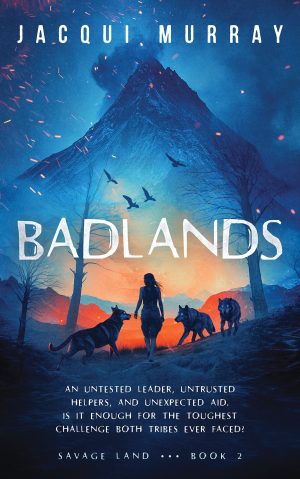
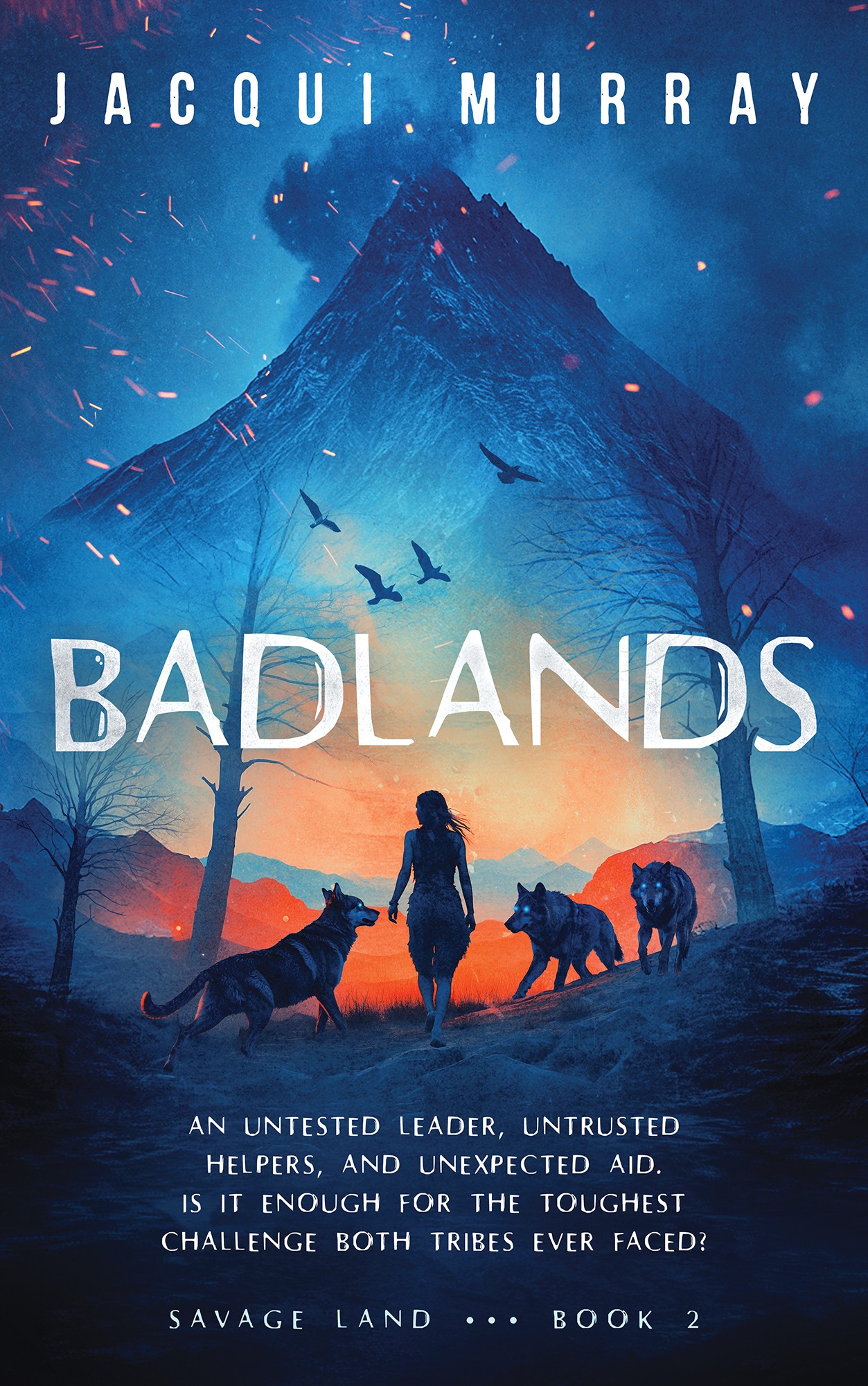
Don’t miss Jacqui’s latest exciting page turner, “Badlands,” the second book of the trilogy, “Savage Land.” If you haven’t read Book One in the series, please check out “Endangered Species.” You can find both books if you click on the link below the cover image of “Badlands.”

*****

Author bio:

Jacqui Murray is the author of the popular prehistoric fiction saga, Man vs. Nature which explores seminal events in man’s evolution one trilogy at a time. She is also author of the Rowe-Delamagente thrillers and Building a Midshipman , the story of her daughter’s journey from high school to United States Naval Academy. Her non-fiction includes 100+ books on tech into education, reviews as an Amazon Vine Voice and a freelance journalist on tech ed topics.
 

Social Media contacts: 

Amazon Author Page:         https://www.amazon.com/Jacqui-Murray/e/B002E78CQQ/

Blog:                                        https://worddreams.wordpress.com

Pinterest:                                http://pinterest.com/askatechteacher

X:                                             http://twitter.com/worddreams

Website:                                 https://jacquimurray.net


Book information:

Print, digital, audio available: http://a-fwd.com/asin=B0DFCV5YFT

 Genre: Prehistoric fiction

Editor: Anneli Purchase 

*****

Here is a sample – just a small part of Chapter One.

Chapter 1  

75,000 years ago

Modern day Altai Mountains, Siberia 

Yu’ung’s legs churned, arms pumped, throat straining to draw in air. Her red hair hung in damp sweaty ropes on her neck and shoulders. After narrowly escaping the cave-in and then Hyaena’s attack, time had run out. B’o was supposed to leave with or without her when Sun reached a particular spot overhead. That point had passed and now, the maelstrom was upon them. She must get to her tribe.

Running never tired her, no matter how long or far. Today was different. Driven by desperation and worry for those who relied on her, she ran too hard and slammed up against her limit.

She stumbled to a stop and bent forward, chest heaving, sucking in one mouthful of air after another. The blue-eyed Canis–the massive Ump with his dark coat, the smaller White Streak with the light colored stripe cutting her black fur from one side of her forehead to the other, and the older Ragged Ear–circled back to her, huffing and prancing. Somehow, they knew time was short. Shanadar, who seemed to be their pack leader, wasn’t even winded. He waited, patient but anxious.

She muttered, “The smoke–it’s much worse.”

Yu’ung had departed her homebase before Sun woke. She had gone there to tell the Tall One Fierce that the People would join him. The air tasted of ash then, but lightly. By the time she reached where Fierce and his Tall One band should have been, the small flakes had grown chokingly large. The Tall Ones–wisely–were gone, but her mother, Kriina, now Fierce’s pairmate, left a message in the tunnel telling Yu’ung their destination and of a possible new homebase for the People.

It was there Yu’ung would lead the People.

“I’m ready, Shanadar,” and she took off again.

She expected the Angry Mountain’s destruction to clear closer to her homebase, but instead, cinders and smoke thickened and the air dimmed to a dingy gray. Uprooted trees blocked the usual passages forcing her to divert onto new, untried trails. Pockets of flames burned without pause on all sides. The grassland and forests that fed the People were almost wiped out.

*****


51 Comments

Did Neanderthals Have Language?

It is my honour and great pleasure to introduce you to Jacqui Murray and her novel, Endangered Species, the first in her latest trilogy in the series called Man vs. Nature. Summaries of the novels in this trilogy may be found near the end of this post.

Who is Jacqui Murray?

Jacqui Murray is the author of the popular prehistoric fiction saga, Man vs. Nature which explores seminal events in man’s evolution one trilogy at a time. She is also author of the Rowe-Delamagente thrillers and Building a Midshipman , the story of her daughter’s journey from high school to United States Naval Academy. Her non-fiction accomplishments include 100+ books on tech into education, as well as reviews as an Amazon Vine Voice , and articles as a freelance journalist on tech ed topics.
*****

While reading about the Neanderthal tribes in this trilogy, it is natural to wonder about some things regarding how these primitive people lived. Here is a question many readers have about the people of those long ago times. Jacqui Murray explains the answers based on her extensive research of the topic.

Did Neanderthals Have a Language?

Language, like so much about Neanderthal culture and lifestyle, didn’t preserve over the four-hundred thousand years of their existence. The best we can do is extrapolate what might be based on what we do find.

Three questions dominate the discussion of whether Neanderthals had a language:

  • Could they speak?
  • Did they speak?
  • Could they write a language?

Could they speak?

Yes. They had the physical ability to speak.

First: The Neanderthal hyoid was indistinguishable from ours so there is no reason to think it wasn’t used exactly in the same way as ours. Their voice box was higher in the throat than ours, which could mean their voices were higher pitched, but it would have no impact on their ability to speak.

Second: Their chests were large. They could control their breath in the same way we do, which is a requirement of speaking.

Third: Their ears were attuned to human speech, as are ours, which meant vocal sounds were important. I won’t try to explain the physiological details of that, but it is documented scientifically by paleoanthropologists. You can dig into that topic if you like–it’s pretty interesting.

Because of all this, there is every reason to believe Neanderthals could speak.

Did they speak?

So, physiologically, they could speak, but did they? Two details to consider with this question:

First: The types of tasks Neanderthals accomplished were complex–turning bark or pitch into glue, hardening spear tips in fire and not burning them, hunting in a group. These were accomplished best by talking to each other and planning. Rebecca Wragg Sykes, author of the acclaimed Kindred: Neanderthal, Life, Love, Death, and Art goes so far as to assume these sophisticated tasks couldn’t be accomplished without talking:

“Some kind of vocal communication was a really important everyday part of Neanderthal life.” 

Second: Speaking is noisy. Neanderthals were more likely to want to melt into their environs rather than stand out. Speaking might have been less common outside their homebases and more common inside.

Could they write a language?

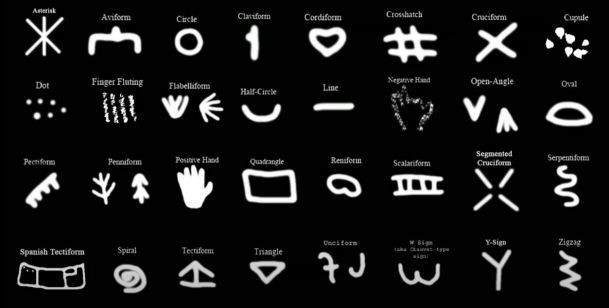
I’ll stipulate that writing as we know it was well beyond their cerebral toolkit, but they were playing with its elements. Shapes and geometric figures that have no basis in nature are found throughout Neanderthal habitats. To take this a step further, the same 32 geometric designs–lines, rectangles, ovals, dots, triangles, circles–occur in caves and on rock walls throughout Europe over tens of thousands of years, many at a time when only Neanderthals inhabited the caves.

Called art by some experts, but “graphic symbols with meaning” by others, these predate common cave art that includes animals and spears and human activities. These symbols (handprint aside) appear nowhere except in the mind of the creators. Whether they were for writing or art or something else, we don’t know, but they are curious. In my trilogy, Savage Land, I propose that they were used by Neanderthal tribes to share information with other tribes about the area. Because Neanderthals were nomadic by nature and shared their caves with whoever was passing through, this could make sense.

*****

Savage Land is the third prehistoric man trilogy in the series, Man vs. Nature. Written in the spirit of Jean Auel, Savage Land explores how two bands of humans survived one of the worst natural disasters in Earth’s history, when volcanic eruptions darkened the sky, massive tsunamis crossed the ocean in crushing waves, and raging fires burned the land. Each tribe starring in the story considered themselves apex predators. Neither was. That crown belonged to Nature and she was intent on washing the blight of man from her face.


In Endangered Species, Book One of the trilogy, Yu’ung’s Neanderthal tribe must join with Fierce’s Tall Ones—a Homo sapiens tribe–on a cross-continent journey that starts in the Siberian Mountains. The goal: a new homeland far from the devastation caused by the worst volcanic eruption ever experienced by Man. How they collaborate despite their instinctive distrust could end the journey before it starts or forge new relationships that will serve both well in the future.


In Badlands, Book Two, the tribes must split up, each independently crossing what nature has turned into a wasteland. They struggle against starvation, thirst, and desperate enemies more feral than human. If they quit — or worse, lose — they will never reunite with their groups or escape the most deadly natural disaster ever faced by our kind.

 Join me in this three-book fictional exploration of Neanderthals. Be ready for a world nothing like what you thought it would be, filled with clever minds, brilliant acts, and innovative solutions to potentially life-ending problems, all based on real events. At the end of this trilogy, you’ll be proud to call Neanderthals family.

Endangered Species – Book 1 of the Savage Land trilogy

Endangered Species trailer: https://youtube/AxBlmays3vE?si=1SMtqDJiLYCRZvB6

Badlands – Coming soon – Book 2 of the Savage Land trilogy

Book information:

Endangered Species—Print, digital, audio available: http://a-fwd.com/asin=B0DJ9Y7PQ8

Badlands—digital on presale now: http://a-fwd.com/asin=B0DFCV5YFT

 Genre: Prehistoric fiction

Editor: Anneli Purchase


17 Comments

Against All Odds

Three Great Books

We all love to read a book that is so good we can’t put it down. Imagine finding three of them! You’ll get that in the Crossroads Series written by Jacqui Murray. Her books caught me by surprise. I read “Survival of the Fittest” not realizing at the time that it was the first of three in The Crossroads Series.

Well, I LOVED the book.

It was a story that could have been true, but of course it was fiction. The setting is  Africa, 850,000 years ago. Yes, you read that right. It was a long, long time ago when mankind was in the early stages of development. People, like animals, had to live by their wits and be very strong, smart, and lucky, or die.  Only the fittest survived the ordeals these people went through in their everyday life: hunting and gathering food, traveling in rough terrain, being attacked by “Others,” and surviving natural disasters.

Though the life rules were different, human nature, even then, was something we can relate to today. The emotions that ran through these people of long ago were much the same as what we feel now.

Xhosa, a strong female character leads her group on a long migration in search of a place where they can be safe and have enough food and shelter to survive. Some other smaller tribes join up with hers for safety, and each brings a new dynamic to the group. Ms. Murray is skilled at making you care about her characters, and before you know it, you will be hooked.

Without saying too much more about the plot, I just want to tell you that I was sorry the book ended, but overjoyed to find that there was a Book Two, called “The Quest for Home.”

I devoured that book as well and still wanted more!

Now, at last, Ms. Murray has Book Three ready for publication. I was lucky enough to have a sneak preview and I can tell you you’re in for a treat if you read these books. “Against All Odds” completes the three-book series.

In this final book, Xhosa’s extraordinary prehistoric saga concludes, filled with hardship, courage, survival, and family.


Jacqui Murray is the author of the popular Building a Midshipman, the story of her daughter’s journey from high school to United States Naval Academy, the Rowe-Delamagente thrillers, and the Man vs. Nature saga. She is also adjunct professor of technology in education, blog webmaster, an Amazon Vine Voice,  a columnist for  NEA Today, and a freelance journalist on tech ed topics. Look for her next prehistoric fiction, Laws of Nature, Book 2 in the Dawn of Humanity trilogy, Winter 2021.

 Available digitally (print soon) at: Kindle US   Kindle UK   Kindle CA   Kindle AU


You can find out more about Jacqui Murray by clicking the links below:

Amazon Author Page:        https://www.amazon.com/Jacqui-Murray/e/B002E78CQQ/

Blog:                                       https://worddreams.wordpress.com

Instagram:                             https://www.instagram.com/jacquimurraywriter/

LinkedIn:                                http://linkedin.com/in/jacquimurray

Pinterest:                                http://pinterest.com/askatechteacher

Twitter:                                   http://twitter.com/worddreams

Website:                                 https://jacquimurray.net

For your entertainment, here is the book trailer for Book Three, “Against All Odds.”