Dogwood in spring.
Dogwood in autumn.

Dogwood in spring.
Dogwood in autumn.
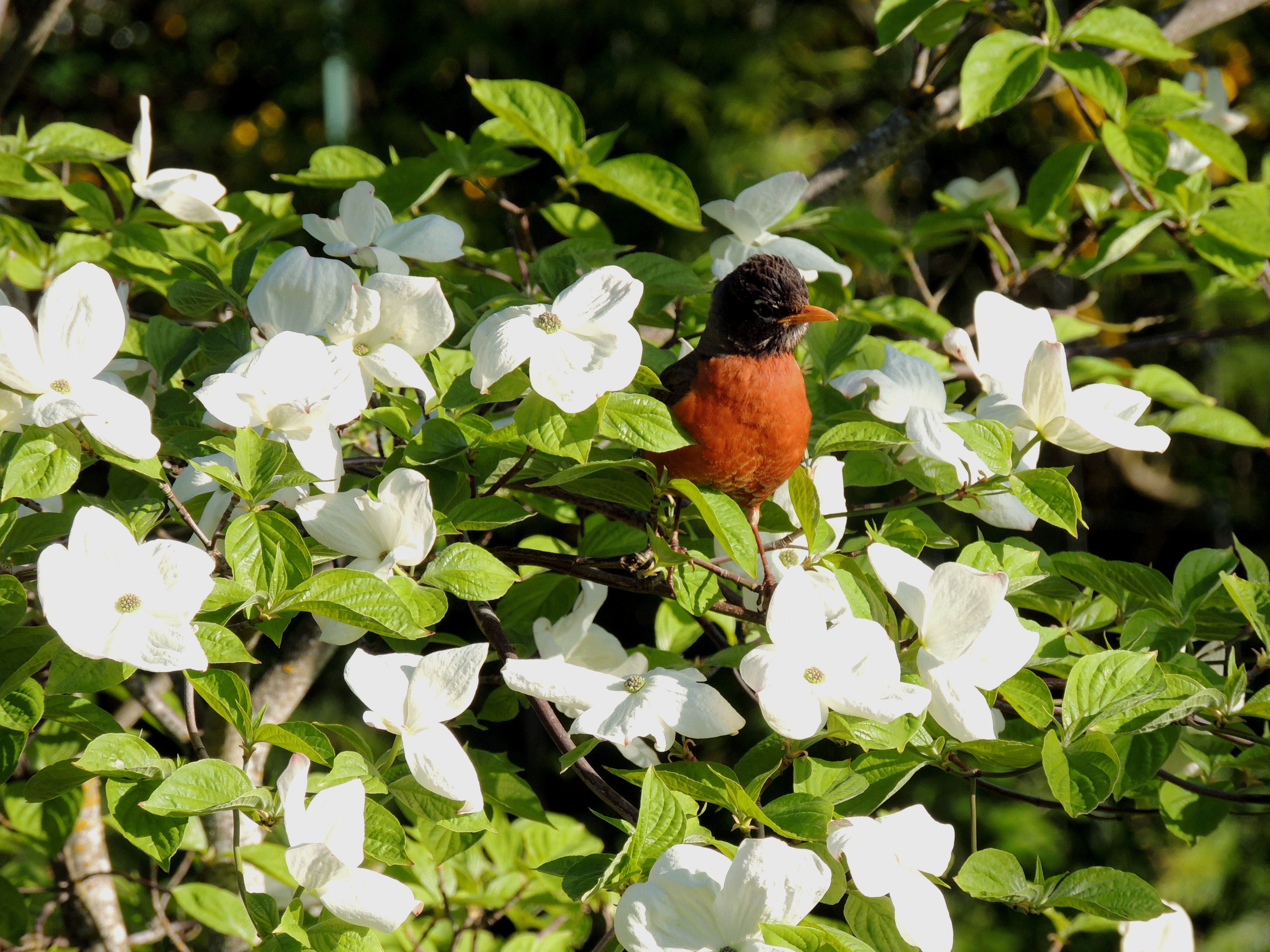
It’s time for the dogwoods to bloom. There are many bigger dogwood trees around, but ours is still quite small.

The robin is enjoying the spring morning sunshine while he wonders about the petal count of these flowers.

Most flowers have a number of petals that fall into the Fibonacci sequence, a mathematical sequence in which each number is the sum of the two preceding ones. So it goes like this: 0, 1, 1, 2, 3, 5, 8, 13, 21, 34, 55, 89, 144 … and it goes on forever.
Our Pacific dogwood usually has between four and six petals, so it’s different from most flowers which tend to follow the Fibonacci sequence.
Next time you’re in a flower garden, see which flowers you can find that have either 3, 5, 8, 13, or 21 petals. You’ll be surprised at what you find.
*Fibonacci sequence was used and further explored by an Italian mathematician, Leonardo Bonacci, who was called Fibonacci, possibly as a name made up from “filius Bonacci” (son of Bonacci). He was born about 1170. Yes, about 850+ years ago.
I bet he loved doing puzzles or writing code.
So what’s the next number after 144? The first nine commenters got it easily, so how about the next three numbers?
 wordsfromanneli