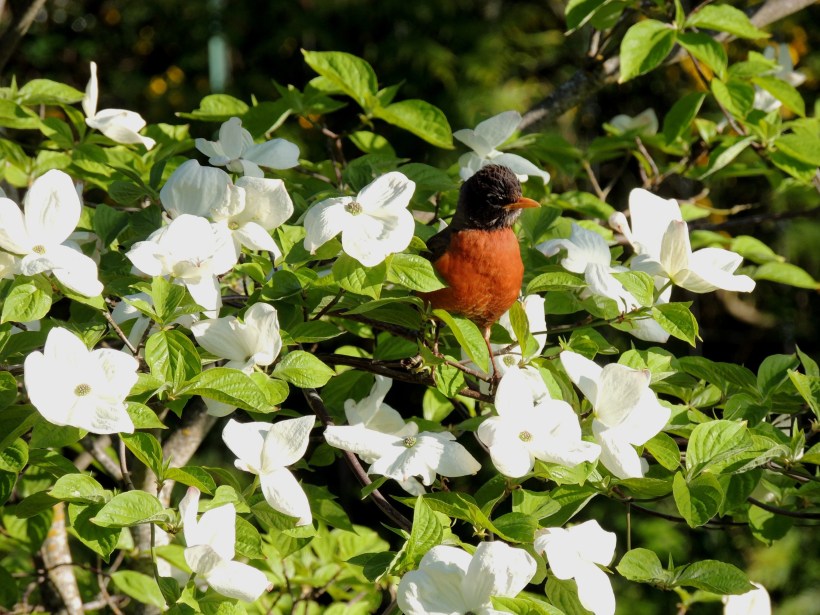
It’s time for the dogwoods to bloom. There are many bigger dogwood trees around, but ours is still quite small.

The robin is enjoying the spring morning sunshine while he wonders about the petal count of these flowers.
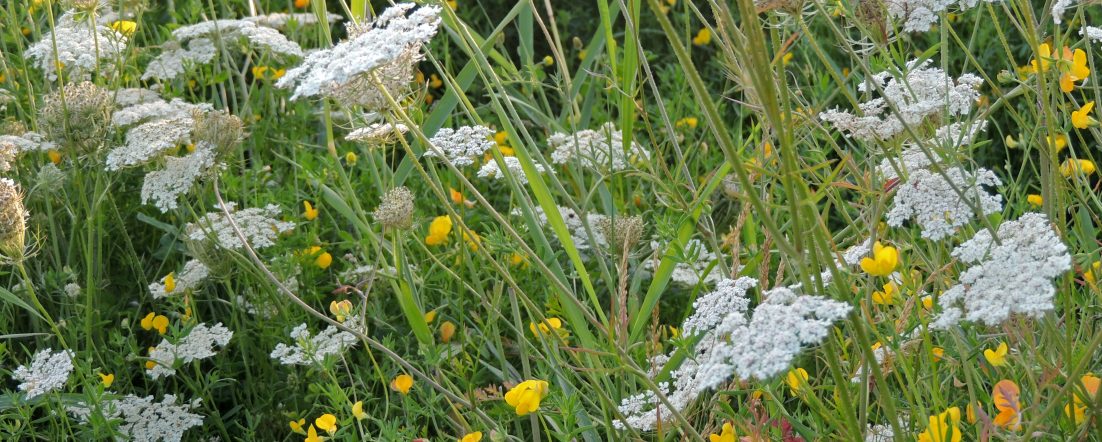
Most flowers have a number of petals that fall into the Fibonacci sequence, a mathematical sequence in which each number is the sum of the two preceding ones. So it goes like this: 0, 1, 1, 2, 3, 5, 8, 13, 21, 34, 55, 89, 144 … and it goes on forever.
Our Pacific dogwood usually has between four and six petals, so it’s different from most flowers which tend to follow the Fibonacci sequence.
Next time you’re in a flower garden, see which flowers you can find that have either 3, 5, 8, 13, or 21 petals. You’ll be surprised at what you find.
*Fibonacci sequence was used and further explored by an Italian mathematician, Leonardo Bonacci, who was called Fibonacci, possibly as a name made up from “filius Bonacci” (son of Bonacci). He was born about 1170. Yes, about 850+ years ago.
I bet he loved doing puzzles or writing code.
So what’s the next number after 144? The first nine commenters got it easily, so how about the next three numbers?

 wordsfromanneli
May 9, 2024 at 11:49 pm
I would say 233. Beautiful photos, Anneli! The dogwood is so pretty.
LikeLike
May 10, 2024 at 9:45 am
Thanks, Lynette. It’s a beautiful time of year. And yes, 233 and on and on and on.
LikeLiked by 1 person
May 9, 2024 at 11:54 pm
233 I guess. Interesting post!
LikeLiked by 1 person
May 10, 2024 at 9:45 am
Right, and it goes on and on and on forever.
LikeLike
May 10, 2024 at 4:40 am
The Fibonacci sequence is everywhere in nature. The first flower that came to mind was the sunflower, but everything from cacti to pine cones can exhibit it. It took me a while to get my mind around the math when I was introduced to it, but now I often can recognize it. Too cool!
LikeLiked by 1 person
May 10, 2024 at 9:44 am
You’re right, Linda. The spirals! And the ratios between the numbers becoming closer to the magic number as they get higher. Dividing one number by the one that comes after it gives you about .6178 (and change) and ever closer to that as you go higher. Math is amazing, especially when it manifests itself in nature.
LikeLiked by 1 person
May 10, 2024 at 10:00 am
That reminds me of my favorite math joke.
Q: “Do you know about pi r squared?”
A: “That’s silly. Pie aren’t square. Pie are round. Cake are square.”
LikeLiked by 1 person
May 10, 2024 at 10:03 am
Love it!
LikeLiked by 1 person
May 10, 2024 at 4:52 am
It’s early in the day for math, but I think I got it: 233 🙂 That’s fascinating, Anneli. And I think you’re right, I bet Bonacci loved puzzles and codes! (Our dogwood hasn’t bloomed yet – soon, though.)
LikeLiked by 1 person
May 10, 2024 at 9:31 am
Right. I love it when I find a connection between math and nature.
LikeLiked by 1 person
May 13, 2024 at 1:48 pm
So cool!
LikeLiked by 1 person
May 10, 2024 at 5:02 am
How fascinating!
LikeLiked by 1 person
May 10, 2024 at 9:30 am
Thanks, Joy. Nature is always surprising us.
LikeLiked by 1 person
May 10, 2024 at 5:08 am
Don’t you love what seems like chaos turned into beauty? Thanks for the pics, Annaeli. Fantastic!
LikeLike
May 10, 2024 at 9:29 am
I do. Nature and math are not so far apart.
LikeLiked by 1 person
May 10, 2024 at 5:14 am
The Fibonacci sequence is pretty old, but still relevant and still being used in computer algorithms today. I love the dogwood flowers Anneli and was happy to see them in flower when we were in Vancouver in April. The only member of the dogwood we get here is the bunchberry. It is pretty but very small. Happy Friday. Allan
LikeLiked by 1 person
May 10, 2024 at 9:29 am
It’s amazing how it works and, as you say, is still used today.
LikeLiked by 1 person
May 10, 2024 at 5:19 am
What a pretty little tree, I’ll go along with 233 🤔
LikeLiked by 1 person
May 10, 2024 at 9:27 am
Yes, and I’ve upped the ante in the post if you get bored.
LikeLiked by 1 person
May 10, 2024 at 9:18 am
My math is not good so I’ll pass, I’ve never heard of this sequence. 😊
LikeLiked by 1 person
May 10, 2024 at 9:26 am
It’s a fun idea though, don’t you think?
LikeLiked by 1 person
May 10, 2024 at 9:35 am
Yes, nature has lots of visible patterns!
LikeLiked by 1 person
May 10, 2024 at 12:33 pm
I’m not up to the Fibonacci sequence right now, but I do love dogwoods. I’ll come back to this later.
LikeLiked by 1 person
May 10, 2024 at 5:06 pm
Don’t worry about it, Jacqui. We all get busy with life things and this is just a fun thing for those who can spare the time.
LikeLiked by 1 person
May 10, 2024 at 2:52 pm
This is so weird. I’d never heard of Fibonacci numbers until a few days ago. I saw someone on Twitter post about them. Now you’ve posted about them. Twice in one week after never hearing about it before. BTW, great photo of the robin between the dogwood flowers.
LikeLiked by 1 person
May 10, 2024 at 5:11 pm
Life can be funny that way. I guess you were meant to find out about it.
LikeLiked by 1 person
May 10, 2024 at 6:50 pm
Fun facts Anneli. I’ve never heard of flowers following the fibonacci cycle!
LikeLiked by 1 person
May 10, 2024 at 10:05 pm
Somehow they just happen to fit in with it. I don’t know why.
LikeLiked by 1 person
May 11, 2024 at 1:54 pm
The dogwoods are beautiful, Anneli, and I haven’t heard of the Fibonacci sequence either. But interesting to know. Gorgeous photos!
LikeLiked by 1 person
May 11, 2024 at 8:41 pm
You are not alone in that, Lauren, but it’s a fun thing to learn about, even if we don’t plan to use it for a mid-life doctorate thesis.
LikeLiked by 1 person
May 12, 2024 at 7:08 am
It’s a great time to celebrate when the dogwoods are blooming. Great photos of your beautiful dogwood, Anneli.
LikeLiked by 1 person
May 12, 2024 at 9:02 am
Thanks, Jet.
LikeLiked by 1 person
May 12, 2024 at 7:59 am
As a former math teacher, I was well aware of the beauty of the Fibonacci sequence that can be found in so many places in nature. What I did not know was the possible origin of the word Fibonacci. Great nature shots as always, Anneli!
LikeLiked by 1 person
May 12, 2024 at 9:03 am
Thanks so much, Peter.
LikeLike
May 13, 2024 at 10:58 am
You want me to do math? LOL. That’s so funny! I love dogwoods; they’re ary and pretty. I don’t have one on the property, but it would make a nice addition. Thanks for the idea!
LikeLiked by 1 person
May 13, 2024 at 11:00 am
I just mentioned getting some dogwoods to my husband, and he said we have plenty of trees. It was funny because it’s true. We can barely see the sky through all the trees. 😀
LikeLiked by 1 person
May 13, 2024 at 3:54 pm
You’re probably like us – having to go to the beach to see the Snowbirds flying over. The trees cover so much of the sky here.
LikeLiked by 1 person
May 13, 2024 at 4:08 pm
Yup, the same. I wouldn’t mind a little more light and a little less moss. 🙂
LikeLiked by 1 person
May 13, 2024 at 5:51 pm
And looking after the roof of the house is an ongoing thing every year.
LikeLiked by 1 person
May 13, 2024 at 7:06 pm
Lol. Yes.
LikeLiked by 1 person
May 13, 2024 at 1:31 pm
Such a cool post. Your dogwood tree is lovely and the Fibonacci sequence was new for me. ❤
LikeLiked by 1 person
May 13, 2024 at 3:51 pm
Thanks, Carol.
LikeLiked by 1 person
May 18, 2024 at 2:02 pm
Beautiful, Anneli!
LikeLiked by 1 person
May 19, 2024 at 1:30 pm
Until I moved to Ohio, I really never had the opportunity to experience the beauty of the dogwood. My native state of Montana is better suited for lilacs.
LikeLiked by 1 person
May 19, 2024 at 2:32 pm
Those are very nice too.
LikeLiked by 1 person
Pingback: A Tale of Two Dogwoods | wordsfromanneli