Spring and Fall – by Gerard Manley Hopkins (1844 -1889)
to a young child
This poem is very famous and is taught in all the English classes in high school. Unfortunately, when we were in high school, we were too ignorant to really appreciate it.
Okay, not all of us were ignorant in high school, but I think it’s safe to say that many of us found this old poetry hard to understand with its twisted and jumbled sentence structure.
Here’s an example from Hopkins’ poem:
Leaves like the things of man, you
With your fresh thoughts care for, can you?
Why couldn’t the poets of that time, especially the English, just “speak English”? In those high school days, I remember thinking, what’s the good of a poem if I need someone to translate it to me (from English to English)? I still feel that way a little bit, but now, decades later, I can appreciate the language of poetry better.
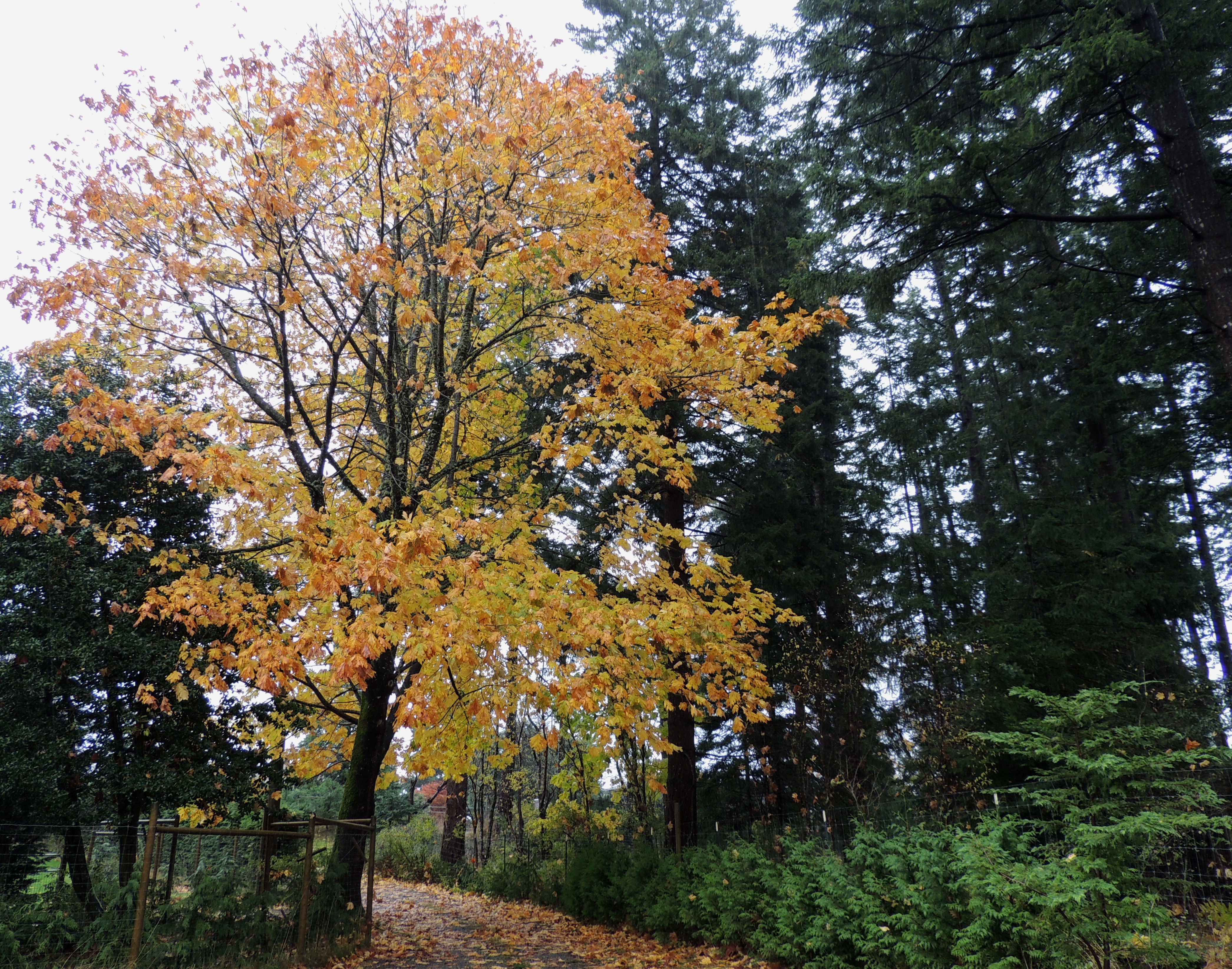
BUT, having suffered through trying to understand this poem as a young adult, I now think of it every year at this time. As soon as our maple tree starts to lose its leaves, I find myself thinking (and my name is not Margaret),
“Margaret, are you grieving,
Over Goldengrove unleaving?”
And I always end up thinking, how incredibly sad it is to see those first leaves fluttering down, and I realize,
“It is Margaret that you mourn for.”
Here is Hopkins’ poem:
Spring and Fall
To a Young Child
Margaret, are you grieving
Over Goldengrove unleaving?
Leaves like the things of man, you
With your fresh thoughts care for, can you?
Ah! as the heart grows older
It will come to such sights colder
By and by, nor spare a sigh
Though worlds of wanwood leafmeal lie;
And yet you will weep and know why.
Now no matter, child, the name:
Sorrow’s springs are the same.
Nor mouth had, no nor mind, expressed
What heart heard of, ghost guessed:
It is the blight man was born for,
It is Margaret you mourn for.
*****
I have learned to appreciate good poetry, but I tend to like the kind that is more fun and less serious. Limericks, funny ditties, rhyming fun.
Still, I have my favourite serious poems too, which I hope to share with you sometime soon.
How do you feel about poetry?

 wordsfromanneli
September 28, 2025 at 11:02 am
The sentences are certainly a bit twisted, difficult to unravel. As a writer, this must twist you, Anneli! 😂
LikeLiked by 2 people
September 28, 2025 at 12:10 pm
I admit I like the message to be easier to understand.
LikeLiked by 1 person
September 28, 2025 at 12:40 pm
Me too… 👍🏻
LikeLiked by 1 person
September 28, 2025 at 11:02 am
I love poetry, but some modern free verse doesn’t do it for me. If it’s nothing more than sentences broken up and rearranged on a page, it’s not necessarily poety (although some works very well). Hopkins’s poem is one of my favorites: one that I read and re-read so often I nearly have it memorized, and have used it in my blog at least two or three times.
LikeLiked by 1 person
September 28, 2025 at 11:24 am
I think much the same way. The old poetry has to grow on me before I can actually “love” it, but some of it becomes ingrained and part of our lives.
LikeLiked by 1 person
September 29, 2025 at 5:31 am
Oh, how I agree. Poetry should have rhythm at the very least. I write poetry and while not all of it rhymes, it all has a structure and fairly strict metre.
I can therefore say from experience that it’s much more difficult to rhyme and keep the rhythm. Easier to write a bit of prose and randomly break it into (often short) lines.
LikeLiked by 2 people
September 29, 2025 at 9:24 am
Good choice of words, good meter, and a bit of rhyme – that’s what does it for me. Rambling words cut off into short lines, not so much.
LikeLike
September 28, 2025 at 11:05 am
When I was young I loved poetry. I bought many books with good poetry. Now in my old age I am not such a fan of it anymore and I wonder why.
LikeLiked by 1 person
September 28, 2025 at 12:11 pm
Do you have some favourites from those days when you liked it?
LikeLike
September 28, 2025 at 12:39 pm
I too remember that poem. I didn’t properly appreciate it in high school either.
LikeLiked by 1 person
September 28, 2025 at 12:44 pm
Funny thing about poetry. Some poems grow on you and some stay in obscurity, but I think it would be easier if the old poets had tried to make their meaning more clear. We would probably enjoy them more.
LikeLiked by 1 person
September 28, 2025 at 1:02 pm
I did a degree in English Literature (many, many moons ago now – I don’t want to even hint at how many) and remember that one of the criticisms of the Victorian era poets (Manley fits right in there) was their focus on stuffy, flowery and unnecessarily wordy formats that stuck to metre over imagery. It was the prevailing style of the time. There was a lot of innovation then too – poets who were much more experimental – but Manley wasn’t one of them. Still, he really explores the idea that if we’re repeatedly exposed to profound loss that we may become used to it. Quite a depressing poem but then again, the Victorian age wasn’t the sunniest, either.
LikeLiked by 2 people
September 28, 2025 at 3:41 pm
Yes it is a bit depressing, but that’s why it makes my point about the leaves coming off and how it marks the end of another cycle of life. Still, not something I want to dwell on too long. There are beautiful things about autumn too.
LikeLiked by 1 person
September 28, 2025 at 1:11 pm
Not my favorite language style for poetry either, but nice message.
LikeLiked by 1 person
September 28, 2025 at 3:30 pm
Same here, but those lines at the beginning and the end stayed with me.
LikeLiked by 1 person
September 29, 2025 at 3:11 am
Dear Anneli
We don’t think that this poem is special. The flow of words is fine, but the syntactic structure is too forced to make the words rhyme. It’s not our kind of lyrics.
The Fab Four of Cley
🙂 🙂 🙂 🙂
LikeLiked by 1 person
September 29, 2025 at 3:49 am
I’m so glad to hear you say that. I feel the same way, with the exception of the first and last parts.
LikeLiked by 1 person
September 29, 2025 at 5:32 am
This is a poem I’ve not come across before. A lovely evocation of both the seasons and life.
LikeLiked by 1 person
September 29, 2025 at 9:25 am
It was a standard in the list of poems for study of the early British poets. I didn’t care for it way back in school, but some parts stuck in my head and will be there forever.
LikeLike
September 29, 2025 at 11:43 am
I always felt reading poems was difficult because most are obscure. For me, a poem is a personal experience from the author, and usually an emotional experience. At least that’s how it is when I write one. Even if I’m writing about something I’ve experienced in nature, it’s how that nature makes me feel. Which I think is what was going on in that poem by Gerard Hopkins. 🤷♀️🙂
LikeLiked by 1 person
September 29, 2025 at 5:42 pm
There’s a fine line between using great words and structure, and getting the message across without making it an unsolvable mystery.
Thanks for your input, Lori. I agree.
LikeLiked by 1 person
September 30, 2025 at 6:34 pm
Quite understandably why most teens weren’t bothered with poetry like this, deep and beyond their conception, even some adults. Personally, I enjoy some newer poetry, my favorite being free style. 😘
LikeLiked by 1 person
September 30, 2025 at 6:51 pm
There’s something for everyone out there.
LikeLiked by 1 person
October 1, 2025 at 4:35 am
Yes indeed. 🙂
LikeLiked by 1 person
October 4, 2025 at 5:19 am
I was the teen who could never get into deep poetry.
LikeLiked by 1 person
October 4, 2025 at 5:25 am
You were definitely NOT alone!
LikeLiked by 1 person
October 4, 2025 at 5:17 pm
😀
LikeLike