When owls eat, they don’t have the best table manners. Unless the animal they are eating is too big, they swallow it whole.
Unlike many other birds, owls (and herons, grebes, cormorants, and several other types) don’t have a crop where they store food before it goes into their stomach. The eaten “food” goes straight into the glandular stomach where enzymes and acids begin the digestion. From there, the “food” passes into the muscular stomach which mushes up the softer parts of the victim, leaving behind only the undigestible parts like the bones, fur, and teeth (or feathers if it was a bird that they ate).
Then hours after the edible parts are liquefied and have passed through, the owl throws up the leftovers. The official way of saying that in “bird study talk” is that it casts a pellet.
Here is a pellet that an owl left behind on top of an upturned aluminum skiff in our back yard.
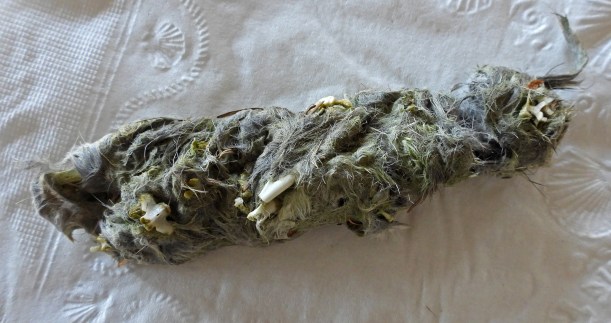
I got an old pair of tweezers and took the pellet apart to see if I could find the bones.
If you click on the photo, you may be able to get a better look.
To the right of the larger long bones, you can see five tiny claws and below those, I have laid out the very thin long bones that I think might be rib bones.
One piece of fur was not matted together, and I thought it looked like it might have belonged to a rat. Also, I think the long bones are too big for a mouse.
Below the piece of fur at the top of the bone collection, are some of the vertebrae.
Some parts are missing, and they might have passed through the owl, or possibly been part of a second casting. Just guessing here.

I made sure to wash my hands and sterilize the area where I put the bones and fur. If the owl’s meal was a rodent, it might have been carrying some bacteria or viruses.
Some people may find this post gruesome, but I thought it was a fascinating part of nature that we don’t often see.














 wordsfromanneli