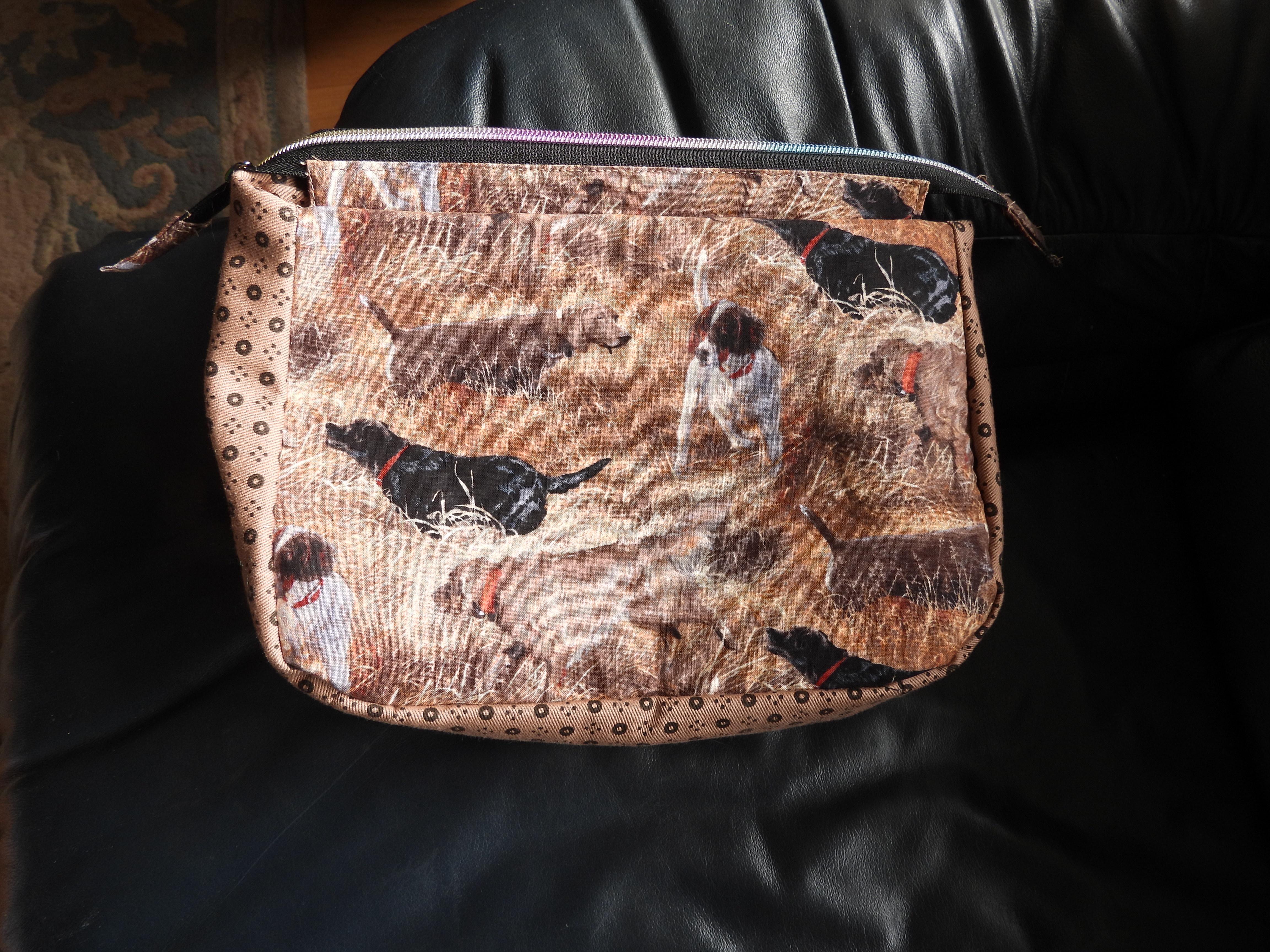
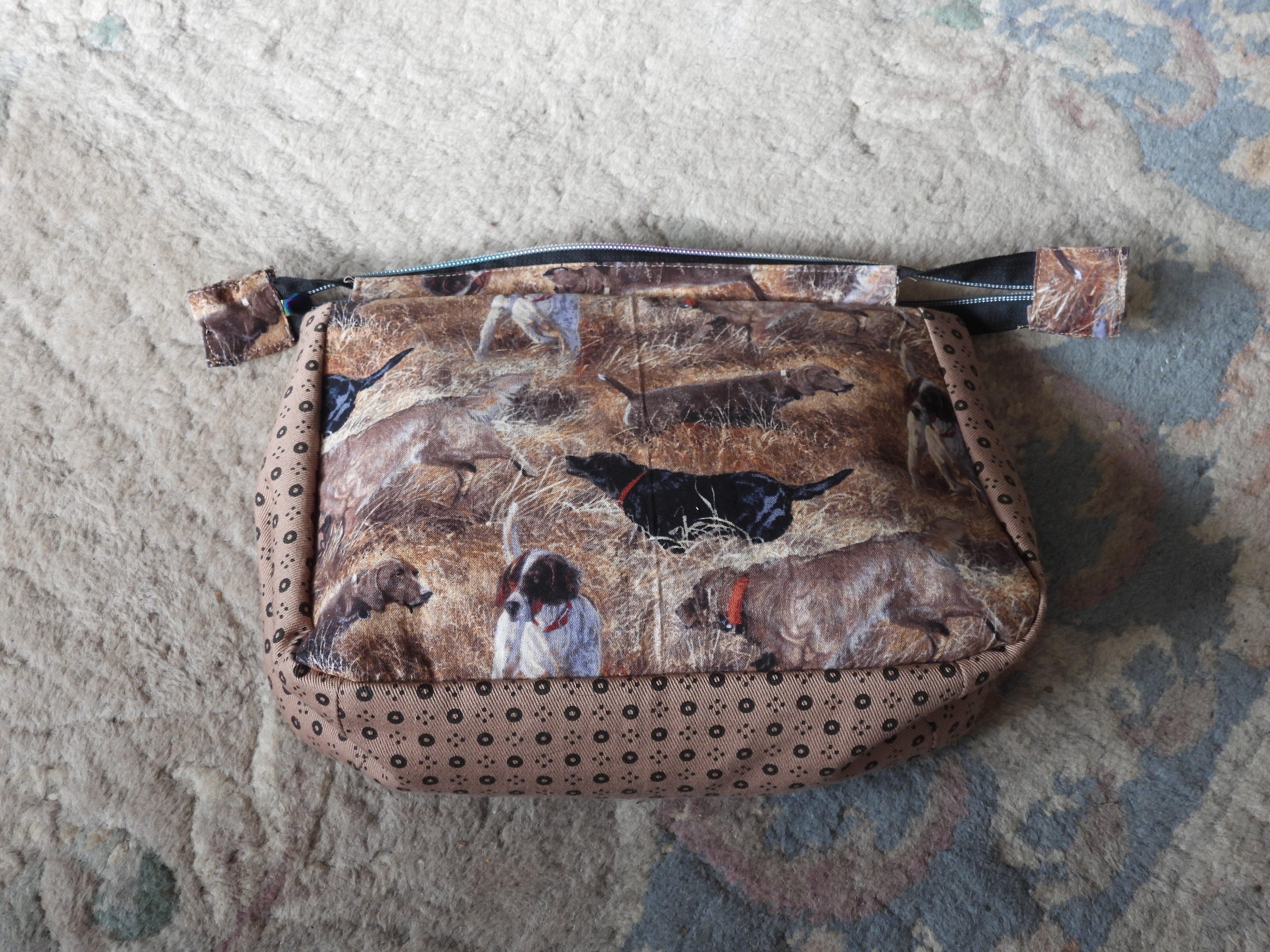
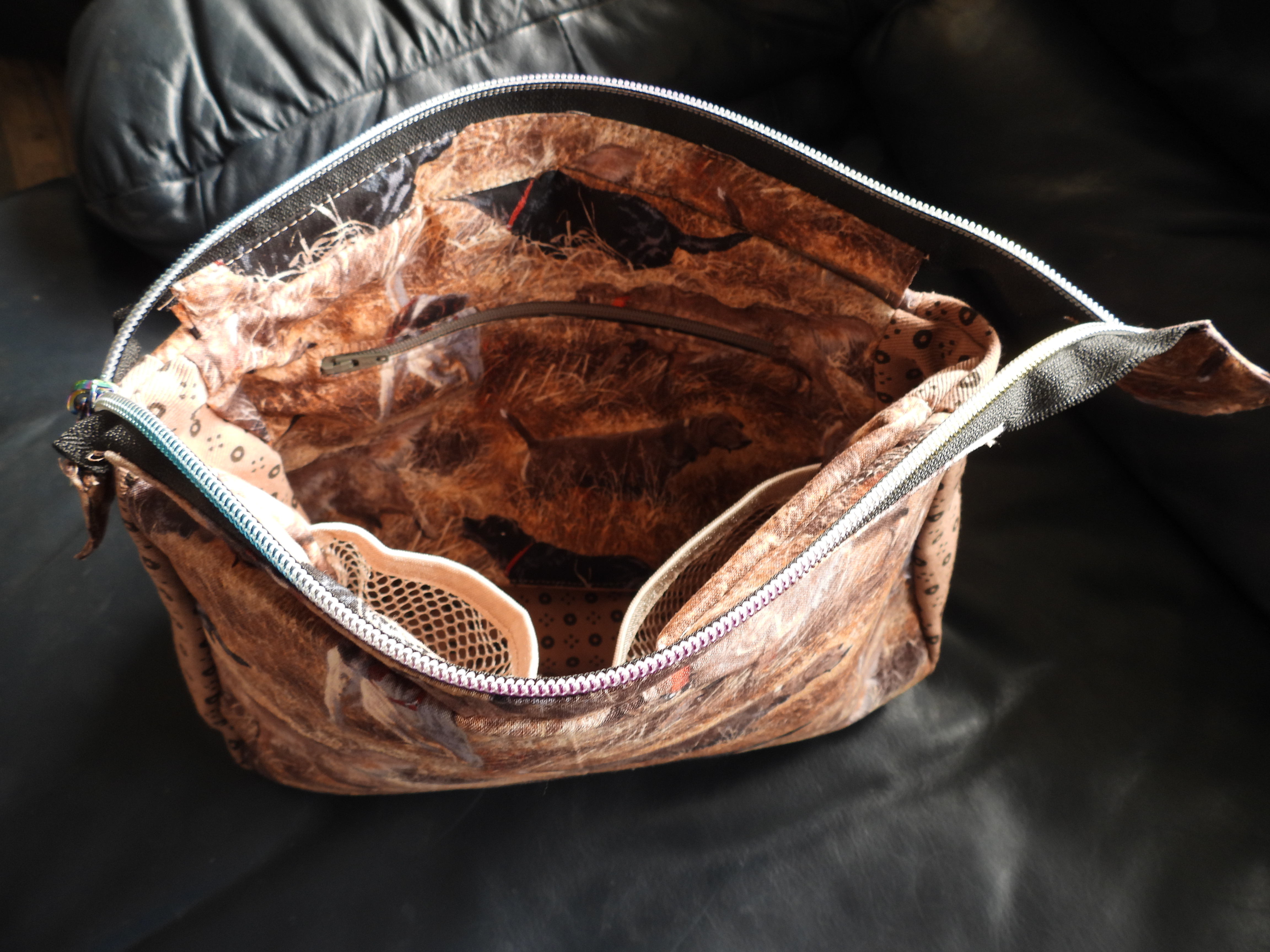
Last week I went to a class to learn how to make a cosmetics bag (which could be used for anything at all, not only cosmetics). I had some dog print material that a friend gave me and I thought it would look nice on a bag. The pattern had three sizes and I decided to make the middle size for a start.
I learned how to use a zipper that you make as long as you want by cutting it off a long, long zipper. Then you put the zipper pull on it and sew tabs on the ends of the zipper. This was my first time trying to make a custom-sized zipper, and it’s a bit rough, but still okay enough for me to try again on another bag sometime.
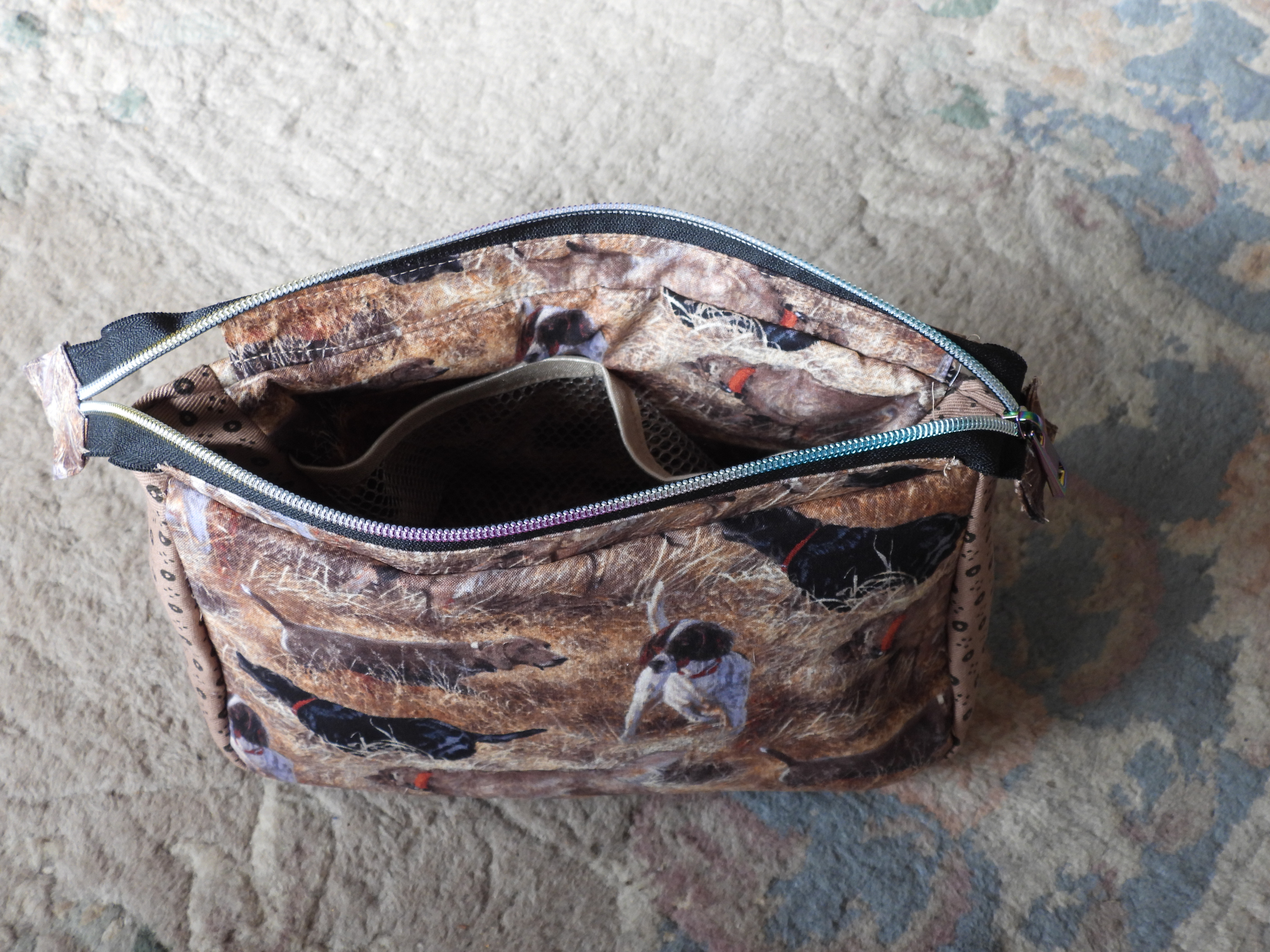
Inside the bag is a lining which I decided to make of the same dog print material. It has two mesh pockets on one side.
On the other side, an extra piece of material was sewn in to make a zippered pocket. This pocket zipper was a pre-determined length, ready made, so it was relatively easy to install.
If I can figure out how to fasten a long over-the-shoulder handle and make the bag the next bigger size, I know someone who would love to use it as a dog training bag. It has a place to put the dog whistle, dog treats, a leash and collar, a bottle of water, and maybe a sandwich or a granola bar. He just has to be sure not to get the treats mixed up. I’m sure Emma wouldn’t mind it, but the Captain might not be so fussy about mistakenly eating a dog treat.
The lack of a steady supply of water makes it hard to grow much. And look at the terrain. Can you imagine an expensive piece of farm machinery trying to negotiate those hillsides? I think farming this area is out of the question.
Still, some vegetation just plants itself. It has to be tough to survive. Grasses are real survivors if they only have a chance to sprout.
But seeds are easily washed away if not in the sparse rain, then at least in the run-off from snowmelt. The wind lends a hand too. Between them, wind and water carve out a landscape full of curves, rifts, pillars, and odd-shaped hills.
So what is the good of these badlands? That is, if there is anything good about them.
At first glance, it looks like a wasteland. You’d be surprised though, how much life it supports. Insects, obviously, and those attract birds and snakes. Lots of snakes. I guess that’s a good thing, if you like snakes. They have to go somewhere.
The carved out crumbling rock formations provide many crevices and holes for a snake to hide in – a place to get out of the hot sun. In the late fall, rattlers will travel miles through prairie grasslands to the badlands where they seek out underground chambers (caves and tunnels) and scooped-out areas where they can snuggle up together for the winter in their very own hibernaculum. These dens are often underground and close to the water table, but preferably in a place where it stays above freezing.
The erosion in the badlands creates all kinds of possible hiding places for small animals. The fields at the edge of a badlands area could provide food for insects, small rodents, rabbits, and game birds such as grouse and pheasants, which in turn attract predators such as hawks and owls.
Even deer may be found wandering through the badlands.
If you have a dog though, watch where it goes. You don’t want it to be bitten by a sneaky snake. If you take your dog there, maybe to hunt a partridge or other game bird for dinner, the best time to do that is probably early in the morning when it is cool and the snakes are still a bit poky.
A friend told me of a time when his dog (same breed as our Emma – an English field cocker) was running down a path ahead of him and a rattler was in the path directly in front of her. The dog leaped over the coiled up snake and kept going. It was lucky that, because of the cold morning, the snake was still quite lethargic. A few hours later, this scenario could have had an unhappy ending.
If you’re ever in a badlands area, keep your eyes open and your camera handy, and bring along your snakebite kit and the local vet’s phone number.


 wordsfromanneli