wordsfromanneli

Thoughts, ideas, photos, and stories.


23 Comments

Dwindling

Not so many years ago the Comox Glacier, on Vancouver Island, had ice and snow all year round, especially on the plateau part of the landscape. I think this photo might have been taken about five years ago. It may have been early spring or late fall, but it had a good layer of ice all year.

Every year, there was less snow, even in the winter. I took the blurry photo below from the side of the road just a few days ago, using my cell phone. I didn’t care so much that it wasn’t a sharp photo. My point was made when I saw the lack of snow and ice. This is the least ice I have ever seen on the Comox Glacier. Soon this icon of the Comox Valley could be completely gone. Since I took that picture, a tiny skiff of snow has dropped on the tops of the hills, but that won’t make any difference to the huge loss of the glacier.

Our climate is definitely changing.


Do you see any signs of our changing climate where you live?


30 Comments

Snowy Hills

Way up high on the hills, the rain turned into snow.

Why is it that white snow comes out of black clouds?

How did that sunshine get through to the hills when the whole valley is in shade?

Can you guess where the deer are that used to live up in the hills? Where are the birds? Bears? Cougars? Squirrels?

I can only hope that those who didn’t wander down to lower elevations are hibernating in some cozy den. Probably even those who might hibernate would have come down from the highest parts of the hills, if they were able.


Meanwhile, I’m in my cozy den at home, not hibernating, but also waiting for winter to pass.

A new year is coming. That gives me hope that spring won’t be too far away.

Have a happy year ahead, everyone.

All the best in 2025.


22 Comments

Seafood by the Seaside

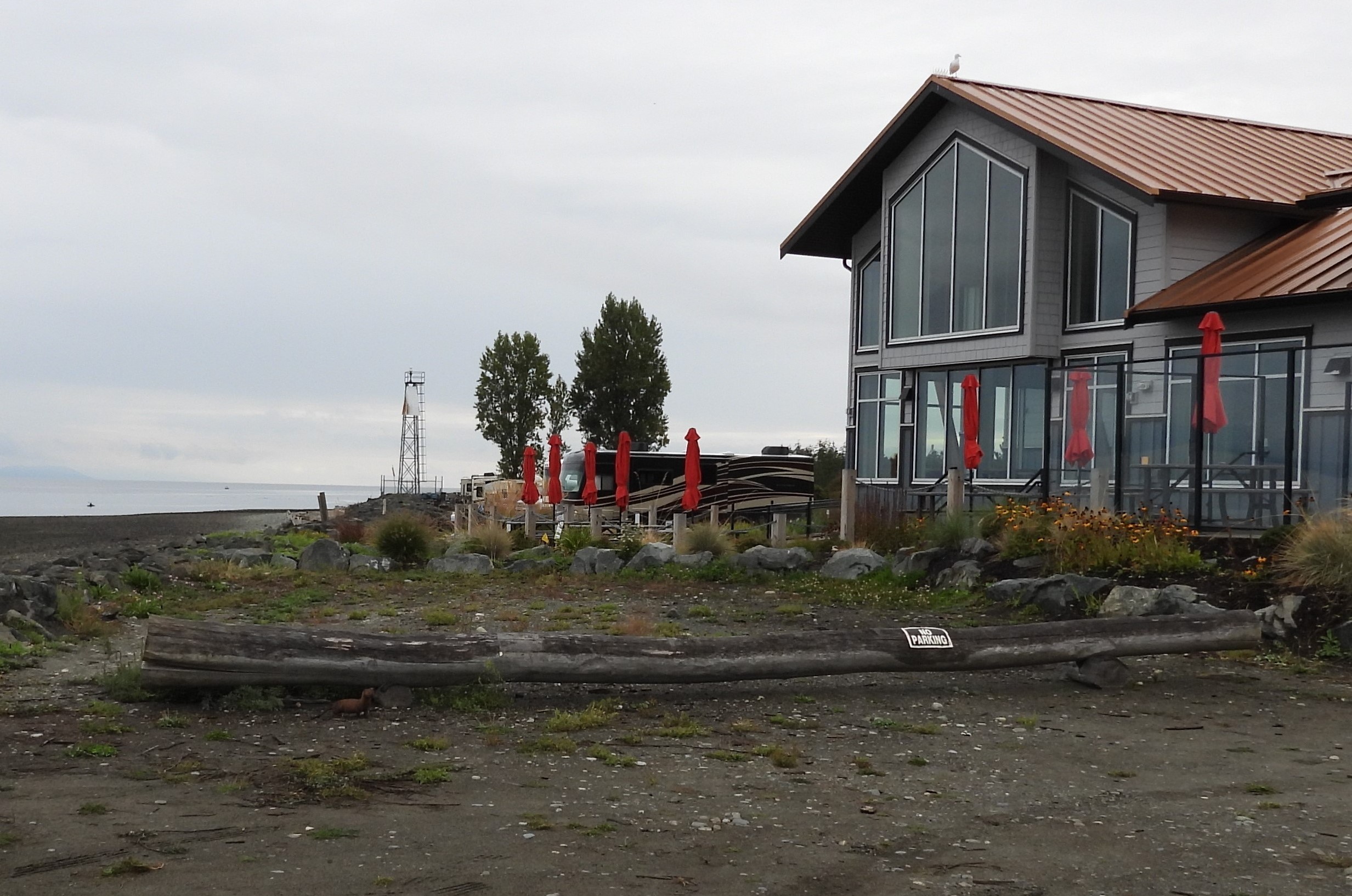
The critter in this post has beachfront property – as much as he wants.

Monty the Mink has his own wading pools which sometimes do double duty as dining areas.

He prefers to sit above the high tide line when he’s eating at his own High Tide Restaurant. He’s very tidy about his dishes, leaving them all in one place for the next tide to rinse. The seagulls sometimes help out with the leftovers.

So who is this rich guy who dines on seafood by the seaside? No, this building is not his restaurant, although he has the free run of the property. He’s a very small guy, smaller than many cats. See him in front of the log that has the “No Parking” sign on it? He is just about five feet from the left end of the log, a tiny fellow who can move very quickly, especially when he knows someone is trying to take his picture. He’d rather be blurry and incognito.

Thinking he’s safe, he sneaks up to the rock garden of the people’s restaurant (bottom left). I’m sorry he was feeling so shy and elusive today. He moved very fast and I had little chance of focusing. Maybe another day we will get a better picture of Monty Mink, a Pacific Northwest coast mink.

My weaselly cousin,

Prefers the dry land,

But I like variety,

Found near the sand.


Frogs, fish, and crayfish,

Or turtles, and clams,

As long as it’s meaty,

Hold back on the yams.


I’m tough for my size,

Taking on bigger meals,

A wandering rabbit,

Tastes good when it squeals.


I’m really not mean,

But I have to be tough,

A mink’s got to eat,

And it’s never enough.


36 Comments

Quilting Retreat

The view from the lodge where we have the quilting retreat is gorgeous, even with snow, which always seems to hit us for the February retreat.

Inside the lodge, in the new section (below),  quilters have their machines set up at the far end and tables are set up for meals at the closer end. See the buffet-style serving area in the middle by the posts.

Next to the new part is the older section of the lodge, with carpet instead of hardwood flooring. The quilters on this side are closer together, but they each have their stations that they use every time they come to a retreat. The banter and chatter is cozy and friendly, and the quilters share new ideas.

Some of their finished products are hung on the railing of the loft. Sometimes just the flimsy (the top of an unfinished quilt) is hung up, and the less creative finishing work is done later, at home.

More quilts.

My project of fish placemats was very time consuming and I haven’t finished them yet, but I’ll post them when I get them done.

When I came home, I had a short (maybe 10-minute) ferry ride from Quadra Island to Vancouver Island, but the sky and sea were all one snow-filled mass. See the bits of snow still sitting on the roofs of other vehicles? I took this picture from inside my truck.

Looking out one of the ferry’s side windows, I could see the white caps blowing off the tops of the waves. The ferry swayed side to side as it battled the pull of the tide near Seymour Narrows while the wind blew in the opposite direction.

I had a white-knuckle 45-minute drive home on a snowy highway once I got off the ferry, but I felt safe in my truck, and was glad we had invested in good tires.


19 Comments

Dialect in Writing


Dialect 

If one or more of your characters have a dialect or accent that you feel is important to note in your novel, I would suggest that unless you are very familiar with those regional speech patterns or accents, use them sparsely so they don’t distract from the story. The safer way to do it would be to choose a few instances of the dialect and use them in dialogue. Try as much as possible to have the rest of the writing in plain English.

Falling out of character by messing up the dialect is going to do damage to your credibility as a writer and to the credibility of the character.

I’d like to give you some examples of how I have used dialect and accent of a character in my novels.

One of my secondary characters in The Wind Weeps is Monique, a French-Canadian girl. I wanted to show that she spoke with a French-Canadian accent, but I didn’t want the phonetic spelling of every word of her speech become a chore for the reader. My solution was to limit Monique’s dialect and accent to a few of the most obvious speech habits that were typical of French speakers of English.

Saying the soft sound of “th” (as in “they”) is often difficult for speakers of French origin,  so, for example, instead of saying “there,” Monique would say “dere.”  For the hard sound of “th,” she might say “somet’ing” instead of “something.”

In French the sound of “h” is not used, so in English, Monique would have a habit of dropping the sound of the letter “h.” I showed this by placing an apostrophe in its place.  If she were saying, “It’s time to have something to eat,” she would say, “It is time to ’ave somet’ing to eat.”

That reminds me of the last clue to Monique’s speech being different; she would not use contractions. Instead of “can’t,” she would say “cannot,”  or she would say “it is” instead of “it’s, and “I ’ave” instead of “I’ve.”

By using these three changes in the dialogue, the reader could instantly identify that it was Monique who was speaking.  Just to be sure, I gave Monique two more habits of her own. I added the odd case of her swearing by having her say, “Tabernac,” once in a while. I also had her use an expression that was all her own by having her conflate two common phrases she had heard used in English. When she wanted to say “For sure” or “Sure thing,” as she had heard others say, she ended up saying, “For sure t’ing.”  Whenever this came up in the book, we would always know it was Monique speaking.

If you’d like to check it out yourself, you can find The Wind Weeps and its sequel, Reckoning Tide, at all amazon   (click on amazon) outlets and at smashwords.com (Click on smashwords.com).

My books are all marked down to 99 cents US so you can load your e-reader with bargain reading.

You can find a review of The Wind Weeps, by clicking on this blog post by Diana Wallace Peach.

P.S. For those who follow both my blogs, I have copied this post for both this one time. I don’t intend to make that a habit.


42 Comments

Camping

A few days of R and R were in order, so we took our old trailer to a lake that was about three hours’ drive from home, and set up camp.

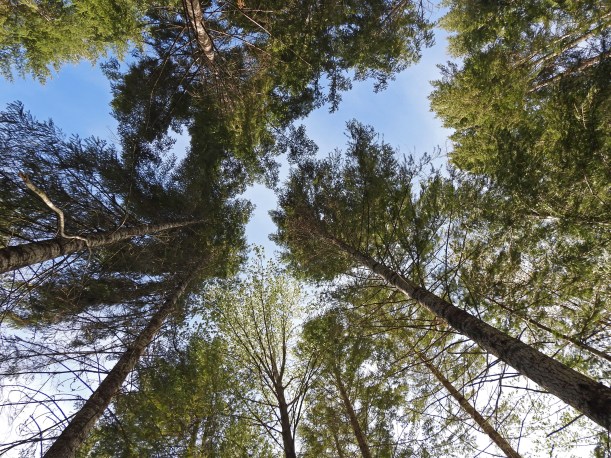
Once the main chores were done, I sprawled back in my lawn chair and looked up.

This is what I saw.  Although there were people camped next to us, it was quiet because they were out on the lake in their kayaks. The peacefulness of the place was a moment to treasure. On the coming long weekend, it would be much more of a party place, but for now, it was wonderfully quiet. Just the whisper of the leaves high up in those trees.

Later we would try our hand at fishing in the lake, but it was so hard to decide whether to hold the fishing rod or the camera.

Now that I’m home and it’s the weekend, I can’t help but wonder how the party is going. I bet it is noisy and a complete change from the quiet few days we spent there. Timing is everything.