Tag Archives: insects
Mystery Bug
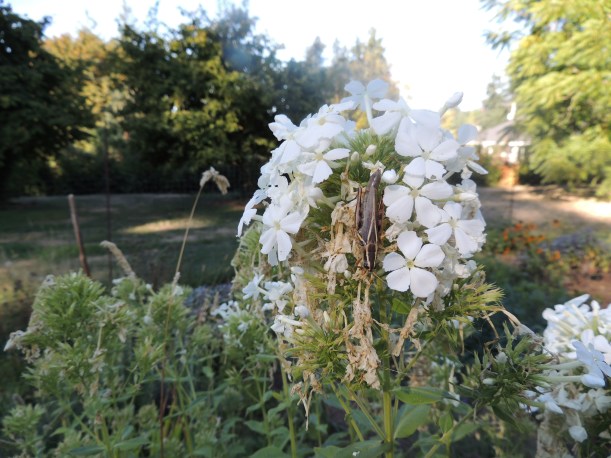
I took this picture a few years ago and had forgotten about it. My white phlox plant still had a few flowers then, but later, most of the white flowers got eaten by this grasshopper and his friends.
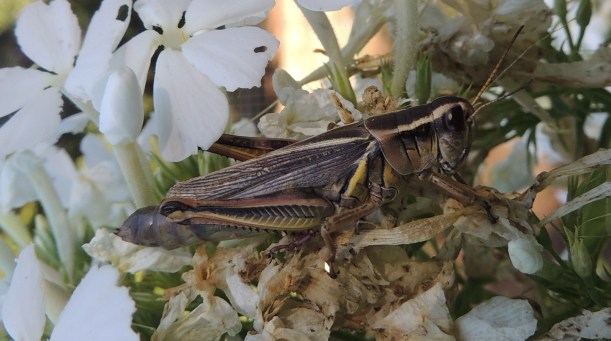
I’m not crazy about insects, but this grasshopper had rather pretty markings. I tried to find out what kind he was. The closest I could find was a two-striped grasshopper. It looks to me that this guy has only one stripe but maybe they are counting the identical stripe on the other side of his body. Any ideas for an accurate I.D.?

I recommend “The Phlox” for lunch,
With seating for a crowd,
Delicious food on offer here,
So far, it’s not too loud.
I’ve stuffed my face with flowers white,
They’re delicate to chew,
If you don’t join me soon, I say,
That’s just too bad for you.
I thought she grew these plants for us,
Perennials you know,
And yet she shoos us all away,
“Get out! It’s time to go!”
Pam the Pileated Woodpecker
The pecking of beaks on wood just past the fence of my yard sent me running for my camera. I was surprised to see not one, but two pileated woodpeckers. They were a bit shy and one of them disappeared around the back of the tree. I had a glimpse of that bird just long enough to guess that it was a sister of the juvenile pileated woodpecker I could see on the opposite side of the tree. Do you see them there on the tree that is farthest to the left? One on each side of the tree; one about a foot below the other, partly hidden by a leaf.
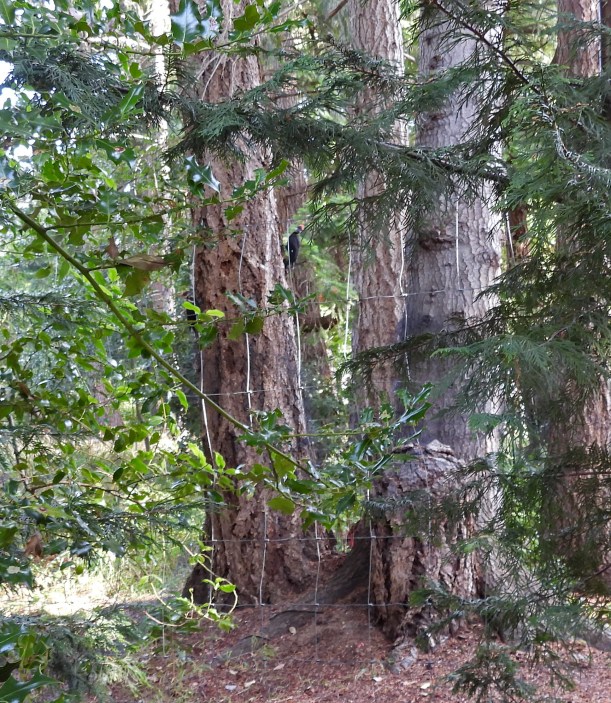
I know her name is Pam, not Paul, because she doesn’t have the red cheek slash that the boys have. Notice how long her toenails are. Great for hanging on and for hopping up and down on the trunk of these Douglas fir trees. Can you do that?
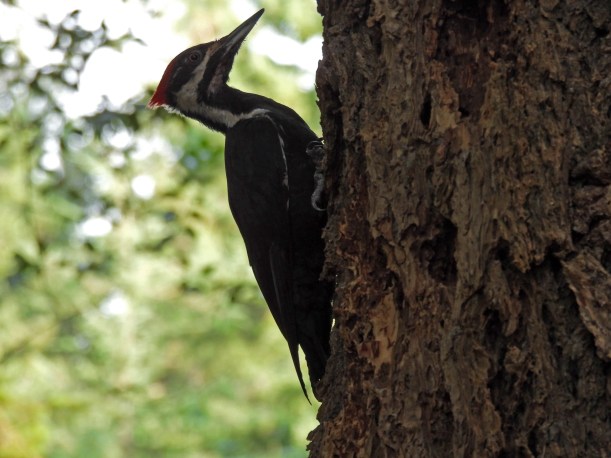
She was finding little bugs in the bark. I watched her eat some as she came across them. I bet they were surprised to be found, thinking they were safe in the maze of coarse bark.

You can watch Pam at work in these two short videos she allowed me to take. It gave me a headache watching her slam her beak into the bark over and over again. If you watch carefully you might see her nibble at a bug she discovered between beak slammings.
In the next one, watch how she hopped around the bark so easily, hanging on with her sharp toenails.
See you around the neighbourhood, Pam, and thanks for helping keep down the invasion of insects.
Badlands
Are the badlands really bad?
The lack of a steady supply of water makes it hard to grow much. And look at the terrain. Can you imagine an expensive piece of farm machinery trying to negotiate those hillsides? I think farming this area is out of the question.
Still, some vegetation just plants itself. It has to be tough to survive. Grasses are real survivors if they only have a chance to sprout.
But seeds are easily washed away if not in the sparse rain, then at least in the run-off from snowmelt. The wind lends a hand too. Between them, wind and water carve out a landscape full of curves, rifts, pillars, and odd-shaped hills.
So what is the good of these badlands? That is, if there is anything good about them.

At first glance, it looks like a wasteland. You’d be surprised though, how much life it supports. Insects, obviously, and those attract birds and snakes. Lots of snakes. I guess that’s a good thing, if you like snakes. They have to go somewhere.
The carved out crumbling rock formations provide many crevices and holes for a snake to hide in – a place to get out of the hot sun. In the late fall, rattlers will travel miles through prairie grasslands to the badlands where they seek out underground chambers (caves and tunnels) and scooped-out areas where they can snuggle up together for the winter in their very own hibernaculum. These dens are often underground and close to the water table, but preferably in a place where it stays above freezing.
The erosion in the badlands creates all kinds of possible hiding places for small animals. The fields at the edge of a badlands area could provide food for insects, small rodents, rabbits, and game birds such as grouse and pheasants, which in turn attract predators such as hawks and owls.
Even deer may be found wandering through the badlands.

If you have a dog though, watch where it goes. You don’t want it to be bitten by a sneaky snake. If you take your dog there, maybe to hunt a partridge or other game bird for dinner, the best time to do that is probably early in the morning when it is cool and the snakes are still a bit poky.
A friend told me of a time when his dog (same breed as our Emma – an English field cocker) was running down a path ahead of him and a rattler was in the path directly in front of her. The dog leaped over the coiled up snake and kept going. It was lucky that, because of the cold morning, the snake was still quite lethargic. A few hours later, this scenario could have had an unhappy ending.
If you’re ever in a badlands area, keep your eyes open and your camera handy, and bring along your snakebite kit and the local vet’s phone number.

Internet image
 wordsfromanneli