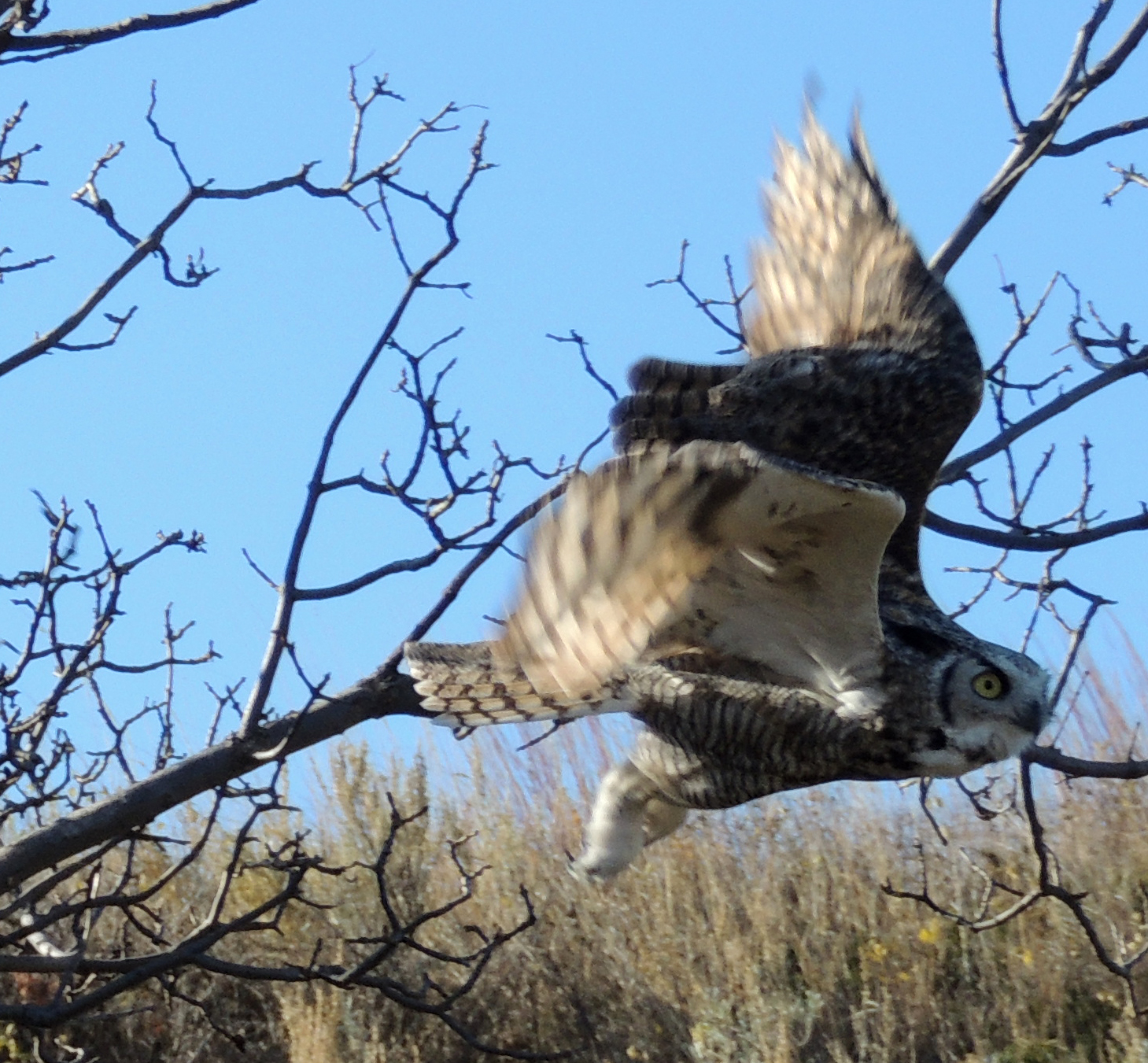
silent bird cruising
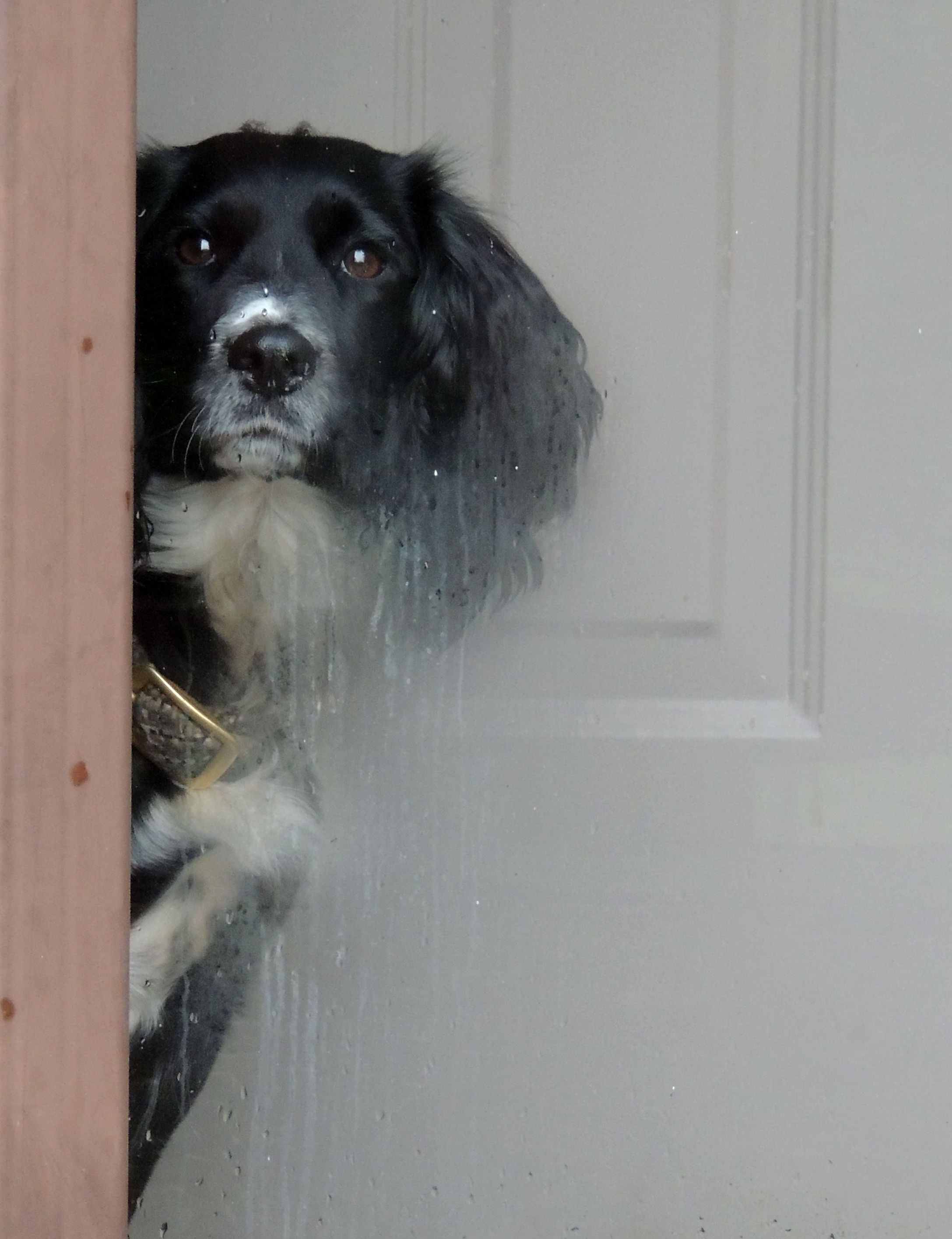
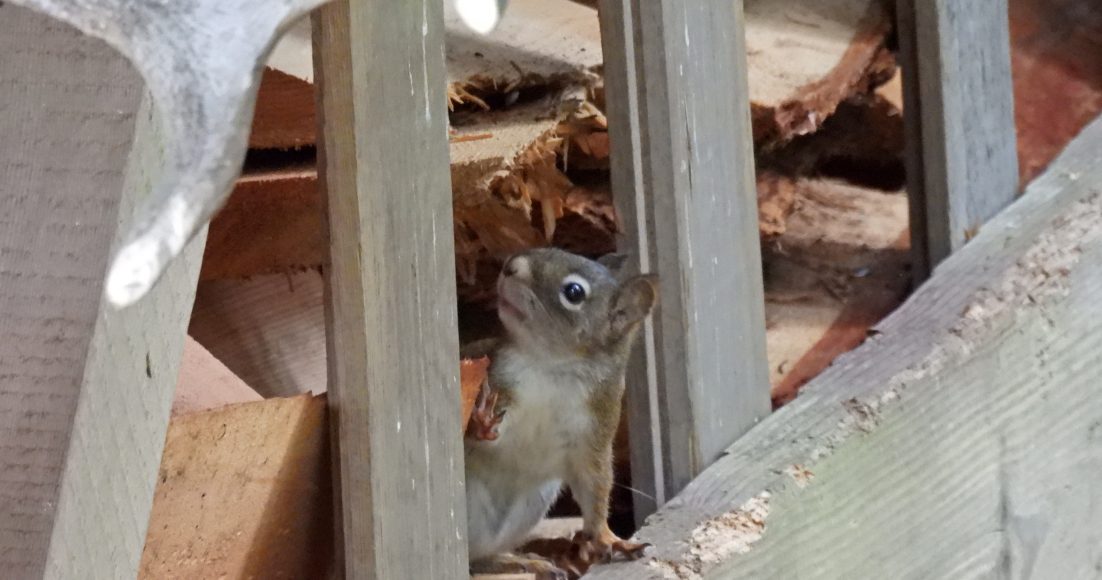
spies pup chasing owl’s dinner
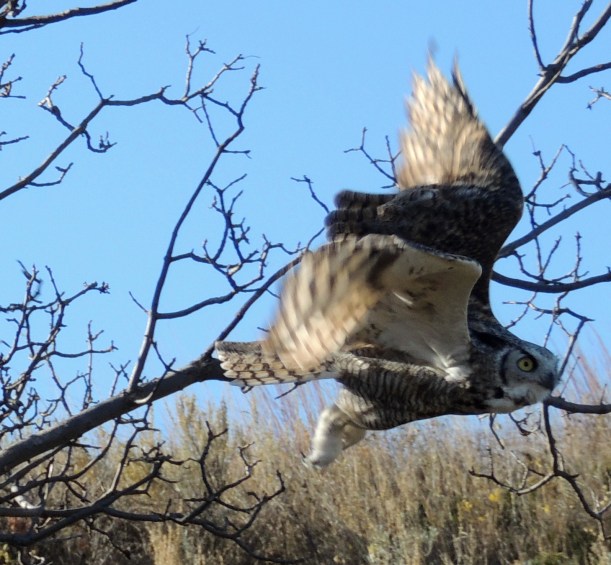
“hoo” let the dog out?
When owls eat, they don’t have the best table manners. Unless the animal they are eating is too big, they swallow it whole.
Unlike many other birds, owls (and herons, grebes, cormorants, and several other types) don’t have a crop where they store food before it goes into their stomach. The eaten “food” goes straight into the glandular stomach where enzymes and acids begin the digestion. From there, the “food” passes into the muscular stomach which mushes up the softer parts of the victim, leaving behind only the undigestible parts like the bones, fur, and teeth (or feathers if it was a bird that they ate).
Then hours after the edible parts are liquefied and have passed through, the owl throws up the leftovers. The official way of saying that in “bird study talk” is that it casts a pellet.
Here is a pellet that an owl left behind on top of an upturned aluminum skiff in our back yard.
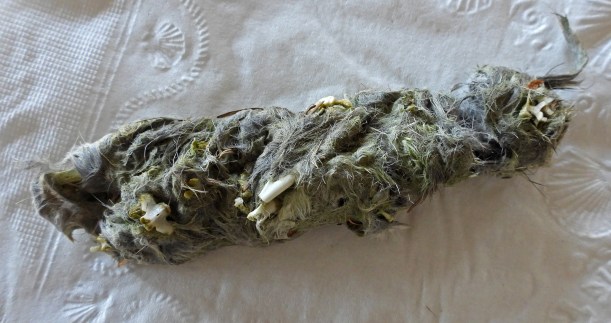
I got an old pair of tweezers and took the pellet apart to see if I could find the bones.
If you click on the photo, you may be able to get a better look.
To the right of the larger long bones, you can see five tiny claws and below those, I have laid out the very thin long bones that I think might be rib bones.
One piece of fur was not matted together, and I thought it looked like it might have belonged to a rat. Also, I think the long bones are too big for a mouse.
Below the piece of fur at the top of the bone collection, are some of the vertebrae.
Some parts are missing, and they might have passed through the owl, or possibly been part of a second casting. Just guessing here.

I made sure to wash my hands and sterilize the area where I put the bones and fur. If the owl’s meal was a rodent, it might have been carrying some bacteria or viruses.
Some people may find this post gruesome, but I thought it was a fascinating part of nature that we don’t often see.


You can hear the great horned owl shrieking, trying to scare the rat (or anything that moves). He’s hard to see in the dark, but watch to the end and you’ll hear him screeching back and forth to his girlfriend, telling her to come over and have supper with him.
Turn on your sound. If you click to make the video clip full screen, it will look better.
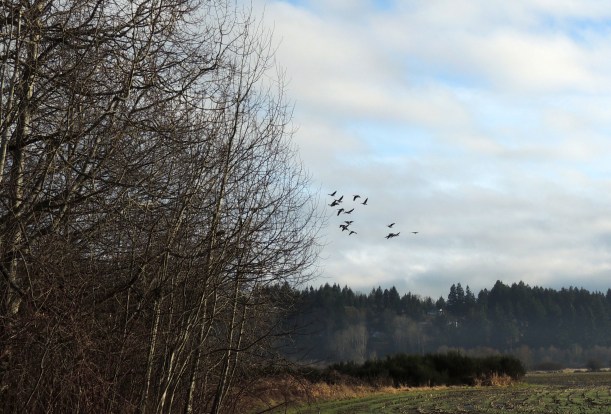
The geese are moving in from places farther north where they have enjoyed warmer weather until now. They sense that the season is cooling off and have come to visit the fields of southern BC to fatten up on leftover grain, bits of corn, and anything else that looks good. Once they have met up with their friends in ever greater numbers, and they have rested and feasted and done little test flights during this staging time, many of them will fly farther south where the winter is not as harsh. A few smaller flocks will settle in to spend the winter here on Vancouver Island, in the hope that the coldest weather will be bearable and not last too long.
The eagle watches and waits. He will take advantage of any stragglers or injured birds to supplement his diet. Once the spawned out fish carcasses are cleaned up by scavengers like seagulls, crows, and eagles, it will be time for a new food source. For the eagles it will often be crippled waterfowl of many kinds.
This bald eagle has a good view of a cornfield that often attracts ducks and geese. If any of them are not able to keep up with the flock, they will make an easy target for a predatory bird.

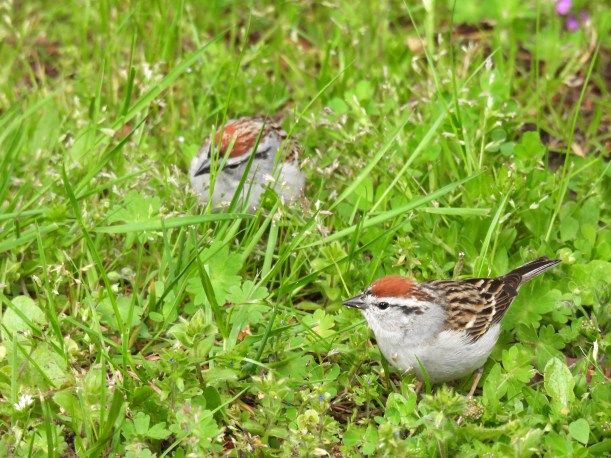
Little songbirds like these chipping sparrows will be targeted by hawks who sit silently in the nearby trees, waiting for an opportunity to swoop down and scoop up a little snack.
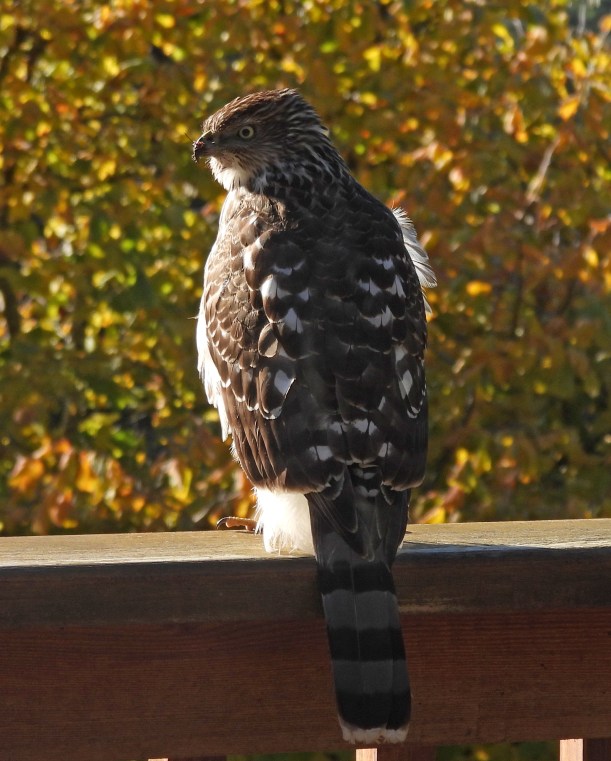
This broad-winged hawk would be happy with a songbird or even a careless squirrel. Patience and alertness are what it’s all about.
The merlin doesn’t mind picking up a songbird either. He’ll happily take down a flicker that might be almost the same size as him.

The red-shafted northern flicker had better be alert. It’s a dangerous world out there.
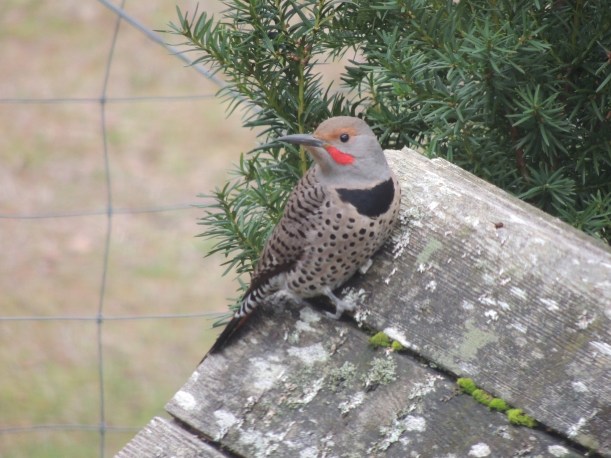
The general rule for non-predatory birds, especially in the autumn, is “heads up or be eaten.” It’s the raptors who are the meat eaters, while the gentler plant- and insect-eaters need to fear them.
And I haven’t even mentioned the owls yet. Rabbits and mice beware!
I think I see him. I hope he’s got my bag of grubs.

Yes, you’re right! And I see the big sack full of hazelnuts for me.
Er, ah, HERE I AM, Santa. OVER HERE!

Where? I don’t see anything.
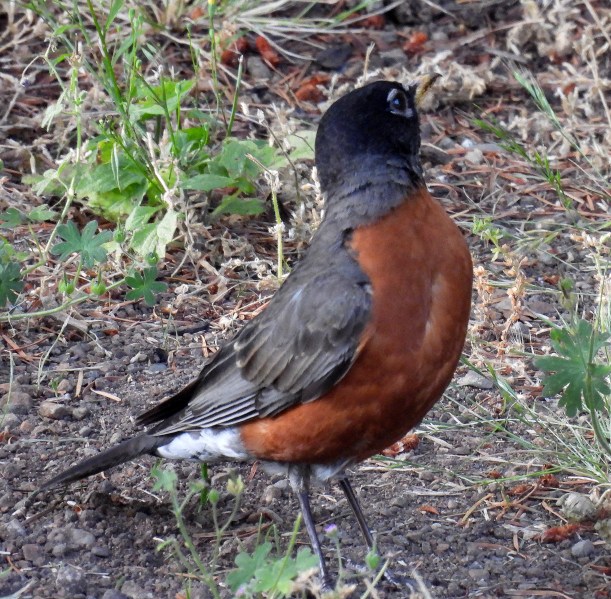
When he does come, I hope he brings me a lot of rosehips. Wonder what they’d taste like. In the winter I get tired of these holly berries and mountain ash berries. But maybe the rosehips are too fuzzy inside. They look good though.

Oooooh! Look! He’s got sleigh troubles. His reindeer are conking out. Should’ve got a Tesla Sleigh. With inflation, the price of reindeer food today is high, even for Santa. But even so, the cost of the Tesla Sleigh itself is enough to break the bank.

Yeah, he’s in trouble all right. Look! He’s turning around. Sniff… there goes that box of dog biscuits I asked for.

I see that. Hmm … I think I hear them complaining about being hitched up so close. Something about social distancing.
Sigh! No herring for supper tonight. Not by special delivery, anyway.

Well, I never! He’s going back to the North Pole. There goes that bunch of tree bugs I asked for.

I’ll go round up some recr-hoots.
Hey, you. Santa’s looking to hire you, Al and the Paca, to be his reindeer substitutes.
What’s that you say? You don’t play second fiddle? Huh! You’d think that in the spirit of Christmas, you’d oblige an old man. I see you are related to those llamas next door with all their llammering. You’re just lazy, the All Packa ya. Well, see if I give a hoot.

Here’s a likely crew.
Say, would you pronghorns like to save Santa’s bacon tonight?
But we’re in Montana.
That’s okay. He’ll have to go by there when he limps home with his rainydeer crew and drops them off. Maybe you can hop on and help get them home before the nightshift begins. Thanks a lot.

I’ve been watching and I don’t see him coming back yet. Must be in the workshop, adjusting the harnesses to the new team.

I think I see him now, with his fresh crew of pronghorns. Funny-looking reindeer. Better than nothing, I guess.
Oh, this is so exciting. We just can’t sit still.

Let’s go meet him.

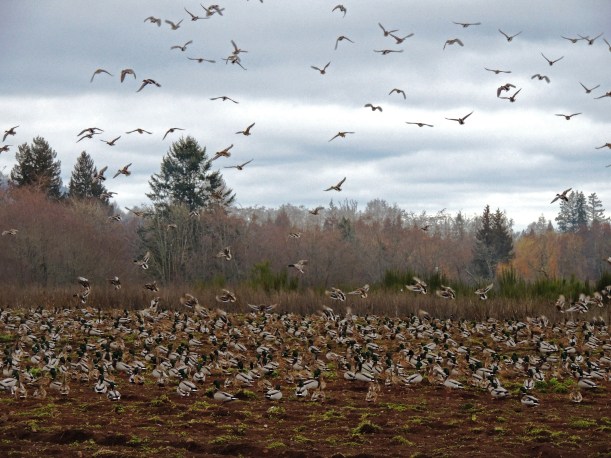
Now settle down or Santa will think you’re all quackers.
Look how well behaved we are; black and white, eating at the same table together. One big happy flock. We’re a “blended flock.”

Oh, listen to you guys. You think it’s easy being the black swan of the family?

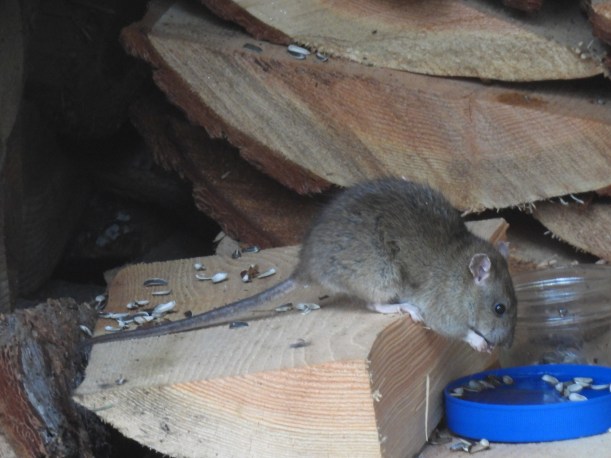
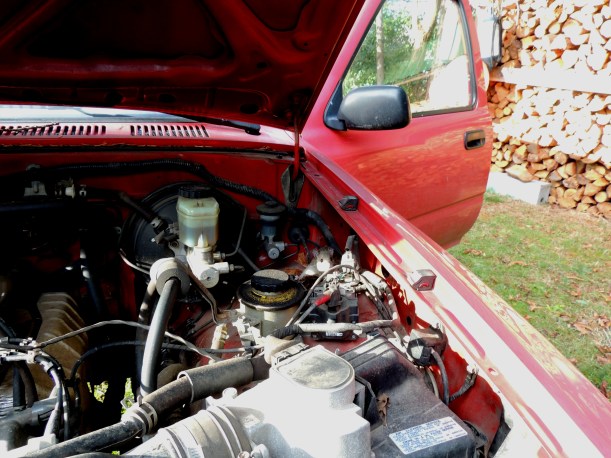
Whaddaya mean? You think you’ve got it bad? You try being a rat. All I did was chew on a few of those lovely black licorice cords in the truck and WHAM! They lifted the trunk and exposed me to the elements. But they won’t see me hiding in the corner. Bet you can’t see me either. I’ve got a really good hiding place in the door well too. I’ll just wait there until Santa brings new wiring for me to nibble on.
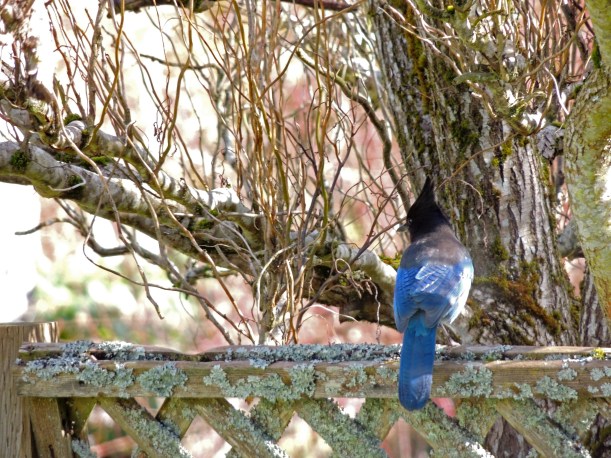
One thing we all got for Christmas – not sure if Santa had anything to do with it – was darn cold weather. So when Santa had to fly back to change his Rainydeer tires for the more heavy-duty Pronghorn brand, he asked the North Wind to provide some Puddle Puzzles for us to play with while we await his return.
Actually, I thought the puzzles were more like A-maze-ing. You just try it. See if you can find a path out of this maze.

I hope your Christmas holiday time is amazing too.
Did you find the rat in the truck? Look on the far back right-hand corner of the picture (actually the left side of the truck).
Are the badlands really bad?
The lack of a steady supply of water makes it hard to grow much. And look at the terrain. Can you imagine an expensive piece of farm machinery trying to negotiate those hillsides? I think farming this area is out of the question.
Still, some vegetation just plants itself. It has to be tough to survive. Grasses are real survivors if they only have a chance to sprout.
But seeds are easily washed away if not in the sparse rain, then at least in the run-off from snowmelt. The wind lends a hand too. Between them, wind and water carve out a landscape full of curves, rifts, pillars, and odd-shaped hills.
So what is the good of these badlands? That is, if there is anything good about them.

At first glance, it looks like a wasteland. You’d be surprised though, how much life it supports. Insects, obviously, and those attract birds and snakes. Lots of snakes. I guess that’s a good thing, if you like snakes. They have to go somewhere.
The carved out crumbling rock formations provide many crevices and holes for a snake to hide in – a place to get out of the hot sun. In the late fall, rattlers will travel miles through prairie grasslands to the badlands where they seek out underground chambers (caves and tunnels) and scooped-out areas where they can snuggle up together for the winter in their very own hibernaculum. These dens are often underground and close to the water table, but preferably in a place where it stays above freezing.
The erosion in the badlands creates all kinds of possible hiding places for small animals. The fields at the edge of a badlands area could provide food for insects, small rodents, rabbits, and game birds such as grouse and pheasants, which in turn attract predators such as hawks and owls.
Even deer may be found wandering through the badlands.

If you have a dog though, watch where it goes. You don’t want it to be bitten by a sneaky snake. If you take your dog there, maybe to hunt a partridge or other game bird for dinner, the best time to do that is probably early in the morning when it is cool and the snakes are still a bit poky.
A friend told me of a time when his dog (same breed as our Emma – an English field cocker) was running down a path ahead of him and a rattler was in the path directly in front of her. The dog leaped over the coiled up snake and kept going. It was lucky that, because of the cold morning, the snake was still quite lethargic. A few hours later, this scenario could have had an unhappy ending.
If you’re ever in a badlands area, keep your eyes open and your camera handy, and bring along your snakebite kit and the local vet’s phone number.

Internet image
 wordsfromanneli