The squirrels have been harvesting hazelnuts from the trees and hiding them to be retrieved in the winter.
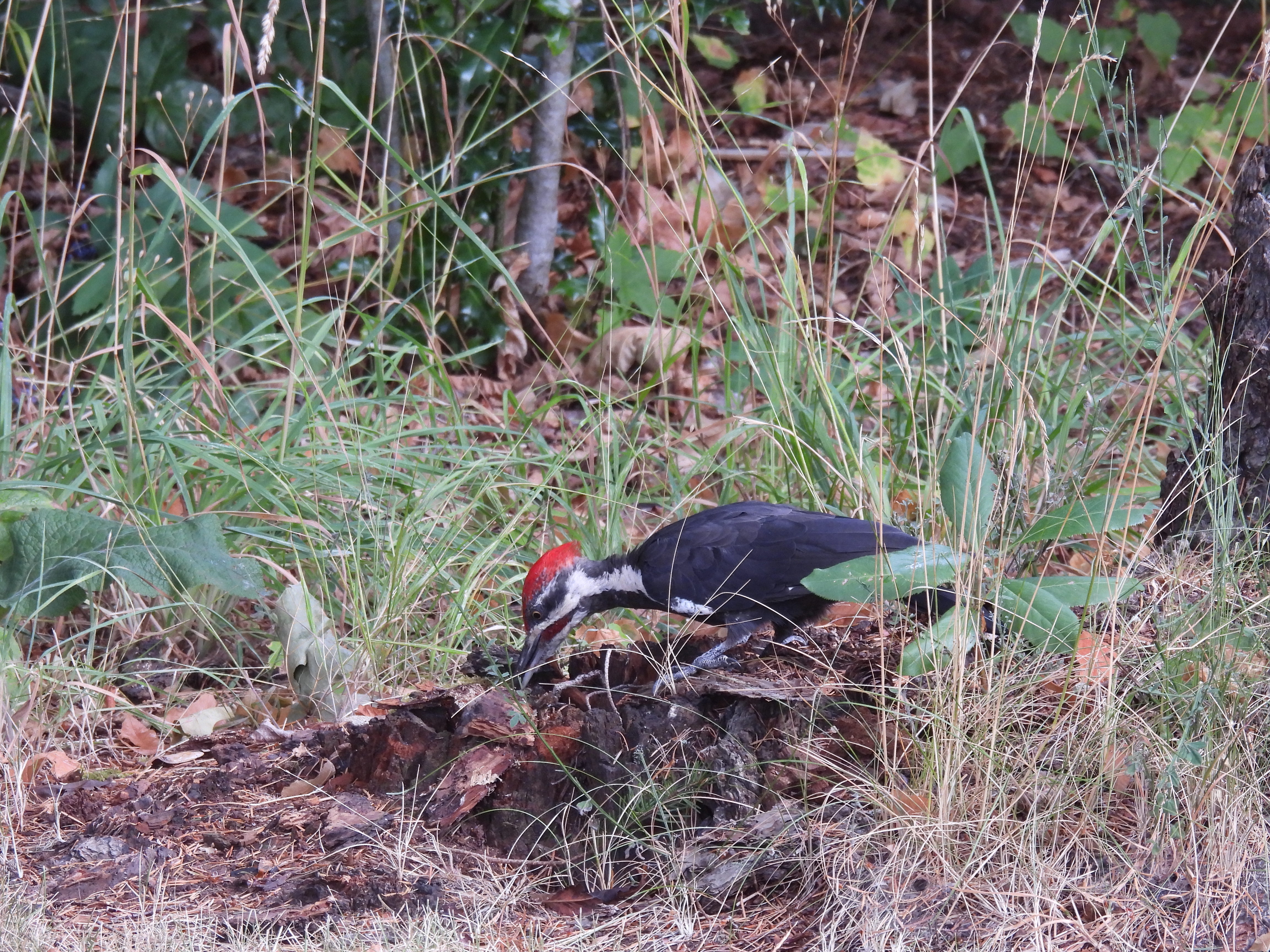
Along comes Woodrow the Woodpecker, innocently looking for bugs.
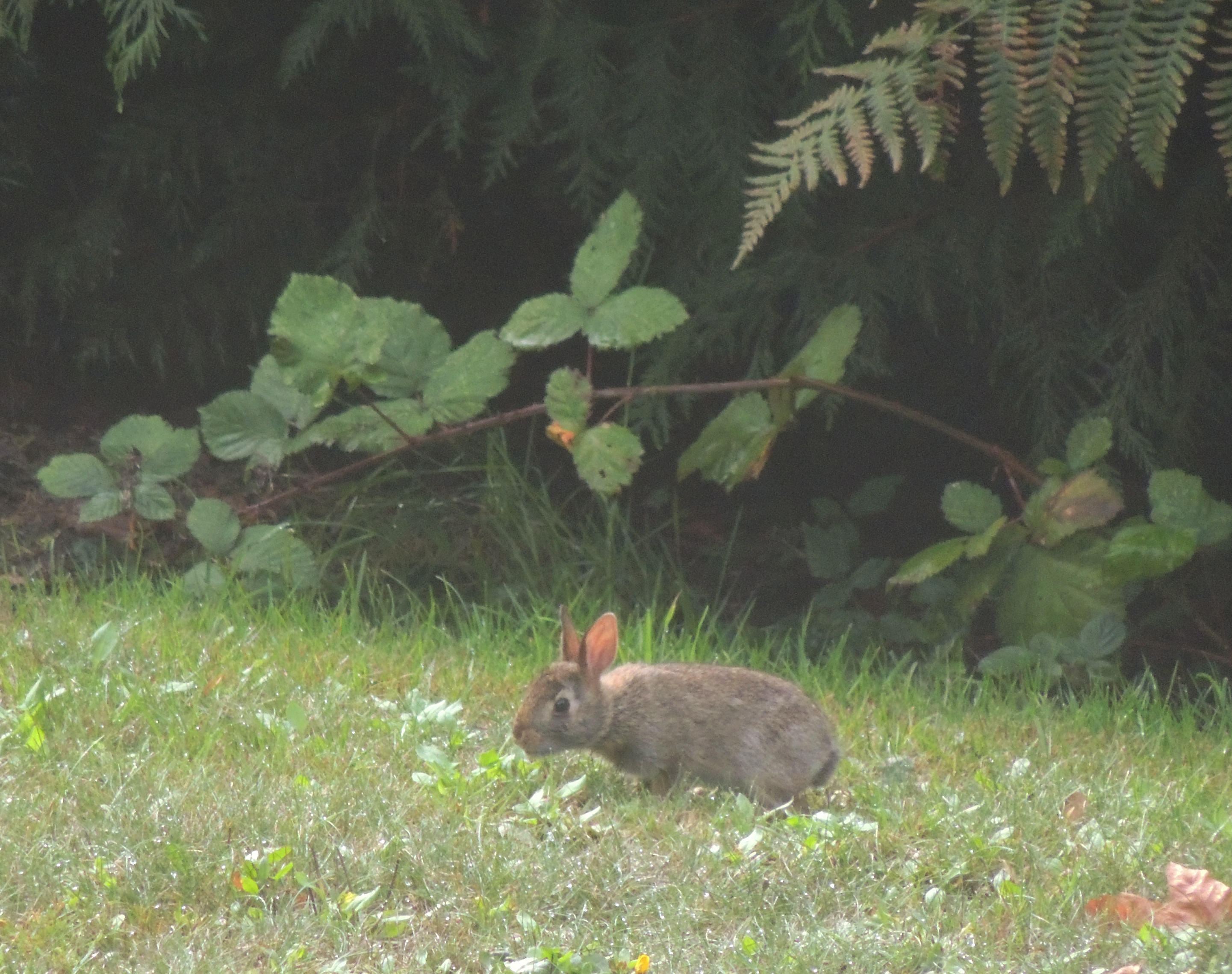
Ronald Rabbit knows the squirrels wouldn’t like their stash to be unearthed, but, “What to do? What to do?”
“Mind your own business, Ronald,” says Woodrow. “That’s “What to do’!”
“I’m telling,” shouts Ronald. “The people will let their dog out and then you’ll be sorry.” Meanwhile, I have one leg raised and ready to make a run for it.
“Look out, you guys! Here I come. And don’t forget! I may be a teddy bear in the house, but I’m a wolverine in the field.”
“Are you serious?” Woodrow calls to Ronald. “Now that the dog is out, we’ll all have to make a run for it.”
“Aw, do what you want. I’m going up here to higher ground and — oh! What have we here? A hole in the tree. Anybody home?”
And so life goes on … unless you’re a bug in that tree.
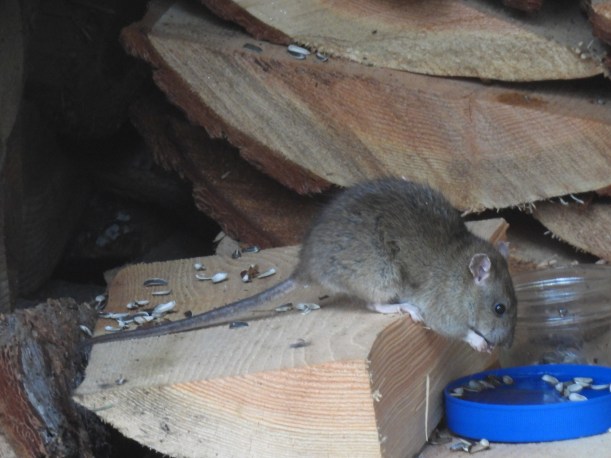
You can hear the great horned owl shrieking, trying to scare the rat (or anything that moves). He’s hard to see in the dark, but watch to the end and you’ll hear him screeching back and forth to his girlfriend, telling her to come over and have supper with him.
Turn on your sound. If you click to make the video clip full screen, it will look better.
My five novels are now available on Amazon for Kindle for only 99 cents in time for the holiday season. Just click on the cover images on the side of the blog post.
If you have another kind of e-reader, you can visit smashwords.com where you can download my books for the same price of 99 cents for your type of e-reader.
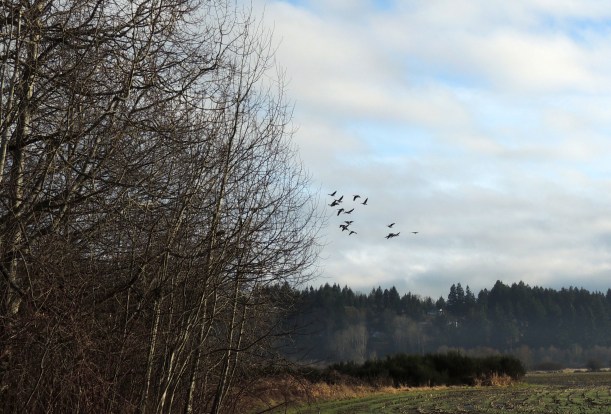
The geese are moving in from places farther north where they have enjoyed warmer weather until now. They sense that the season is cooling off and have come to visit the fields of southern BC to fatten up on leftover grain, bits of corn, and anything else that looks good. Once they have met up with their friends in ever greater numbers, and they have rested and feasted and done little test flights during this staging time, many of them will fly farther south where the winter is not as harsh. A few smaller flocks will settle in to spend the winter here on Vancouver Island, in the hope that the coldest weather will be bearable and not last too long.
The eagle watches and waits. He will take advantage of any stragglers or injured birds to supplement his diet. Once the spawned out fish carcasses are cleaned up by scavengers like seagulls, crows, and eagles, it will be time for a new food source. For the eagles it will often be crippled waterfowl of many kinds.
This bald eagle has a good view of a cornfield that often attracts ducks and geese. If any of them are not able to keep up with the flock, they will make an easy target for a predatory bird.
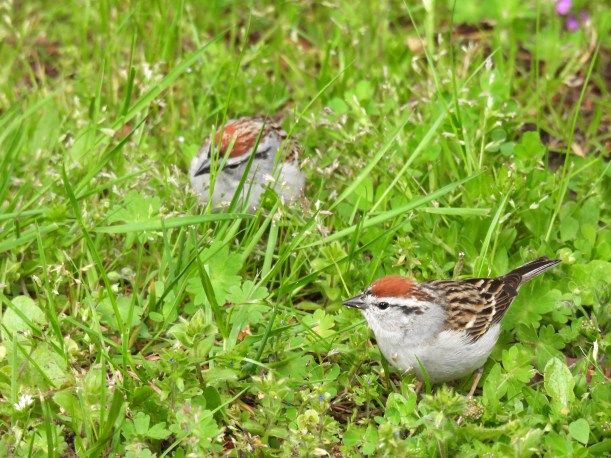
Little songbirds like these chipping sparrows will be targeted by hawks who sit silently in the nearby trees, waiting for an opportunity to swoop down and scoop up a little snack.
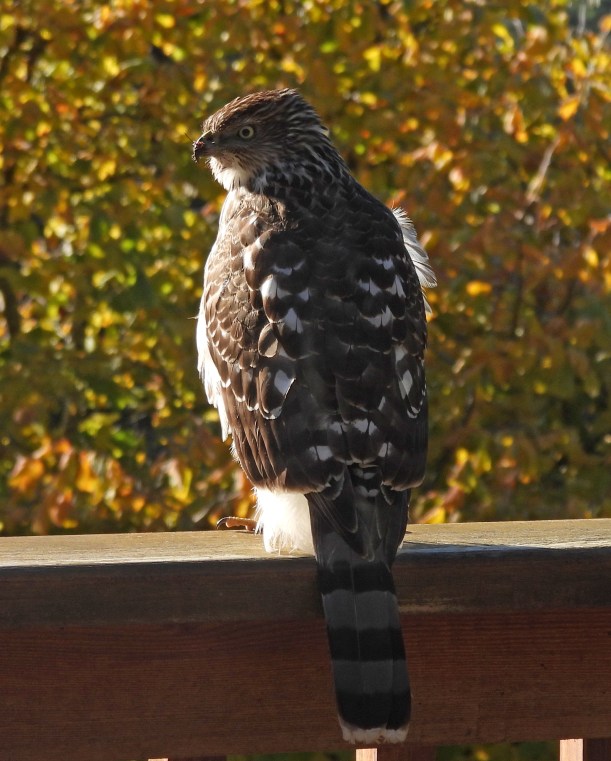
This broad-winged hawk would be happy with a songbird or even a careless squirrel. Patience and alertness are what it’s all about.
The merlin doesn’t mind picking up a songbird either. He’ll happily take down a flicker that might be almost the same size as him.
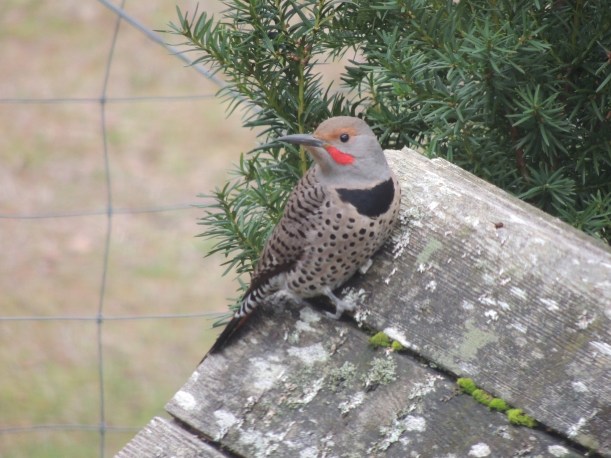
The red-shafted northern flicker had better be alert. It’s a dangerous world out there.
The general rule for non-predatory birds, especially in the autumn, is “heads up or be eaten.” It’s the raptors who are the meat eaters, while the gentler plant- and insect-eaters need to fear them.
And I haven’t even mentioned the owls yet. Rabbits and mice beware!
When we see the shadows on the moon, we are probably looking at craters, or so we’ve been told.
Sometimes when we look, we see eyes and a mouth that looks like a big O! Last night I couldn’t see the big O but I thought I saw eyes and a nose. Maybe he was wearing a Covid mask. Moments later the man in the moon was gone. But who was that masked man?
Well, we know he arrived in the spaceship Apollo 11.
I tried to make the face a likeness of Neil Armstrong, but I’m not much of an artist.
But sometimes, when I look at the moon, I see “el conejo en la luna,” the rabbit in the moon. Aztec legends tell several versions of the story of their god, Quetzalcoatl, who was responsible for the rabbit ending up in the moon.
In one version Quetzalcoatl is still a man on Earth. He is tired and hungry from wandering and a rabbit offers himself up as food for him. Quetzalcoatl lifts him up to the moon and then brings him down again, thanking the rabbit for his noble offer and saying that for this generosity his shadow will be displayed on the moon forever to remind people of the rabbit’s goodness.
(We don’t know if he ate the rabbit.)
My apologies to all the bunnies out there for the lumpy, bumpy image I’ve posted. I’m sure the earthly rabbits look much better than el conejo en la luna.
The Captain and I were having an afternoon coffee on our deck when Randolph came to visit. He’d been lurking around the yard late at night and usually disappeared in the wee hours of the morning. But lately he is getting braver about being seen in the glaring daylight hours.
He wasn’t too concerned about anything – even took time to scratch an itch.
He came right out in the open, looking for dandelions in the grass, and this explains his more frequent visits. Our grass is loaded in weeds. Definitely not a Scott’s Turfbuilder lawn. I don’t really mind him digging out the weeds to get at the roots or bugs, but I wish he would refill the holes.
Until now I had been blaming Bonnie and Benny Bunny for all the holes dug in our “lawn,” and they do their fair share of digging, but I saw Randolph in action this day, and knew I had to allow the bunnies some leniency. They are probably only guilty of digging a third of the holes in the yard.
A new load of firewood waits for someone to move it into the shed. Doesn’t seem like a big job unless you consider that each piece of firewood must be picked up and set down again. If there are 300 pieces of firewood that means I have to bend down to pick up or put down wood 600 times. My back hurts already!
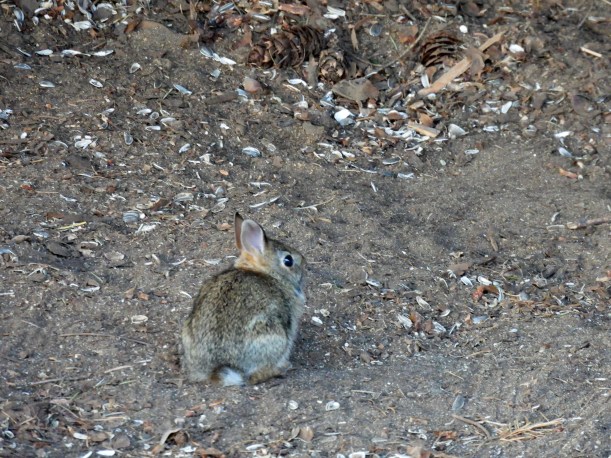
If I thought this prospect was daunting, how do you think young Benny Bunny felt when his hiding place was discovered after only a short time and he came bouncing out from under the firewood? Now he will have to find another place to hide.
“Don’t fret, Benny,” said Bonnie Bunny. “As long as we have each other, we can snuggle up together tonight. But for now, let’s get out of here. Quick like a bunny!”
You can see how tiny Bonnie is compared to the piece of firewood she’s sitting beside.
The lack of a steady supply of water makes it hard to grow much. And look at the terrain. Can you imagine an expensive piece of farm machinery trying to negotiate those hillsides? I think farming this area is out of the question.
Still, some vegetation just plants itself. It has to be tough to survive. Grasses are real survivors if they only have a chance to sprout.
But seeds are easily washed away if not in the sparse rain, then at least in the run-off from snowmelt. The wind lends a hand too. Between them, wind and water carve out a landscape full of curves, rifts, pillars, and odd-shaped hills.
So what is the good of these badlands? That is, if there is anything good about them.
At first glance, it looks like a wasteland. You’d be surprised though, how much life it supports. Insects, obviously, and those attract birds and snakes. Lots of snakes. I guess that’s a good thing, if you like snakes. They have to go somewhere.
The carved out crumbling rock formations provide many crevices and holes for a snake to hide in – a place to get out of the hot sun. In the late fall, rattlers will travel miles through prairie grasslands to the badlands where they seek out underground chambers (caves and tunnels) and scooped-out areas where they can snuggle up together for the winter in their very own hibernaculum. These dens are often underground and close to the water table, but preferably in a place where it stays above freezing.
The erosion in the badlands creates all kinds of possible hiding places for small animals. The fields at the edge of a badlands area could provide food for insects, small rodents, rabbits, and game birds such as grouse and pheasants, which in turn attract predators such as hawks and owls.
Even deer may be found wandering through the badlands.
If you have a dog though, watch where it goes. You don’t want it to be bitten by a sneaky snake. If you take your dog there, maybe to hunt a partridge or other game bird for dinner, the best time to do that is probably early in the morning when it is cool and the snakes are still a bit poky.
A friend told me of a time when his dog (same breed as our Emma – an English field cocker) was running down a path ahead of him and a rattler was in the path directly in front of her. The dog leaped over the coiled up snake and kept going. It was lucky that, because of the cold morning, the snake was still quite lethargic. A few hours later, this scenario could have had an unhappy ending.
If you’re ever in a badlands area, keep your eyes open and your camera handy, and bring along your snakebite kit and the local vet’s phone number.
The balance of nature has been out of kilter for hundreds of years – basically, since man has interfered to make things better. In many cases, some species have been introduced to an area where they are not indigenous to solve a problem “naturally,” without resorting to pesticides or culling of another species.
An example is the cane toad in Australia. It was brought into the country to deal with the cane beetle in the sugar cane fields. Unfortunately the cane toad is now the bigger problem.
Rabbits, too, were introduced there, and have multiplied as only rabbits can, making their population unmanageable.
The green crab has been transported in ships’ ballasts and has upset the marine ecosystems wherever it has established itself.
Zebra mussels are also an invasive species transported by ships.
Feral swine (also called wild pigs, Eurasian boar, or feral hogs) destroy agricultural fields and impact the regeneration of forests by eating the seeds, nuts, and cones of trees. The swine are omnivorous and so are a threat to young livestock. They can do tremendous damage to the agricultural industry. Feral swine carry at least 30 types of diseases and 40 types of parasites. They are really bad news!
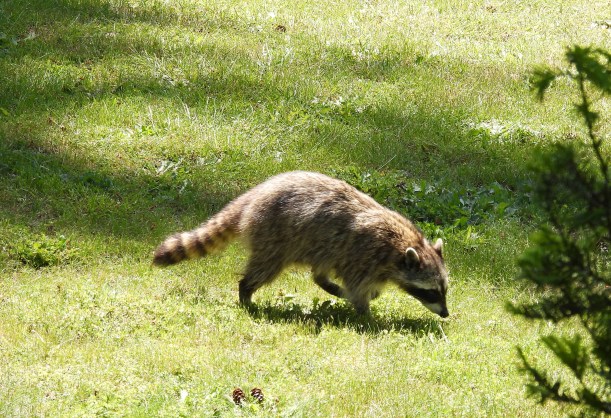
Burmese pythons have been introduced to Florida’s Everglades through the pet trade and have upset the balance of nature there. They prey on rabbits, foxes, raccoons, and birds, to name a few. Many populations of smaller mammals have been decimated. The Burmese python has also brought a pentastome parasitic disease, infecting other reptiles. The parasite is now considered to be endemic in Florida.
So you see that introduced species can be quite detrimental to their new habitat.
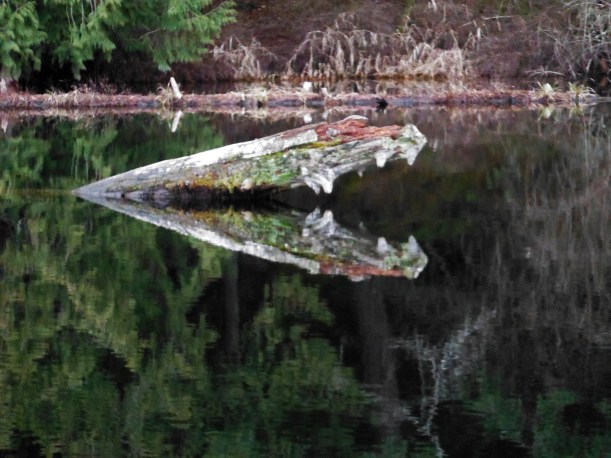
While trout fishing on a local lake recently, the Captain encountered a new invasive species, the freshwater crocodile. It is pictured here, photo taken with the Captain’s little point-and-click Fuji camera. It is a bit blurry because he was shaking with fear, and paddling with one hand while he risked his life to take the photo with the other.
If you ever find yourself tempted to swim in a freshwater lake in British Columbia, be aware that these newly introduced crocodiles could appear from the depths to nibble on their favourite delicacy, swimmers’ toes.












 wordsfromanneli