Category Archives: Animals
Reflections of Love
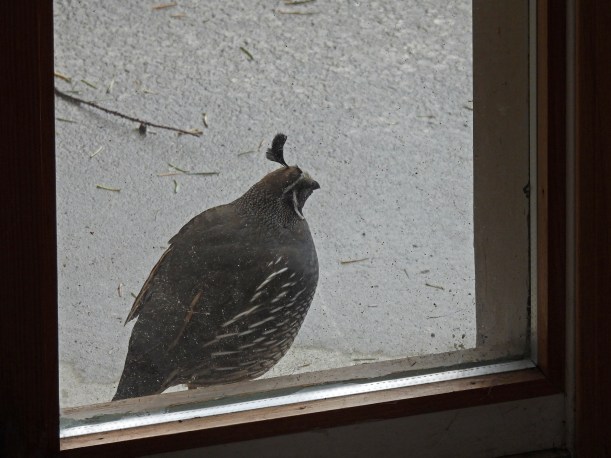
The other day I finally got around to cleaning some of the windows. I wondered if Quentin would be at the front door even more enthusiastically than before, talking to his reflection, hoping this “friend” would come out to play.
Sure enough, he appeared in a short time and had a conversation with himself at the window next to the front door.
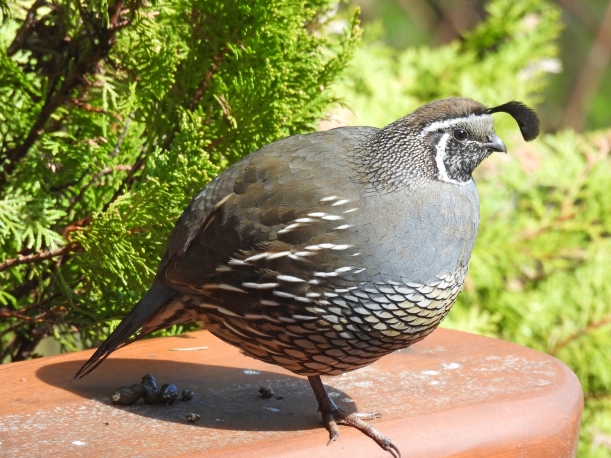
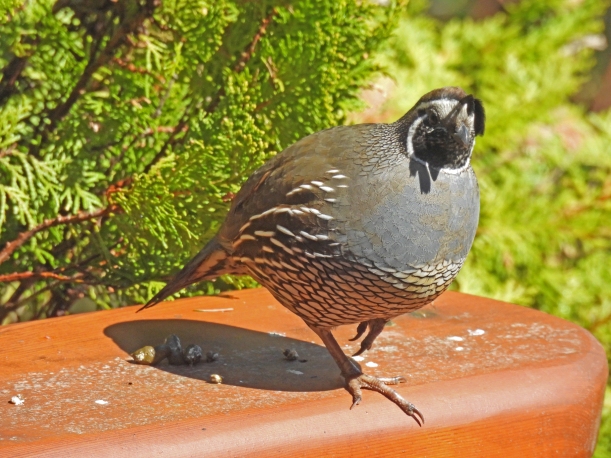
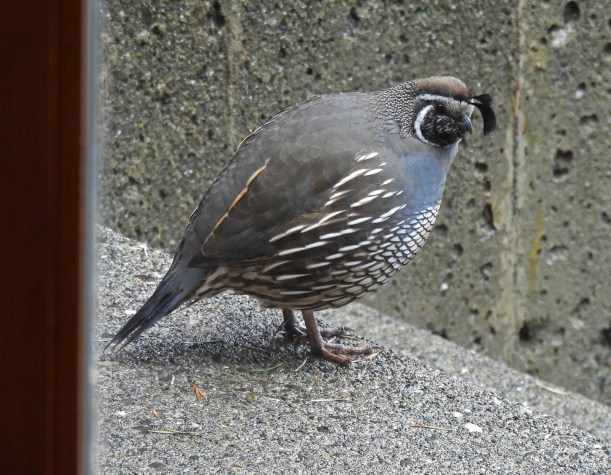
Then he hopped onto the railing and sunned himself. (By the way, he does have two legs. Maybe he’s just warming one leg in his feathers.)
I told him he’s making a mess of the railing. What if someone wanted to hold onto it to steady themselves as they walked down the steps? But he just looked at me incredulously and said, “Well, I have to go somewhere!”
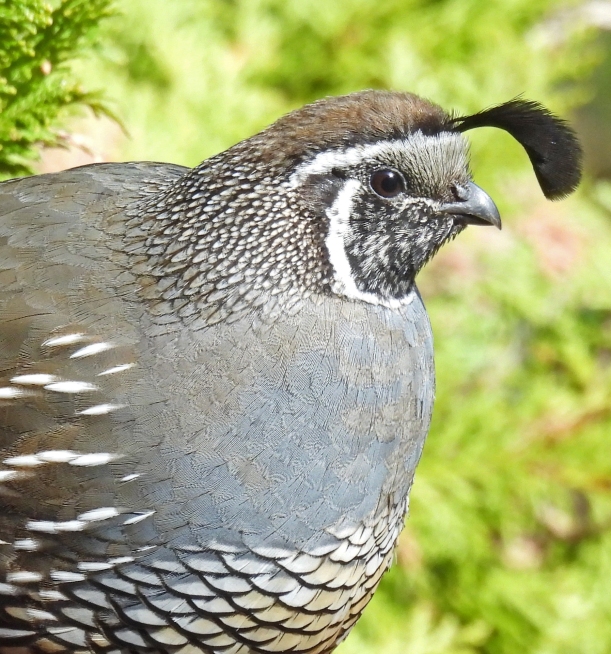
Just look at his beautifully designed head. So many different feather sizes, shapes, and colours, all in perfectly arranged sets of patterns.
Quentin Quail is beautiful,
Still his search is dutiful,
Hunting for his long lost mate,
Lonely living is his fate.
Yet he visits at the door,
His reflection to adore,
Thinking this is Queenie Quail,
Though he once again will fail.
Pondering his solitude,
He does nothing to intrude,
Quietly he soaks up sun,
Waiting for his only one.
A Different Drum
I’d been reading a book in my living room. The sun shone in through the window and I dozed off with its warmth on the back of my neck.
I woke to the sound of someone dragging a big metal appliance across the concrete outside the downstairs family room. Emma barked like crazy to tell me that someone was burgling the house.
I ran out onto the deck to see what was going on. I saw nothing, but I heard the noise again. Strange!
The metallic rattling came again and I looked up towards the sound.
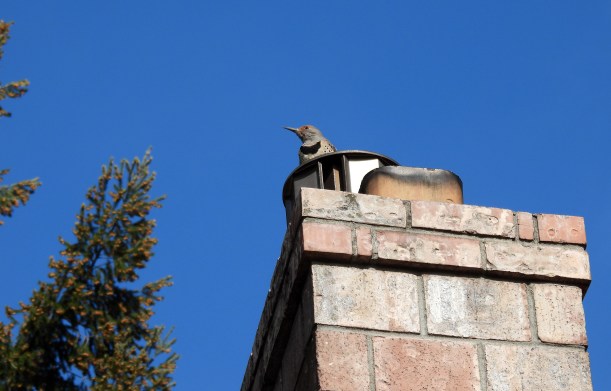
A flicker was sitting on the top of the new flue to the gas fireplace.
Just listen to his drumming!
The Weather Wins
Evidence of winter damage can last for years in America’s prairie landscapes. Farmers did their best to put up strong buildings to withstand the elements in the days before modern building materials were available. Even so, the fierce storms often proved too much for the buildings. These roofs most likely had a huge dump of snow on them at one time. The weight crushed the roofs as it crushed the farmer’s will to rebuild. In the dry climate, with little rainfall and lots of heat, crops could easily fail, discouraging even those who would have wished to rebuild.
Many buildings were left to their fate in the lonely landscape.
Even in more modern times, nature was more powerful than man. I hope the family who lived here wasn’t in the trailer when it blew over. If they were, they would have been rocking and rolling.
The tenants in these houses have moved out long ago. Most likely they, or the people they sold to, live nearby.
Somebody has to feed the horses.
Even the horses are hiding behind the house to get out of the blazing sun or the howling wind.
And yet, it’s a beautiful place to visit. Just very hard to live there, because the weather always wins.
Caviar, anyone?
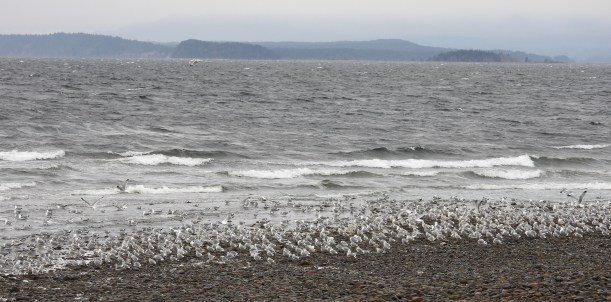
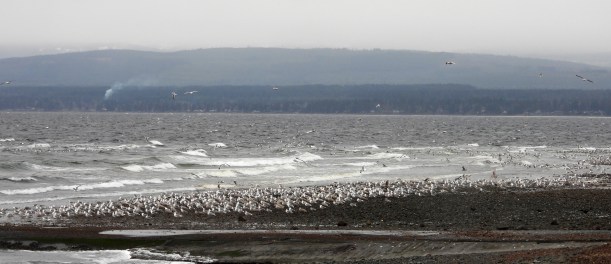
This Vancouver Island beach is very popular at this time of year. The western gulls flock here literally by the thousands.
What’s the attraction?
It’s not exactly a pretty, touristy beach of white sand.
But the gulls know what they’re after.
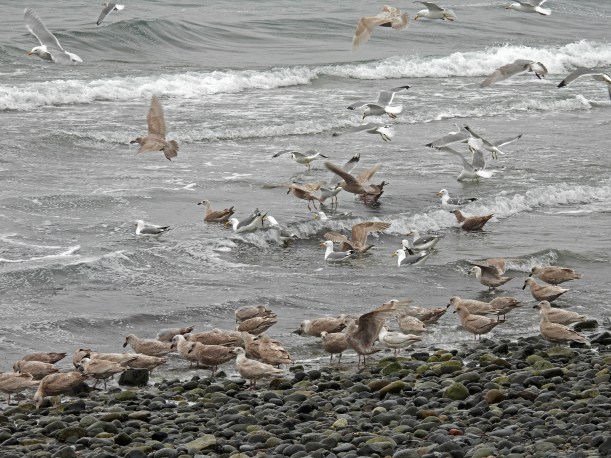
Lunch is being served. The gull in the top left of the photo below has a beak full of caviar.
It’s herring time and the roe is all over the beach. Gourmet dining at its finest.
A word to the wise: if you are walking this stretch of beach at herring time, it might be a good idea to bring an umbrella even if it’s not raining. When the gulls get riled up and are wheeling overhead, some of them can’t always contain their excitement. Best to have that umbrella ready.
Introduced Species
The balance of nature has been out of kilter for hundreds of years – basically, since man has interfered to make things better. In many cases, some species have been introduced to an area where they are not indigenous to solve a problem “naturally,” without resorting to pesticides or culling of another species.
An example is the cane toad in Australia. It was brought into the country to deal with the cane beetle in the sugar cane fields. Unfortunately the cane toad is now the bigger problem.
Rabbits, too, were introduced there, and have multiplied as only rabbits can, making their population unmanageable.
The green crab has been transported in ships’ ballasts and has upset the marine ecosystems wherever it has established itself.
Zebra mussels are also an invasive species transported by ships.
Feral swine (also called wild pigs, Eurasian boar, or feral hogs) destroy agricultural fields and impact the regeneration of forests by eating the seeds, nuts, and cones of trees. The swine are omnivorous and so are a threat to young livestock. They can do tremendous damage to the agricultural industry. Feral swine carry at least 30 types of diseases and 40 types of parasites. They are really bad news!
Burmese pythons have been introduced to Florida’s Everglades through the pet trade and have upset the balance of nature there. They prey on rabbits, foxes, raccoons, and birds, to name a few. Many populations of smaller mammals have been decimated. The Burmese python has also brought a pentastome parasitic disease, infecting other reptiles. The parasite is now considered to be endemic in Florida.
So you see that introduced species can be quite detrimental to their new habitat.
While trout fishing on a local lake recently, the Captain encountered a new invasive species, the freshwater crocodile. It is pictured here, photo taken with the Captain’s little point-and-click Fuji camera. It is a bit blurry because he was shaking with fear, and paddling with one hand while he risked his life to take the photo with the other.
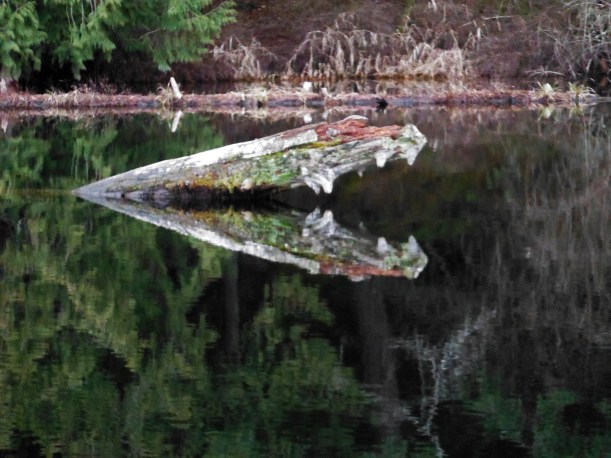
If you ever find yourself tempted to swim in a freshwater lake in British Columbia, be aware that these newly introduced crocodiles could appear from the depths to nibble on their favourite delicacy, swimmers’ toes.
Quentin’s Return
I may have mentioned that a few years ago we had so many quail here, they crossed our yard like a living carpet of quail, forty or more.
As more houses were built, cats and dogs and people have disrupted the quail’s natural habitat, and the fate of the quail population was doomed. In a few short years the quail died off. One lone survivor has hung on, all alone for at least three years.
You may have met Quentin Quail in one of my previous blog posts. https://wordsfromanneli.com/2021/04/11/quentin-quail/
He still is the loneliest quail I’ve ever seen. I thought for sure this past cold winter would have killed him, but even after deadly cold blizzards and bone-chilling north winds, he has survived.
As usual, he is looking for the friend he thinks he sees in the window by our front door. Even with the glass so dirty from the weather and from Emma’s nose prints, he must see his reflection in it and think it is another quail. My heart breaks for him.
“I just don’t understand why she won’t come out to play.”
I really hope Quentin is careful. These past couple of days I’ve noticed what I think is a merlin hanging around. I tried to get a picture of it today, but it flew to a nearby pole and the picture is not as good as I’d like it to be. But here he is, the potential quail killer.
I hope he finds a mouse or a rat to eat instead.
Over- and Underachievers
Seems that when spring is near, the increased daylight hours spark something in chickens that gets them laying more. Some of the younger birds lay tiny eggs, and then they skip a day and lay a double-sized egg (usually with a double yolk). It takes a while to get it all sorted out and they start laying regular-sized eggs.
The people who own the free-range chickens where we get our eggs have a contented flock of hens. These chickens have the run of the yard and the family’s big black labrador retriever keeps an eye on them. The dog and the hens are good friends. She wouldn’t dream of harassing the chickens.
It’s a happy farmyard.
Some of the hens lay green eggs; others lay brown ones. At this time of year, the size difference in the eggs can be dramatic.
I’ve tried to arrange them so you can compare the sizes. One green egg and three brown ones are huge (I felt sorry for the hen’s bum). I put a normal-size egg next to the big ones for comparison, and then there is a small … very small … brown egg.
You may wonder what the speckled egg is all about. It is a quail egg – one that I’ve had for years and is blown out. Remember in the old days when we painted Easter eggs and put a pinhole in the top and the bottom of the egg? We blew on the one pinhole and the contents of the egg came pouring out of the other. Then the shell could be preserved without a rotting egg inside.
I put that quail egg beside the small chicken egg so you can see how tiny they are.
And that reminds me. I had a very special visitor yesterday. In my next blog I’ll tell you about it.
Considerations
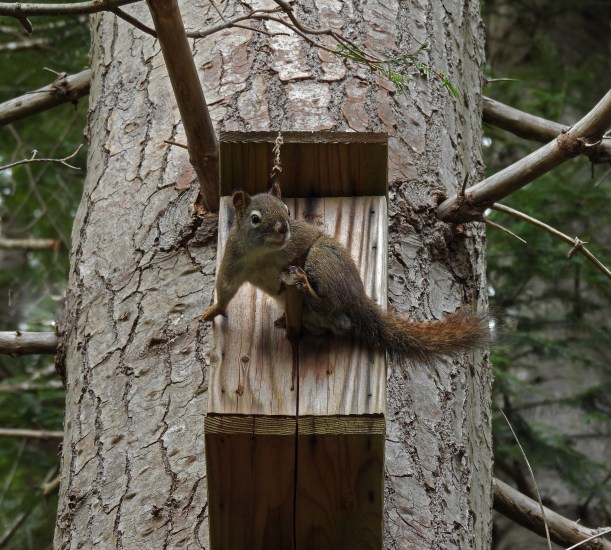
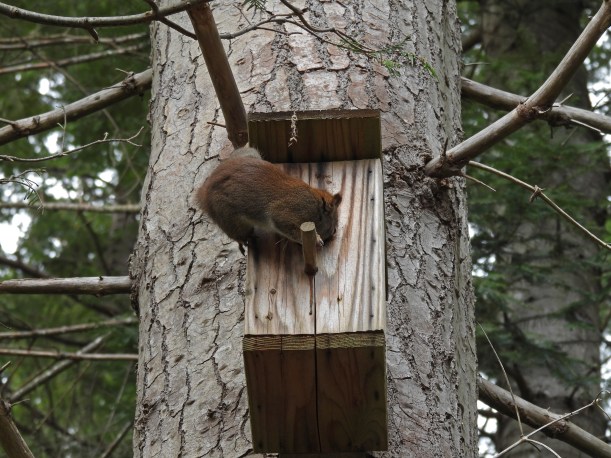
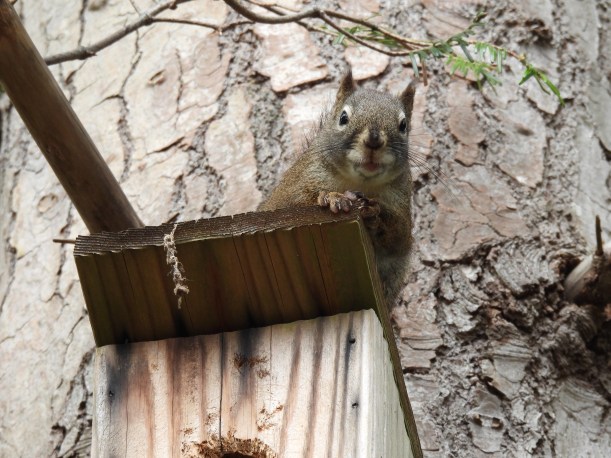
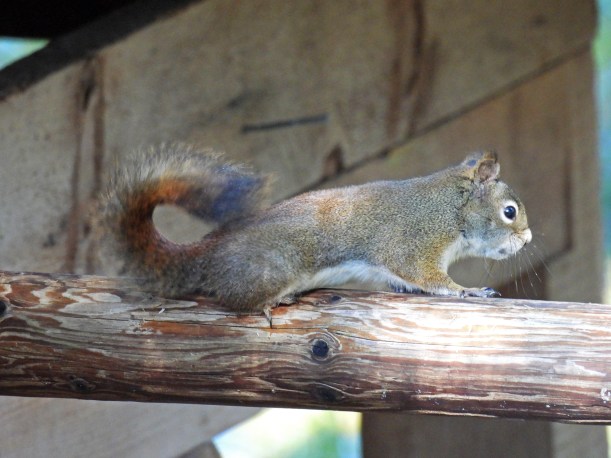
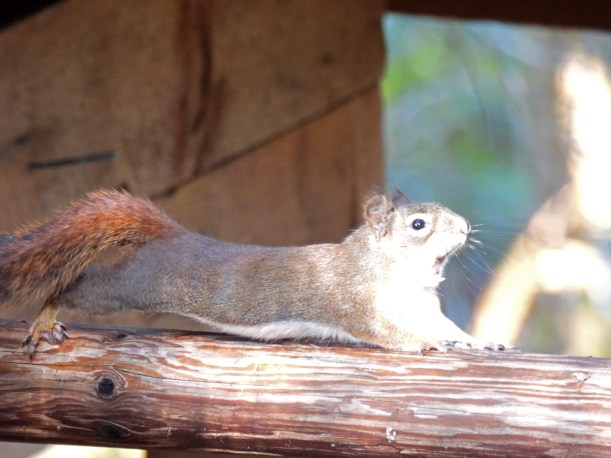
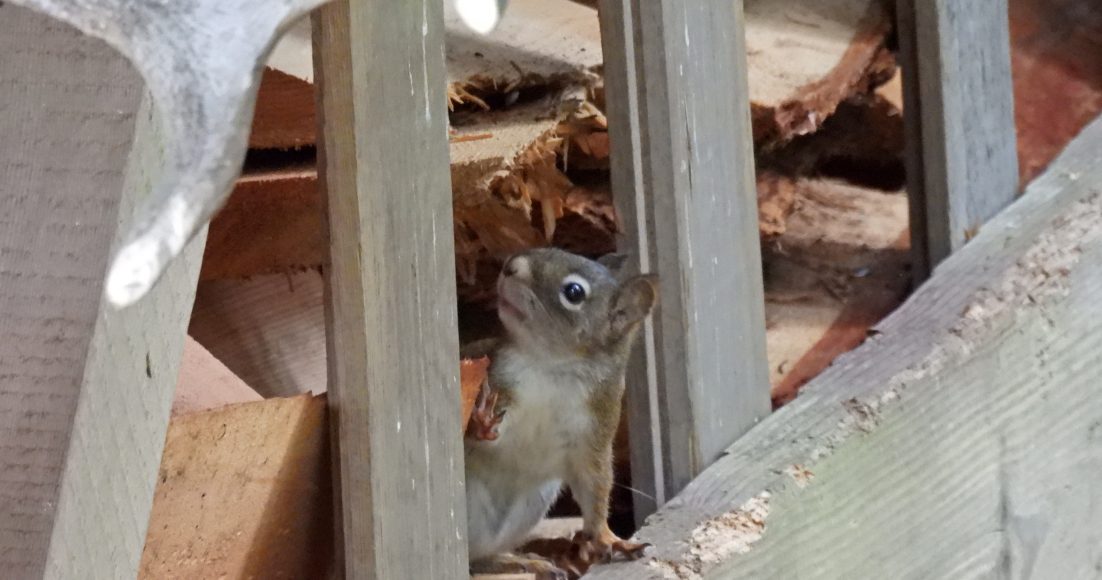
In spite of being pregnant, probably with triplets or quadruplets, Della still likes to explore the forest around the woodshed. She has a long pole that she runs out on. She checks for danger, and then launches herself to the nearest fir tree.
Usually … that’s what she does.
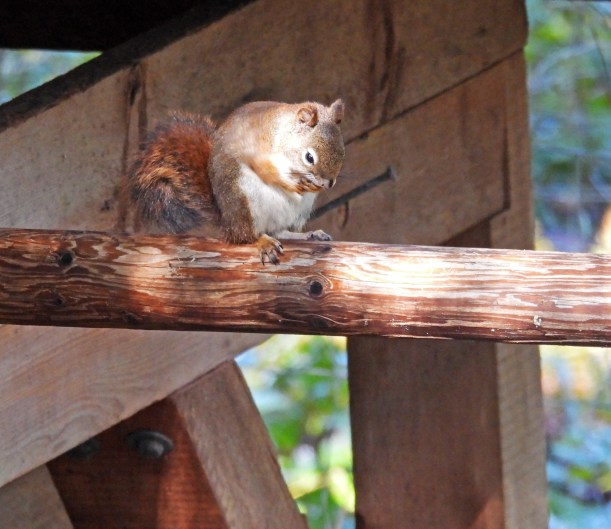
Today, getting ready to take the leap, she hesitates.
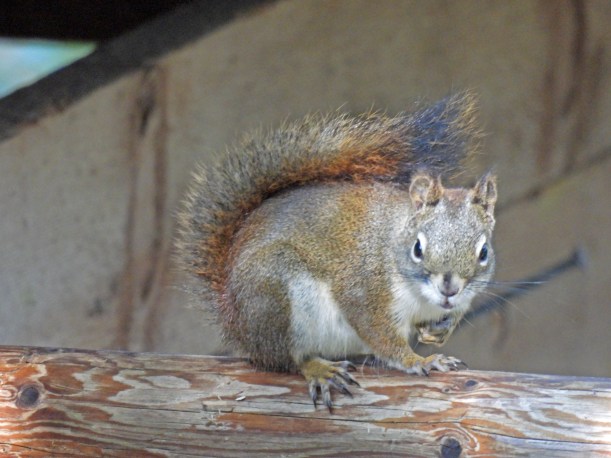
Concentrate! Get ready to leap.
Ahh! Yawwwwwn! The sun is shining here and it’s so lovely after so much snow and rain. I’m just going to enjoy a few rays of warmth before I launch myself into the trees.
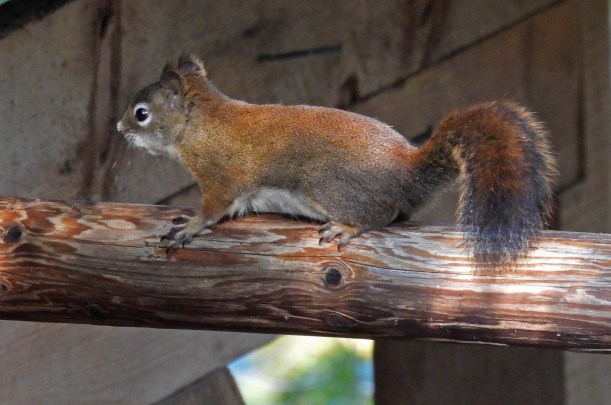
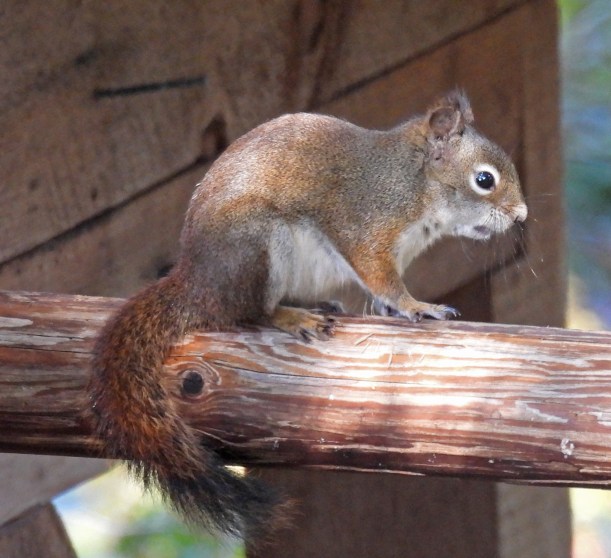
Now for that jump to the fir tree. Hmm … was it always this scary?
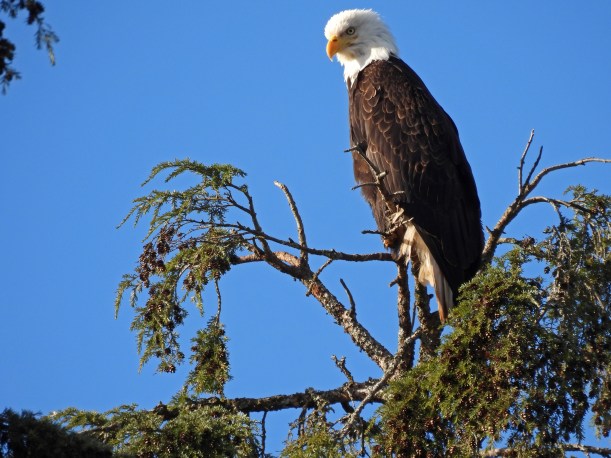
Hhhhh! Oh dear … what if I fall? My poor babies!
Such a long way down….
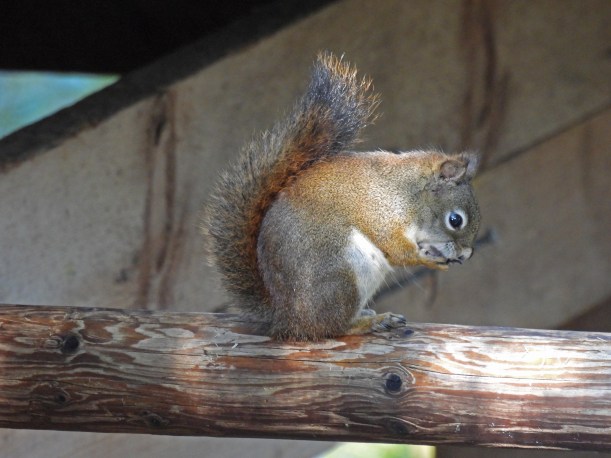
Know what? I think I’m going to play it safe today.
I’m going to check out the sunflower seeds in my jar and have a little snack … and then we’ll see.
As a young and playful squirrel,
Nothing could deter this girl,
Now I’m older, more mature,
Chances that I take are fewer.
Flying through the air with ease,
Grasping branches of the trees,
Up a hundred feet, I’d run,
I’d get high this way for fun.
But for now I take it slow,
I’m more careful where I go,
Babies soon will be with me,
And we’ll all go tree to tree.