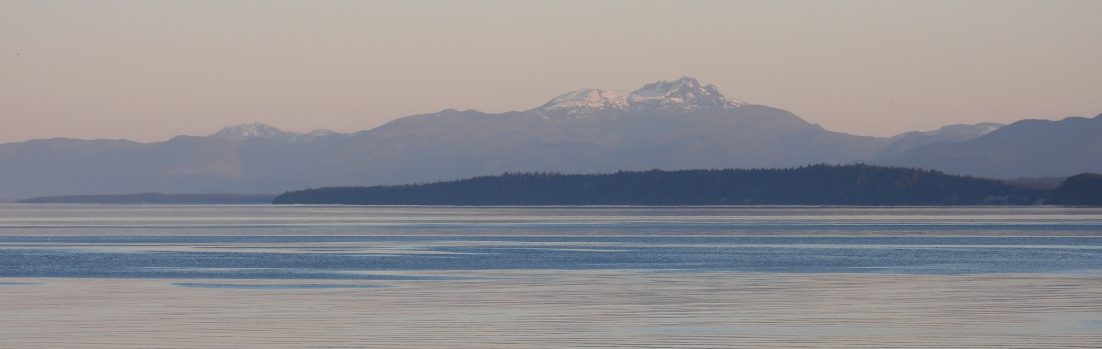
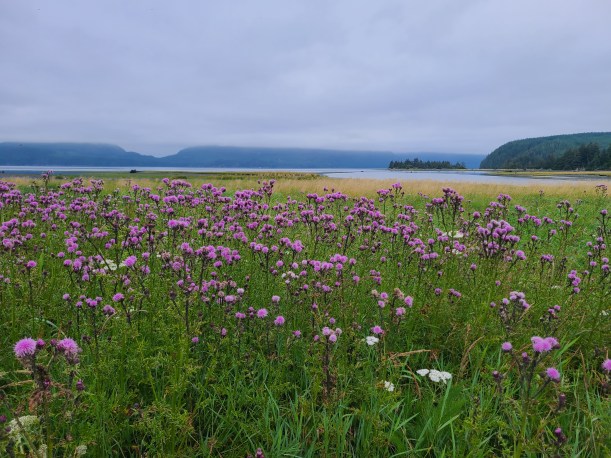
The lack of a steady supply of water makes it hard to grow much. And look at the terrain. Can you imagine an expensive piece of farm machinery trying to negotiate those hillsides? I think farming this area is out of the question.
Still, some vegetation just plants itself. It has to be tough to survive. Grasses are real survivors if they only have a chance to sprout.
But seeds are easily washed away if not in the sparse rain, then at least in the run-off from snowmelt. The wind lends a hand too. Between them, wind and water carve out a landscape full of curves, rifts, pillars, and odd-shaped hills.
So what is the good of these badlands? That is, if there is anything good about them.
At first glance, it looks like a wasteland. You’d be surprised though, how much life it supports. Insects, obviously, and those attract birds and snakes. Lots of snakes. I guess that’s a good thing, if you like snakes. They have to go somewhere.
The carved out crumbling rock formations provide many crevices and holes for a snake to hide in – a place to get out of the hot sun. In the late fall, rattlers will travel miles through prairie grasslands to the badlands where they seek out underground chambers (caves and tunnels) and scooped-out areas where they can snuggle up together for the winter in their very own hibernaculum. These dens are often underground and close to the water table, but preferably in a place where it stays above freezing.
The erosion in the badlands creates all kinds of possible hiding places for small animals. The fields at the edge of a badlands area could provide food for insects, small rodents, rabbits, and game birds such as grouse and pheasants, which in turn attract predators such as hawks and owls.
Even deer may be found wandering through the badlands.
If you have a dog though, watch where it goes. You don’t want it to be bitten by a sneaky snake. If you take your dog there, maybe to hunt a partridge or other game bird for dinner, the best time to do that is probably early in the morning when it is cool and the snakes are still a bit poky.
A friend told me of a time when his dog (same breed as our Emma – an English field cocker) was running down a path ahead of him and a rattler was in the path directly in front of her. The dog leaped over the coiled up snake and kept going. It was lucky that, because of the cold morning, the snake was still quite lethargic. A few hours later, this scenario could have had an unhappy ending.
If you’re ever in a badlands area, keep your eyes open and your camera handy, and bring along your snakebite kit and the local vet’s phone number.
The robin’s nest lies empty, and four little newly feathered babies are braving the unseasonably cold spring. The wind ruffles the baby featherlets. Drips of rain plaster the down onto their skinny pink bodies. What little body heat they had must be replenished quickly with food brought to them by their parents.
Junior #1 sits, wondering what to do.
Junior #2 sits a little more hidden, waiting for his mother to feed him.
Mother robin wonders where she should look for food for her brood. She also needs to find Junior #3 and #4.
I felt so sorry for them all that I went out into the miserable, cold wind, and dug up a few shovelfuls of dirt in my garden, knowing that it is infested with the grubs of the ten-lined beetles. I threw them onto the upturned lid of an old garbage can.
These grubs hide deep in the soil and wait for potatoes to grow so they can eat them before I try to harvest them.
Then, satiated, they wait for the first very hot day to come out of the ground and fly around as ten-lined beetles, again, as they do every year, looking for me so they can land on my back where I can’t reach them, and I have to run around the yard screaming until the Captain comes out to save me.
But this year I’m getting my revenge on them. At the same time I’m helping the mother robin to feed her brood.
Watch this video of how “Man” (in this case “Woman”) has helped Nature.
Then you can tell me if I did a bad thing or a good thing.
You may also remember that there were four pretty blue eggs in it.
A few days after discovering the eggs, I peeked into the nest when the mother wasn’t on the nest and I saw that the eggs had hatched, but I couldn’t tell how many.
About ten days later, I dared to take another quick peek with my camera ready. I had to hurry before the mother came back. I didn’t want to upset her. Balancing on a few toes, I leaned into the yew tree, held the branches back with one hand and took the picture with the camera flailing around in the other hand. Hence, the challenge for you to figure out what you’re looking at.
Can you sort out how many baby robins have hatched? It helps to look for big eyes and beaks.
Don’t forget to visit my other blog for helpful hints in writing-related topics.
If you have any tree stumps on your property, you might want to think twice before getting them removed. They are the equivalent of a gourmet restaurant for a woodpecker. Here is Dryocopus pileatus (the pileated woodpecker) working for his meal. Pileatus means capped and refers to his red cap.
As the wood decays, all sorts of worms and bugs feed off it, and in turn they become food for some birds. This pileated woodpecker is chipping into the bark of the stump and must be finding something good to eat. See his tongue sticking out, slurping up the appetizers?
Now he’s discovered a crack where the wood has split. This is typically a good place to look for bugs, as the rainwater has dripped into the split and rotted the wood, making it ideal for the bugs that the woodpecker is looking for.
Notice how the pileated woodpecker is using his tail for balance as he hammers away at the stump looking for his supper.
In the video below, I had some trouble holding the camera still, but halfway through, I finally got it settled. Have a look at Woody pecking for his dinner.
Blue grouse on Vancouver Island generally live in coniferous forests on the hilly slopes. In the summer they spend more time in the lower elevations near the edges of treed areas, presumably eating more berries and insects, while in the winter they go higher up the slopes to more dense stand of coniferous trees where they eat buds and shoots of the trees.
We live far from the slopes of the hills, quite close to the water, so I was shocked to see this blue grouse flying up into our fir trees to get away from Emma (our English cocker spaniel) whom I had just put out into the backyard.
I still don’t know how it got here, and what it was doing in our neck of the woods.
The bright yellow skin over the eye is a telltale marking of the male blue grouse. The female has only a pale patch of bare skin over the eye. But even without noticing this slight difference, if you saw a male and female grouse side by side, you’d wonder if they were the same species. The males are shades of black, brown, blue and gray, speckled with white, while the females are smaller and a dark reddish brown.
Keeping their legs warm on those higher elevations are the tiny feathers that go down to their toes.
I raised chickens many years ago and was used to picking them up. So when I saw a blue grouse strutting back and forth along the side of a logging road one spring, I walked over to it. Most likely its mate had a nest nearby. It was quite aggressive and ran at my legs. I crouched down and slowly reached out my left hand. It pecked the skin between my thumb and forefinger. While it held onto my left hand, I scooped it up in my right hand and immediately tucked its head under my arm so it was in the dark. It stayed very still while the Captain and I had a good look at it. We gave it a gentle pat and put it back down on the side of the road.
I don’t go around disturbing nesting birds (and I can only assume its mate had a nest nearby – I never saw it), but this bird was so actively patrolling the area I couldn’t resist getting out and saying hello. It was an amazing feeling to actually hold a wild bird for a few moments.
It was a day of surprises. Yesterday, this plum tree had only tightly bunched up buds. Today the sun came out for a few minutes and the plum tree called out,
“Look at me! Look at me!
Every flower a plum will be!”
The next surprise lay at my feet as I stopped to admire the plum tree. It was just lucky I didn’t step on it.
“Nothing interesting, Ma. I’m just wondering who’s going to clean up all the mess those seagulls are making. After eating all those herring and the herring roe, I bet it’s pretty slick and hummy on that roof.”
“The squawking and shrieking is ear piercing. They have no pride. Slithering around on that roof as they digest their shreds of herring. But I guess they do a good job of cleaning up the beaches. If only they’d clean up the roof after they … you know …. But wait! What’s that I hear the seagulls saying?”