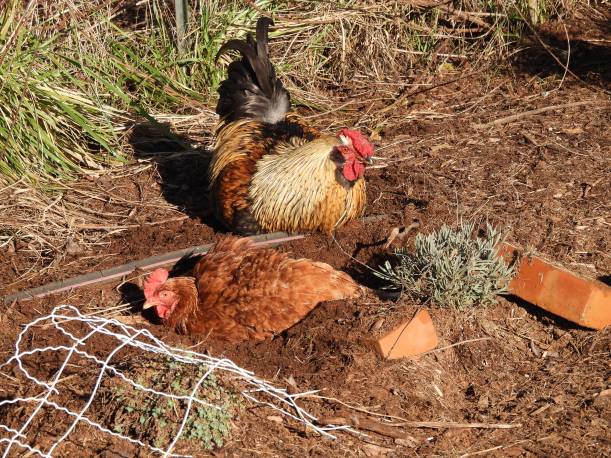
“Prince Goldie,” said White Betty. “Just look here. First rays of sunshine this year, and I think Bossie Betty is depressed. She’s dug herself a hole so deep she’ll never get out. Can’t you make her get up?”
“She doen’t seem to be listening to me. Not paying attention to the pecking order at all,” Goldie said. “I tried crowing and she just scrunched her eyes shut and ducked her head down.”
“Ooooh! That’s bad, if she’s ducking. She doesn’t even know she’s a chicken anymore. Well, that’s just ducky! I give up on her. I’m leaving.”
“Aw, c’mon! Don’t chicken out, Betts. We can’t just leave her there.”
“Don’t you worry, my pretty Bossie Betty. I’ll stay with you. Right here in this nice sunny spot … ahhhh…. Oh, this is ni-i-i-ice. No wonder you didn’t want to move,” crowed Goldie. “So warm! And the earth smells so wonderful, so dry and aromatic after a winter of wet muck. Yes, I could get used to this.”
“Would you like to go bowling, Goldie?” Bossie asked.
“Bowling?”
“Yes. Dust bowling. It’s like a beautiful bath and the sun warms you at the same time.”
“I see what you mean, Bossie. Ah yes, it’s fit for a prince. Better than playing in a mud puddle, that’s for sure.”
Has anyone seen Anneli? She hasn’t posted anything for quite a few days. Is she okay? I’ve been keeping my eyes open for her in between pecking for bugs, but I haven’t seen a glimpse of her. Anyone…?
I don’t know what’s going on,
Anneli seems to be gone.
I keep on looking out for her,
Time to make a post I’m sure.
It isn’t like her to neglect,
All us birds, but what the heck,
Soon she’ll get it all together,
She’s just hiding from the weather.
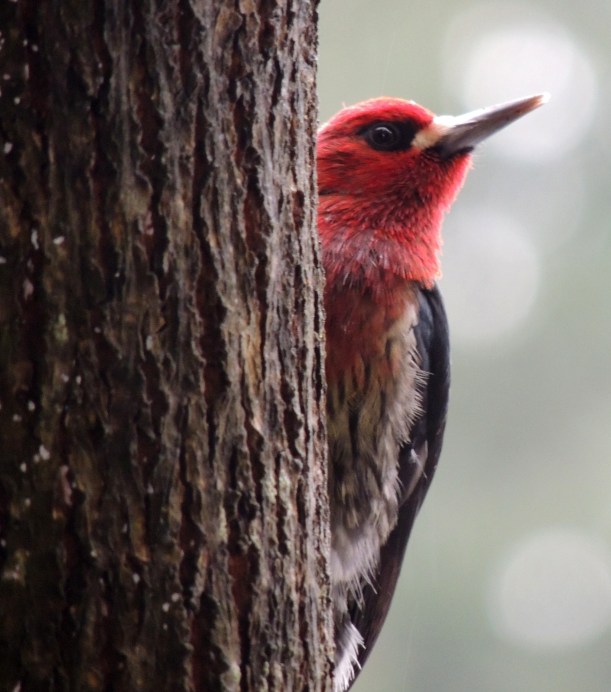
Okay, okay, I’m here! It’s just that I’ve been up to the proverbial eyeballs lately, and I’m very busy with copy-editing, but I’ll be back soon. Meanwhile, hang in there, and please don’t kill that tree with all your pecking.
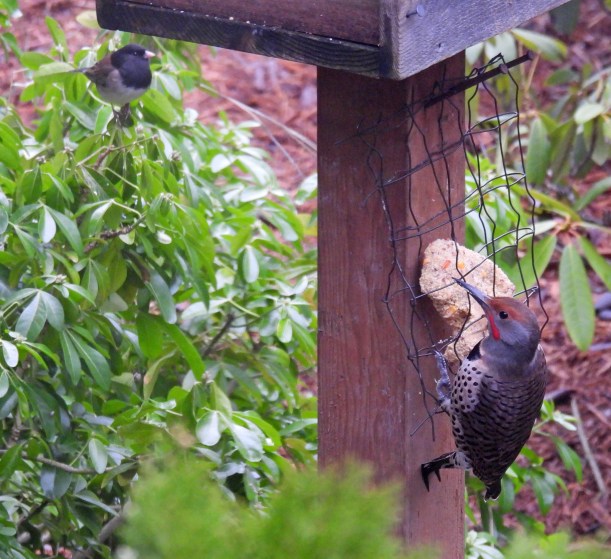
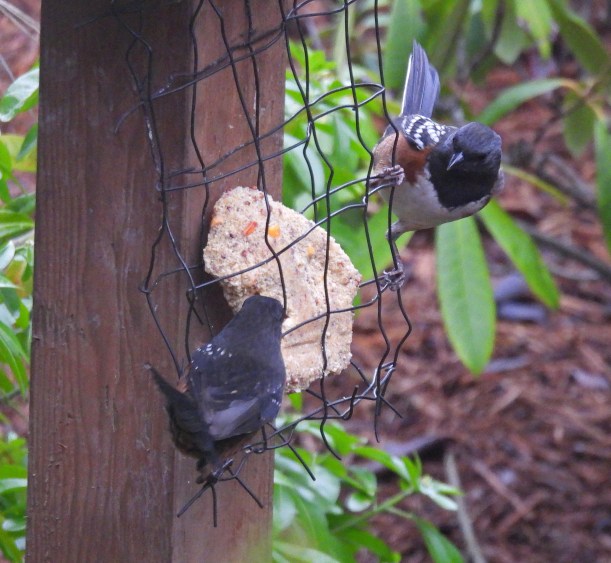
“Floyd! You’ve been at the suet block forever!” says Johnny Junco. “Don’t you think you should give me a turn?”
“Bah! Go eat the seeds I drop,” says Floyd.
Rufus and his Missus zoom in as soon as Floyd takes a break. “How is it?” asks Rufus.
“A lot of fat before you can get to the good stuff,” she says.
“Well, why don’t you get right into the cage?” Rufus says. “You’re slim enough.”
“Why thank you,” the Missus says. “How kind of you to say so. I hadn’t thought of that. But you stand guard in case Floyd or his girlfriend, Bossy Flossie, comes back.”
“I guess I’ll just have to pick at what drops on the ground,” Johnny says. “Those guys are just too big for me to take on. But at least there’s something for everyone.”
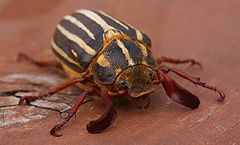
The ten-lined June beetle lives underground for two or three years as a larva that looks like a hungry white prawn. It eats the roots of plants, and loves to destroy my potato crop.
When it is about 1 1/2 to 2 inches long, it hatches as a beetle, in those hot days of summer. It likes to fly around and land on an unsuspecting person’s back, where that victim can’t reach it.
These bugs freak me out. I always turn up my collar and stay close to the house when I take our dog out for last call.
Our English springer spaniel puppy, Ruby, had a different view of these beetles. She thought God had put them on this earth for her to chase and, perhaps to bring them into the house to play with.
At this point I would like to share an entry I made in one of my journals where I wrote things of note that happened on any particular day. (The Captain was away commercial fishing and might later be interested in reading how I spent my summer.) Our puppy, Ruby, was a little bit wild and crazy those first months of her life.
August 22, 2007
Ruby brought in a beetle again, after her last pee of the evening. She’s getting very surreptitious about it. She went straight to her doggie bed and put her chin on the bed, trying to look innocent. But I’m onto that fake innocence and sure enough, I heard bug screams coming from inside her mouth. “M-m-m-r-r-z-z-z! M-m-m-r-r-z-z-z!”
It was hard to make her give it up, but finally she spat it out, and batted at it meaning to play with it. I couldn’t just pick it up with my bare hands, but a little dog bowl was nearby, so I used it to try to scoop up the bug. I say “try” because it didn’t work out so well. The beetle has tiny hooks on its legs and they stuck to the fuzzy material of the dog bed. I tried scooping again and as it let go it brushed against my hand and I shrieked. The bug was flung into the corner under a chest of drawers, and Ruby, freaked out by my shriek, leapt up off the bed and backed off a few feet.
I laughed until I cried. Again. She has me laughing so often with her antics out in the yard. I’m sure the neighbours wonder about the old woman who lives alone and goes out into her backyard laughing out loud all by herself.
Folks! Dickie here. I wasn’t going to make a New Year’s resolution, but something happened to change my mind. I’m sorry to tell you we’ve got thieves in the woodshed. Well, at the very least, they’re freeloaders.
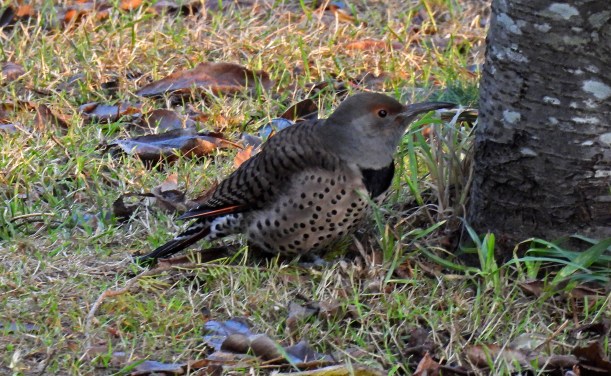
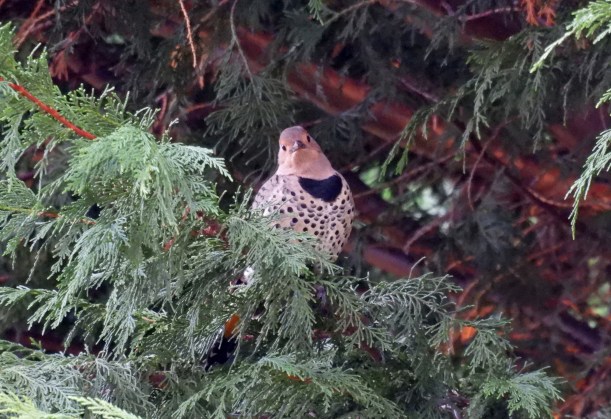
Here’s what happened. Flossie and Flora Flicker and their brother Floyd were checking out breakfast joints….
“I’ve been picking at the ground for those ant eggs and beetles, but they’ve all gone into hiding,” said Flossie.
“Give it up. I know a better place,” called Flora.
“What did you say?” Flossie shouted. “I had my head in the sand there for a minute. Didn’t hear what you said.”
“I said, Flossie, there are easier ways to get a meal around here. Your brother, Floyd has already gone to look. So, are you interested?”
“I know the sunflower seeds are stashed around here, in the woodpile,” Floyd mumbled. “I bet Rufus Towhee knows where they are, but he hasn’t been very helpful.”
“I was just about to tell Floyd about the sunflower seeds in the jar,” said Rufus, “but then he found this big ugly bug. I just had to turn my back. Can’t stand to watch him crunching away on it.”
“And now for dessert!”
“I do feel a little bit bad, eating Dickie’s sunflower seeds. He’ll be so disappointed when he sees they’re gone.”
“Oh deardeardear! They found my stash. And Floyd is bigger than I am. Did you see that spear of a beak on him? Well … lesson learned. My first New Year’s resolution – I’m going to have to start getting up earlier and get my share.”
I think I see him. I hope he’s got my bag of grubs.
Yes, you’re right! And I see the big sack full of hazelnuts for me.
Er, ah, HERE I AM, Santa. OVER HERE!
Where? I don’t see anything.
When he does come, I hope he brings me a lot of rosehips. Wonder what they’d taste like. In the winter I get tired of these holly berries and mountain ash berries. But maybe the rosehips are too fuzzy inside. They look good though.
Oooooh! Look! He’s got sleigh troubles. His reindeer are conking out. Should’ve got a Tesla Sleigh. With inflation, the price of reindeer food today is high, even for Santa. But even so, the cost of the Tesla Sleigh itself is enough to break the bank.
Yeah, he’s in trouble all right. Look! He’s turning around. Sniff… there goes that box of dog biscuits I asked for.
I see that. Hmm … I think I hear them complaining about being hitched up so close. Something about social distancing.
Sigh! No herring for supper tonight. Not by special delivery, anyway.
Well, I never! He’s going back to the North Pole. There goes that bunch of tree bugs I asked for.
I’ll go round up some recr-hoots.
Hey, you. Santa’s looking to hire you, Al and the Paca, to be his reindeer substitutes.
What’s that you say? You don’t play second fiddle? Huh! You’d think that in the spirit of Christmas, you’d oblige an old man. I see you are related to those llamas next door with all their llammering. You’re just lazy, the All Packa ya. Well, see if I give a hoot.
Here’s a likely crew.
Say, would you pronghorns like to save Santa’s bacon tonight?
But we’re in Montana.
That’s okay. He’ll have to go by there when he limps home with his rainydeer crew and drops them off. Maybe you can hop on and help get them home before the nightshift begins. Thanks a lot.
I’ve been watching and I don’t see him coming back yet. Must be in the workshop, adjusting the harnesses to the new team.
I think I see him now, with his fresh crew of pronghorns. Funny-looking reindeer. Better than nothing, I guess.
Oh, this is so exciting. We just can’t sit still.
Children, children, not so loud,
Reindeer’s nervous of the crowd,
Send a delegation out,
Find that sleigh, and kids don’t pout.
Let’s go meet him.
This way! This way!
Santa’s big sleigh.
Sliding, gliding,
Santa’s riding.
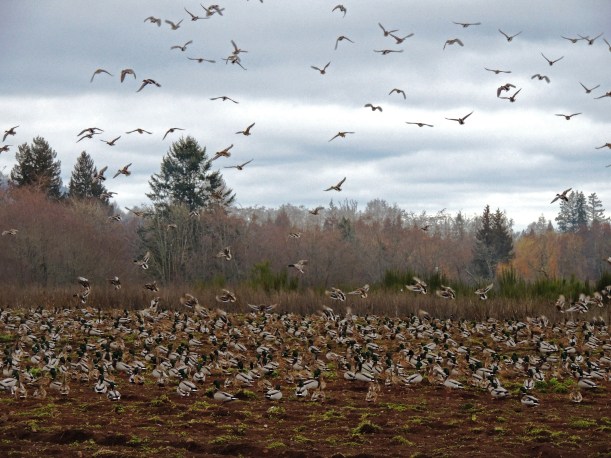
Now settle down or Santa will think you’re all quackers.
Look how well behaved we are; black and white, eating at the same table together. One big happy flock. We’re a “blended flock.”
Oh, listen to you guys. You think it’s easy being the black swan of the family?
Whaddaya mean? You think you’ve got it bad? You try being a rat. All I did was chew on a few of those lovely black licorice cords in the truck and WHAM! They lifted the trunk and exposed me to the elements. But they won’t see me hiding in the corner. Bet you can’t see me either. I’ve got a really good hiding place in the door well too. I’ll just wait there until Santa brings new wiring for me to nibble on.
One thing we all got for Christmas – not sure if Santa had anything to do with it – was darn cold weather. So when Santa had to fly back to change his Rainydeer tires for the more heavy-duty Pronghorn brand, he asked the North Wind to provide some Puddle Puzzles for us to play with while we await his return.
Actually, I thought the puzzles were more like A-maze-ing. You just try it. See if you can find a path out of this maze.
I hope your Christmas holiday time is amazing too.
Did you find the rat in the truck? Look on the far back right-hand corner of the picture (actually the left side of the truck).
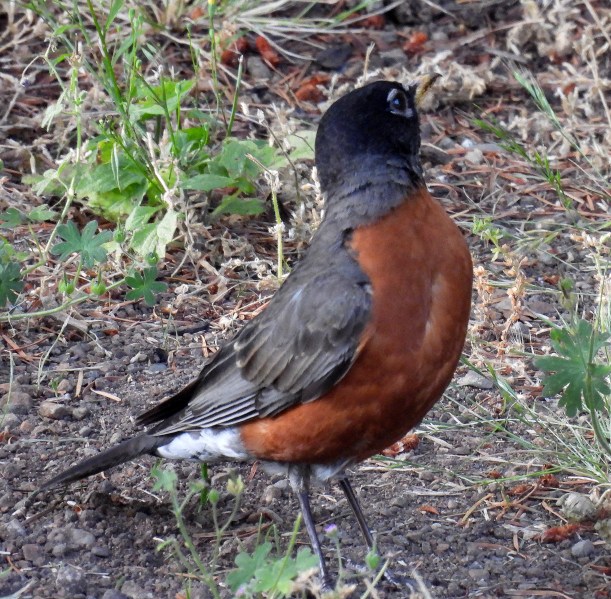
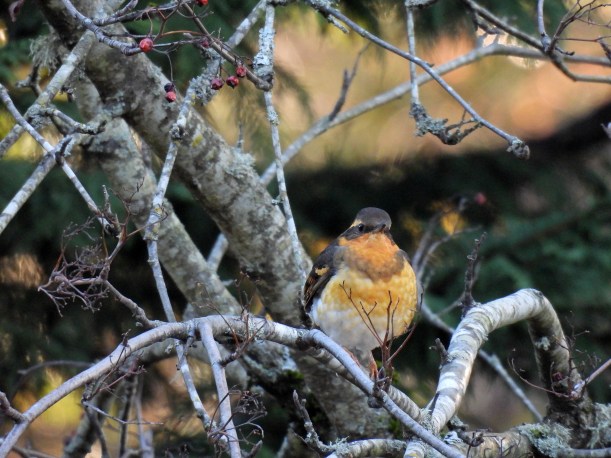
My name is Vera. I’m a varied thrush. You may think I look a lot like Roberta the robin. She’s my cousin.
Here’s Roberta the robin this spring, looking a bit ruffled up against the wind.
Roberta came down from the hills with her friends and family last week and so did all my varied thrush friends. We’d been in the conifers in the hills, picking at berries and bugs, but then the snow came and covered all our food.
So we huddled in the woods until the worst of the weather blew over and then found out where Roberta had gone. Well, we all congregated at Anneli’s house and at some of her neighbours’ too. The bare patches of dirt had bugs and worms we could pick at, and the houses along this road had a lot of mountain ash trees growing, so we ate some of those red berries they grow.
1 envelope dry yeast (7 g), or 2 tsp. fast rising yeast
5 cups plain flour
2 Tbsp. olive oil
1 tsp. salt
You can make the dough the old-fashioned way, or if you have a bread machine, you can put in the wet ingredients, followed by the dry ingredients, and put the yeast on top of the flour. Then use the dough setting to mix the ingredients and let them rise in the machine.
After the dough is mixed and set aside to rise (or the machine is doing all this for you), crush a clove of garlic into 1/3 cup of olive oil.
In a separate bowl, place two medium white onions, thinly sliced, and sprinkle with 1 teaspoon coarse salt, and set aside.
When the dough is ready, having risen in a bowl or in the bread machine, punch down the dough and divide it in half. Roll out each piece to make 30 x 25 cm rectangles (it works out to cover two of my smaller baking sheets). Place on the greased baking sheets. Cover and let stand about 15 minutes.
At this point, preheat the oven to 450 F.
Using the handle of a wooden spoon, press indentations all over the dough about a half inch (or 1 cm) deep. Brush the dough all over with garlic oil and sprinkle with half the onion mixture on each baking sheet.
Bake at 450 F for about 15 to 20 minutes.
Cut into pieces to serve.
If you freeze it later on, you can take out what you need and put it in the toaster.
The batch in this picture could have been done a minute or so longer to be more golden brown, but it is still good.
Goes very well with any soups or stews, or just as a snack with a piece of cheese. It’s perfect with a glass of white wine.
If you don’t like garlic, you can substitute and sprinkle some chopped rosemary onto the dough before baking.
Lori Virelli’s new novel, Through His Disciples’ Eyes, is based on a mission that Joshua Cane undertook. He had “the gift of the gab,” and traveled about the country talking to people and helping them any way he could. Joshua never presented himself as a modern-day Jesus, but he happened to embody many of his good qualities. The followers of Joshua Cane were skeptical of him at first, but they soon came to adore him and to cling to his word. He did not seek fame; instead, it found him, most likely because his message “to forgive yourself” appealed to so many who heard him speak.
When we read a good book, its characters, with their aspirations, successes, dilemmas, and failures, continue to live in our head, sometimes long after we finish reading the book. The author’s challenge is to make us care about the characters. Otherwise, why should we bother to continue reading?
In Lori Virelli’s novel, Through His Disciples’ Eyes, I met several characters from various backgrounds, and soon worried about their problems and the potential dangers that might befall them.
The author does an excellent job of presenting her characters as having feelings, emotions, needs, and desires, just as we do. They are not perfect, but most people aren’t. Their imperfections make us empathize with them even more.
Julia is a young girl whose luck is spiraling downward. Luckily, she stumbles across Joshua and his group. Here, the story begins, and we learn to love Julia in spite of her troubled childhood and her many anxieties. Throughout the novel we watch her character grow into something admirable, but not without problems along the way.
Each of the characters (and they are a real variety pack) evolves along the story arc.
Tobias has some bad history, but he feels remorse, and worries about how he will be able to redeem himself.
Max has issues that many of us could identify with. We hope he can work through them.
The author cleverly weaves the actions and personalities of the characters together into a story that spans decades.
I enjoyed being a part of that ride, and I’m sure you will love this book and come away from it feeling good.
Here is the blurb about the book.
In the year 2029, the world is broken, and so is Max Greenwood. In his attempt to find inner peace, he learns of a long-lost prophet—Joshua Cane—who lived in the 1950s. His life appears to mirror that of Jesus, complete with healing miracles, disciples, and being murdered in his thirties.
Researching for more, Max uncovers information on two of the disciples. Tobias Jones is a tempestuous man who separates from Cane’s other followers to spread the prophet’s teachings on his own. His ideas to control the righteous message lead to trouble.
Julia Flores is a teen whose mother kicked her out. Homeless and feeling unloved, she finds purpose in following Joshua Cane on his Mission to spread peace. As she travels with him, emotional issues from her past emerge, causing drama along the way.
The stories of these troubled souls searching for meaning trigger life-altering revelations for Max Greenwood—revelations not only about Joshua and his disciples, but about himself and all of us.
L. Virelli interweaves concepts from self-help, spirituality, the Bible, and New Thought into an allegorical tale.
To find out more about the launch of this book, click this link: