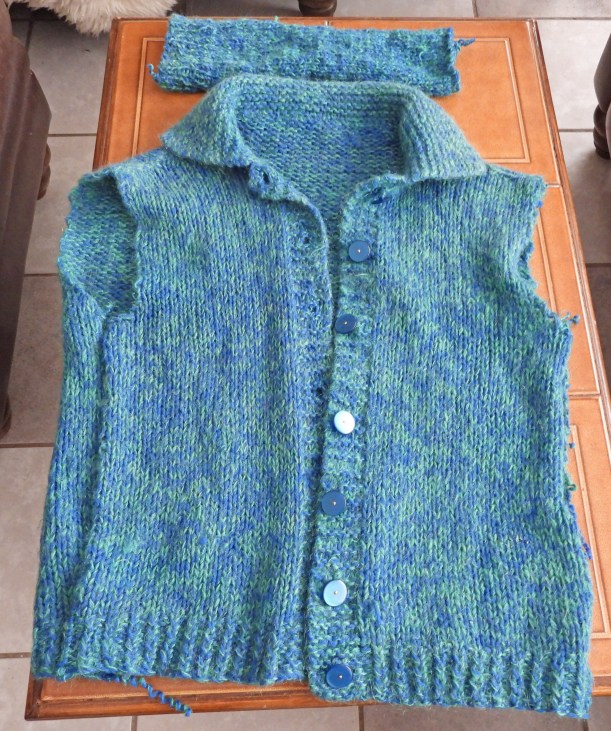
A couple of years ago, my mother-in-law asked me to get rid of some of her old sweaters that she had made a long time ago. I found a really pretty cardigan in the bag of discards, but it was way too small for me. I had the idea that if it were bigger I could make a vest out of it. I took the sleeves out and unraveled the yarn, undid the side seams of the cardigan and, with the yarn from the sleeves, I knitted two bands (one of which you can see at the top of the picture below) to put in the sides to make the old sweater bigger for a new vest.
But when I sewed in the bands to make the vest larger, the armholes were way too big.
I unraveled half of the bands and reknitted them to taper them and make them smaller at the armhole.
On the photo below you can see the cardigan taken apart at the side and the sleeves gone. At the top of the photo you can see one of the bands I knitted to insert at the side seams.
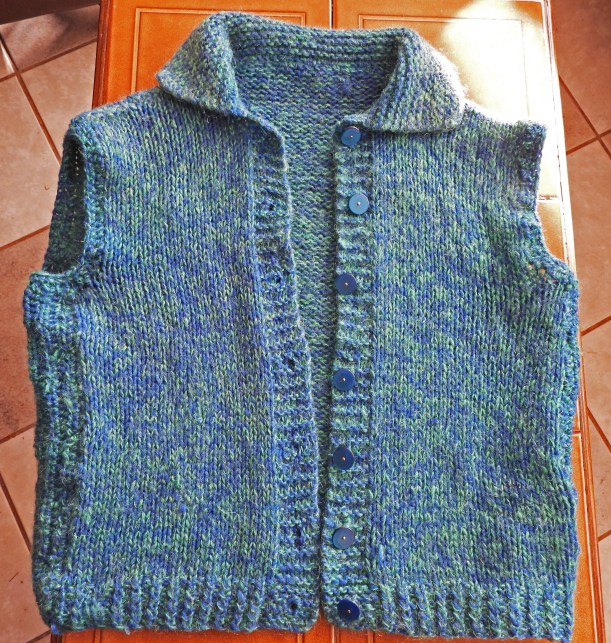
Still, there were lumps and bumps here and there. I unraveled the two side bands I had knit (and reknit), and decided instead to crochet a piece into each side of the vest from the waistband to the armhole.
I see there are still a few lumpy parts, but they will flatten out once I wear the vest and it isn’t so freshly crocheted.
I’m really happy to have given a second life to the cardigan my mother-in-law knitted. She had put a collar and buttons and buttonholes on the cardigan and done a nice job of knitting it, so I was happy to have been able to salvage it and get some more use out of it.
Just in time for the colder weather, I now have a new vest.
Imagine these flowers as the size of a potted chrysanthemum that a friend brought me as a hostess gift about a year ago; maybe a five-inch potted plant.
The potted plant looked so pretty and I thought what a shame that the flowers would soon die and that would be the end of it. But later when the blooms wilted, I put the pot outside and cut back the dead flowers. Out on the deck, I kept the worst of the frost off the plant all winter.
In the spring it got new green growth and wanted to be a tall plant. I should have cut it back, but didn’t, so it got a bit leggy.
But look how it bloomed in spite of me! Next spring I’ll try to keep it pruned better and who knows, I might get even more flowers – if that is even possible.
Anyway, it’s a beautiful way to remember a friend. I smile whenever I look at this mum.
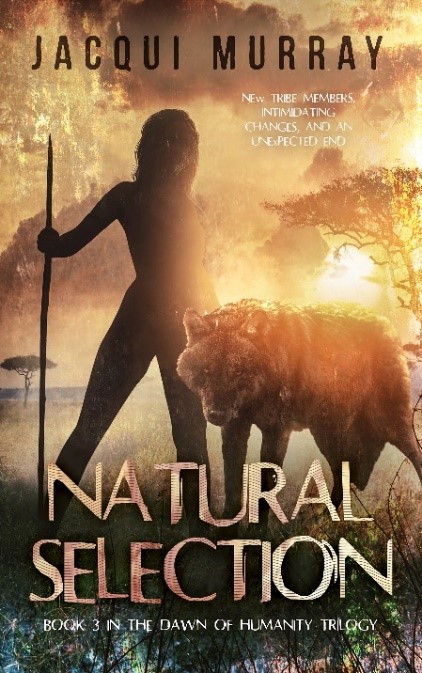
Jacqui Murray has done it again. She has provided us with more wonderful entertainment with the release of Natural Selection, book three of her Dawn of Humanity trilogy. I’m so pleased to host her on my blog today. For a review of this latest page-turner, please also visit my other blog, https://annelisplace.wordpress.com/2022/11/06/natural-selection-my-review/
Natural Selection
Summary
In this conclusion to Lucy’s journey, she and her tribe leave their good home to rescue former tribe members captured by the enemy. Lucy’s tribe includes a mix of species–a Canis, a Homotherium, and different iterations of early man. In this book, more join and some die, but that is the nature of prehistoric life, where survival depends on a combination of our developing intellect and our inexhaustible will to live. Each species brings unique skills to this task. Based on true events.
Set 1.8 million years ago in Africa, Lucy and her tribe struggle against the harsh reality of a world ruled by nature, where predators stalk them and a violent new species of man threatens to destroy their world. Only by changing can they prevail. If you ever wondered how earliest man survived but you couldn’t get through the academic discussions, this book is for you. Prepare to see this violent and beautiful world in a way you never imagined.
A perfect book for fans of Jean Auel and the Gears!Book information:
Title and author: Natural Selection by Jacqui Murray
In my latest trilogy, Dawn of Humanity, I present the almost unbelievable idea that early man–in this case, not Lucy’s kind but the next version of man, Homo erectus–hunted by chasing herds until the animals were too tired to continue. Readers who have never heard about what is called the “Endurance Running Hypothesis” or “persistence hunting” reject that idea, but many scientists don’t (to be fair, some do). Here’s why.
African land animals run fast, some at speeds of 45-60 mph. Most of us assume our ancestors hunted by surprising animals as they grazed, killing only the old or injured while the rest fled. That is true, but they also chased the herd and were likely to catch them.
How was that possible? Read on.
Because earliest man had few offensive traits like fangs or claws, evolution selected those who could run fast enough to escape predators and run down prey for food. That included physical characteristics like long legs, a prominent butt (for balance), loose hips, shock-absorbing joints, a stable head, shorter toes, a springy foot formation, considerably less body hair, skin loaded with cooling sweat glands, and a larger lung size. By the time Homo erectus arrived in man’s lineage (Xha and Wild in the story, Natural Selection), man could run all day while animals had to stop periodically to rest. Animal bodies were powerful, but covered in fur and their only way to cool off was to stop and pant. Herd animals would think they had escaped, because they could no longer see the tall skinny creatures who carried a tree limb wherever they went, but they hadn’t. Man ran slower, but because of his adaptive qualities, he ran endlessly. He caught up with the animals when they stopped to catch their breath. The animals would again take off, but each time they sprinted from their human predators, they had to stop sooner until they couldn’t run anymore and were speared by the chasers who never seemed to require rest.
This continues today as the preferred hunting technique of African wild dogs, domestic hounds, and the human hunter-gatherers still living in the central Kalahari Desert.
Want more? Check out this three-minute video on Endurance Running:
Author bio:
Jacqui Murray is the author of the popular prehistoric fiction saga, Man vs. Nature which explores seminal events in man’s evolution one trilogy at a time. She is also author of the Rowe-Delamagente thrillers and Building a Midshipman, the story of her daughter’s journey from high school to United States Naval Academy. Her non-fiction writing includes over a hundred books on integrating tech into education, and reviews as an Amazon Vine Voice. She is a columnist for NEA Today, and a freelance journalist on tech ed topics.
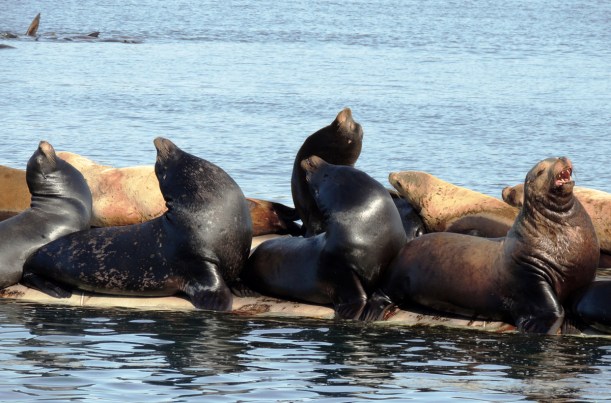
California sea lions used to visit Vancouver Island every spring and stay for the summer, following the salmon up the coast and back down to California. But in recent years many have set up residence on Vancouver Island. Why do all that traveling when the food supply is fairly constant here?
The Steller’s sea lion, named for the same man who studied the Steller’s jay, is another type of sea lion that visits our coast, usually farther north.
From these photos, I can’t tell which is which, or even whether there are both kinds of sea lions here. I do know that California sea lions, averaging about 220 lbs. (females) and about 700+ lbs. (males) are much smaller than the Steller’s sea lions which can weigh on average 580 lbs. (females) and almost 1200 lbs. (males). The males quite often weigh much more than that.
Their loud barking carries a long way across the water, as they sun themselves and socialize.
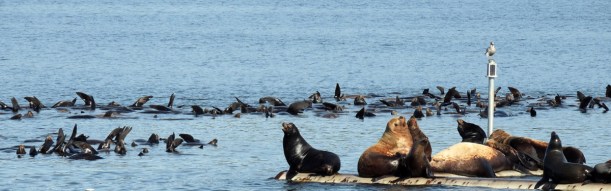
Not enough room on the raft? Make your own raft of bodies.
Sea lions don’t target humans who might be in the water with them, but they have been known to nip them when they get too close, and a nip with those huge teeth would not be funny.
Enemies of sea lions are mainly sharks and killer whales.
Picture by Pat G.
I’m surprised these sea lions seem so calm when the coastal ferry, Salish Orca, motors past, especially when it has pictures of the killers on its hull.
Here is a video taken by a friend. You can hear a couple of short sea lion barks (or coughs) near the end of the clip.
The sea lion couple were both rather large,
Bubba was nearly the size of a barge.
Grace, oh my darling, you’re getting so fat,
Can’t you lose weight and be sleek as a cat?
Bubba, my dear, it’s a way to keep warm,
And can’t you express yourself better, with charm?
The white chrysanthemum is doing its faithful blooming again. It’s that time of the year. But this particular plant has a long history. It used to belong to my mother. She died in March of 1982 at the age of 69. She had this very chrysanthemum hanging in a basket on her back veranda, and since chrysanthemums bloom in the fall, I can assume that she bought it some time in 1981 or earlier, at least 41 years ago.
My dad asked if I wanted to take the plant home because it would just die. He was no gardener. So the chrysanthemum came home with me in 1982. Every year since then, it has bloomed in the fall. I think of my mother more often than just at chrysanthemum time, but when I glance at the flowers on my deck, I find there is some connection to her.
Last year I realized I’d been greedy about this plant and since it was crowded in the pot, I shared part of the plant with my sister. She now has some of this plant in her garden. I worried a little bit that by dividing the plant I might have killed it, but it came back as cheerily as ever this year.
I’d like to share some of my mother’s traits with you.
She loved her children.
She loved to laugh and tease in a kind way. And she loved puns.
She had a beautiful singing voice and loved music.
She could cook and bake great food without a recipe.
She taught us to keep ourselves and our house clean.
If one of us kids were in a nasty mood, she’d say, “Go find some place out of this room, and come back when you can smile.”
But if we had a problem that needed solving, she was always there to listen and most of all to give us a hug.
She made us pitch in to help with chores. I learned a lot about cooking from being her helper in the kitchen. I can still hear her telling me not to leave the wooden spoon in the pot or pan. “Don’t cook the wooden spoon,” she’d say.
She was kind to animals. We always had pets – dogs, cats, turtles, tropical fish, gerbils – and they had a good life in our house.
She was a “nurse” without official training, taking care of all our aches, pains, and illnesses, as well as those of our pets. When our cat had trouble closing its jaw, I watched as my mother reached way back into the cat’s mouth, and pulled a fish backbone (a vertebra – like a tiny spool of thread) off the cat’s back tooth where it had become stuck. The moment the cat felt that the bone was removed, she licked my mother’s hand to say thank you over and over.
She encouraged me about school. Every single day, as I left for school, she told me, “Listen to the teacher and be good.”
About my schoolwork she told me, “Every day when you do your work, turn the page and look at yesterday’s work. Then start today’s work and try to do it better than yesterday’s.”
I never saw her lie down for a nap. There was always work to do. Sometimes at night if the bedroom light was on as I tip-toed past on my way to the bathroom, I would see her reading in bed, and as often as not, her eyes would be closed. She’d had a full day.
She didn’t have a long life, but she sure packed a lot into the life she had, and she made the world a better place when she was in it.
So I’m always happy to see that her chrysanthemum, the very same plant, still blooms for her and has done for forty years.